- Type
- Goddess
- Domain
- Water, female power, weaving, children, fate
- Source status
- folkloric
laumės
Who is Laumė in Lithuanian mythology?
Laumė is one of the mythical beings most often mentioned in Lithuanian legends. Her mentions were recorded almost only in Lithuanian-inhabited territories, so Laumė is considered a distinctive and deeply Lithuanian image.
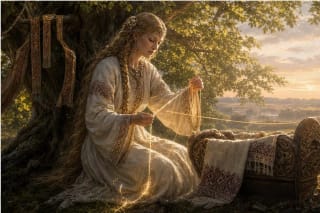
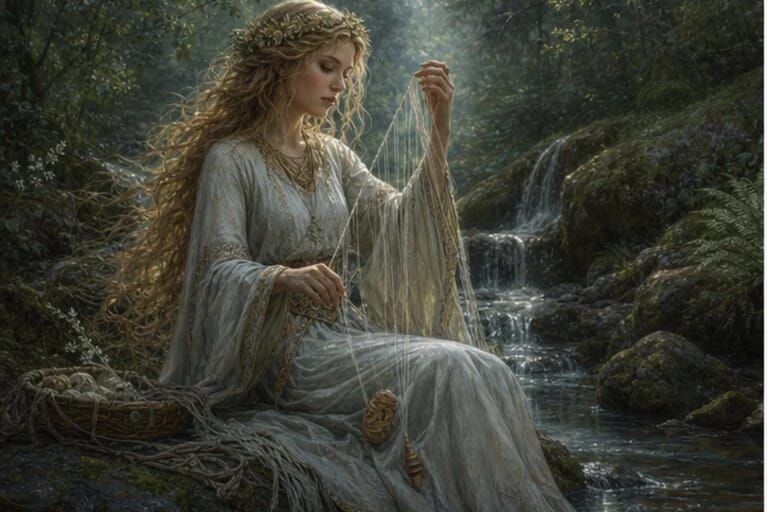
In legends laumės usually appear near bodies of water, springs, and forest edges, while humans encounter them in fields or bathhouses. They look either like beautiful young women with very large breasts and loose hair, or like old women, sometimes with the body of a hen or mare, and sometimes as giantesses.
Laumė in sources: water or earth goddess?
Old sources from Lithuania Minor describe laumės in different ways. Matthäus Praetorius classifies them among water gods and says the Nadruvians imagined laumės as women with somewhat flat hands, feet, and fingers.
Jacob Brodowski calls Laumė a goddess of birth, Christian Gottlieb Mielcke a goddess of the earth, recording the belief that laumės could exchange children, and Gottfried Ostermeyer a tormenting goddess whom Lithuanians greatly feared. This variety shows that Laumė joins several functions: water, birth, earth, and punishment.
Laumė's work: weaving, spinning, and children
According to Norbertas Vėlius, the main functions of laumės are doing women's work, harming or protecting children, interacting with men, and harming livestock. Laumės spin, weave, bleach linen, and do everything with extraordinary speed.
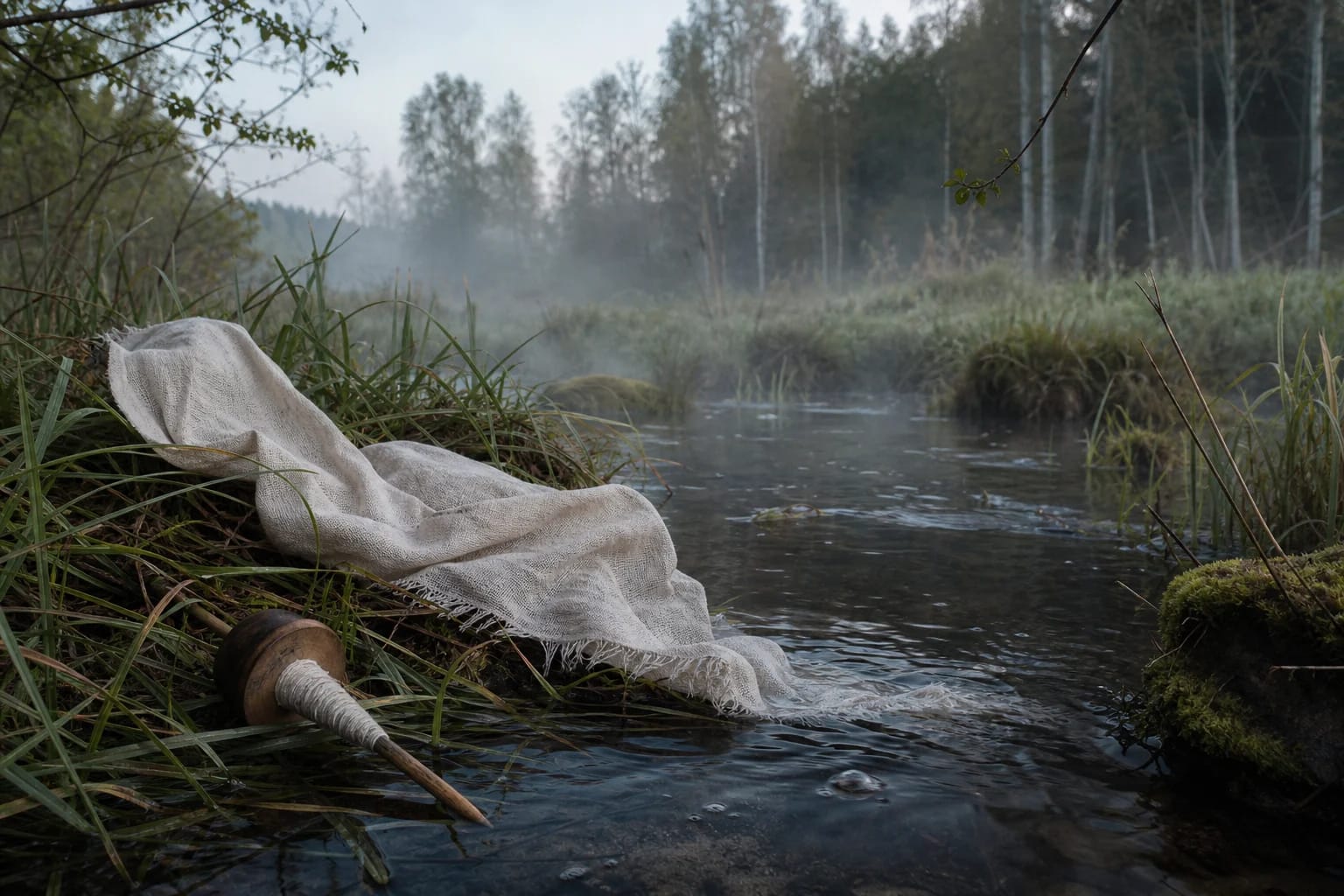
The child motif is especially strong: a laumė can replace a child with a false one, cares for and rewards children left by accident, but tears apart those left deliberately. She can harm or help humans and is able to alter the landscape, for example by damming a river.
Laumė and Perkūnas: the reconstruction of a heavenly wife
In studies by Vyacheslav Ivanov, Vladimir Toporov, and Nijolė Laurinkienė, Laumė is proposed as a possible wife of the thunder god, expelled from heaven to earth for infidelity and married to Velnias.
This reconstruction partly corresponds to a Samogitian legend presented by Liudvikas Adomas Jucevičius: the heavenly goddess Laumė fell in love with a mortal and bore a son, Meilus, so the supreme god punished her by cutting her to pieces. Still, some researchers regard Laumė only as a folklore character, so such reconstructions should be read cautiously.
Laumė among other female beings
Laumė should be distinguished from other female images. She differs from Laima because Laima determines fate and protects women in childbirth, while laumė herself works, steals or protects children, and can be dangerous. She differs from ragana because laumė is a mythical being, not one of human origin.
This comparison shows that female power in Lithuanian mythology was not uniform. It is distributed across fate, water, work, children, and liminal states.
Laumė today
Laumė's image helps explain the world of Lithuanian legends, where female beings live by water, work at night, and follow their own rules. Many place names with the root laum- show how widely this image spread.
Laumė is best read as a liminal being: she lives between water and earth, night and day, help and punishment. For that reason she remains one of the most vivid figures in Lithuanian mythology.