- Place
- Kaunas City Municipality
- Region
- Kaunas
- Type
- interwar central-bank palace and national cultural monument
- Address
- Maironio g. 25 / K. Donelaičio g. 85, Kaunas
- Coordinates
- 54.89908, 23.90951
Bank of Lithuania building, Bank of Lithuania in Kaunas, Bank of Lithuania Palace, Lietuvos banko rūmai Kaune
A financial-state palace
The Bank of Lithuania Palace in Kaunas is a building where architecture is directly connected with the state's monetary system. The Money Museum e-guide recalls that the Bank of Lithuania began operating on October 2, 1922, the same day the national currency, the litas, was introduced.
Kaunas was then the temporary capital and the centre of financial life, so the central bank needed not only premises but an image of reliability. The palace had to show that the young state could manage money circulation, issue banknotes, protect valuables, and operate as a modern financial institution.
From competition to Songaila's project
In 1924 an international architecture competition was announced for the new Bank of Lithuania palace. The Money Museum writes that the winning Paris architect's project was considered too modern, complex, and expensive, so the decision was made to revise and supplement it.
That work was carried out by Mykolas Songaila, who is therefore regarded as the palace architect. The cornerstone was laid on March 12, 1925, and the blessing ceremony was conducted by Prelate Jonas Mačiulis-Maironis. The palace was formally opened on December 8, 1928.
Cost, litas, and prestige
The Money Museum e-guide states that the palace cost more than 6 million litas, a sum that at the time could buy almost a tonne of gold. This is more than an impressive comparison: it shows how much symbolic weight was placed on the central bank.
In the interwar period, the bank did more than issue currency. The Money Museum explains that people could deposit money, take loans, and leave valuables for safekeeping. The palace therefore had to serve simultaneously as administration, customer hall, vault, and stage of financial trust.
Exterior: neoclassicism in modern Kaunas
This building is often mentioned in the Kaunas modernism context, but its language is not purely functionalist. The Money Museum calls it one of the best examples of neoclassicism in Kaunas and Lithuania, while KVR names the style as historicism, with Art Deco motifs in the interior.
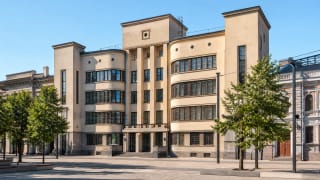
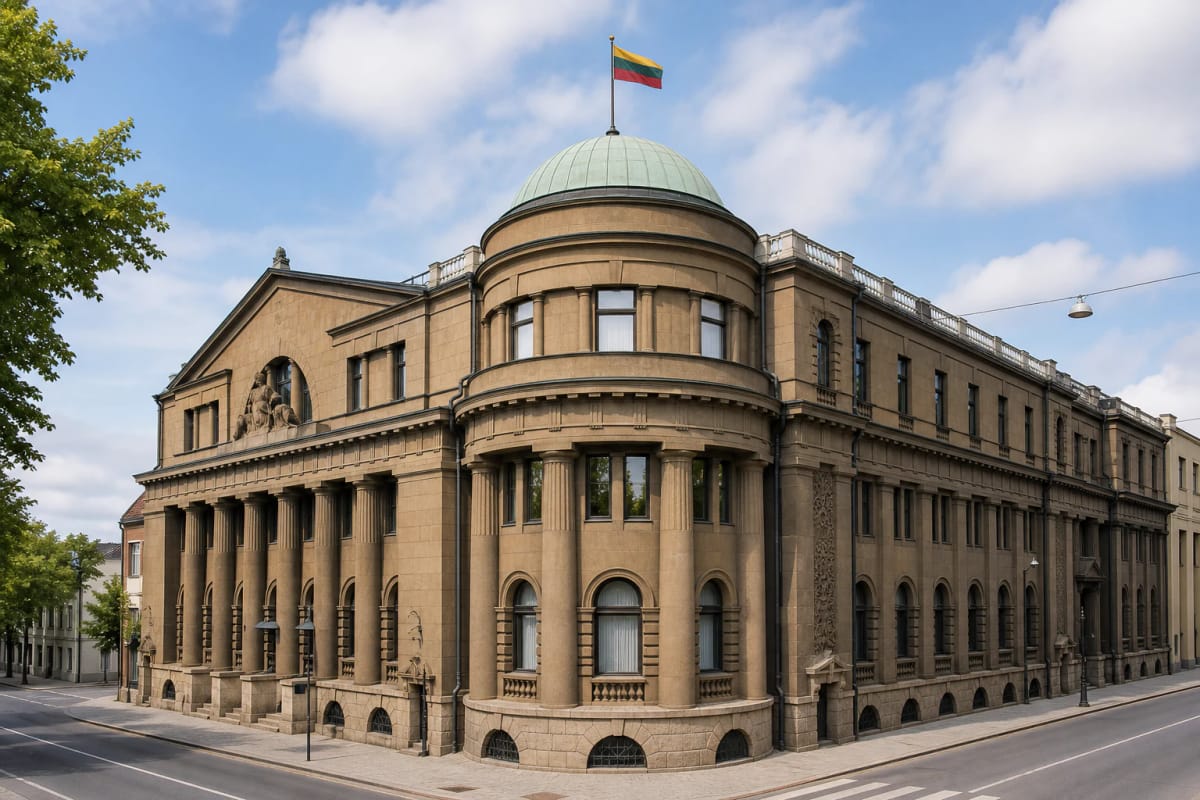
From the street, notice the rounded corner volume with dome, the long monumental facade lines, rhythm of columns, arched first-floor windows, and the weight of the portal. It is a building meant to look trustworthy even to someone who knows nothing about banking.
The pediment sculpture
Above the facade is an important sculptural composition by Kajetonas Sklėrius. The Money Museum describes it as figures of a worker, two peasant women, and a soldier, with a shield bearing the Vytis and Columns of Gediminas at the centre. Allegorically, it connects agriculture, industry, and the military.
During the Soviet occupation, the Vytis and Columns of Gediminas were dangerous symbols. The Money Museum recounts that they were not destroyed but hidden under metal mesh and plaster. After the restoration of independence, the shield recovered its original appearance.
Operations hall and vaults
The largest interior space is the two-storey operations hall with a gallery and a large triangular skylight. It was a stage for customers, money, documents, and institutional authority, not merely a practical hall.
Money vaults were installed beneath the operations hall. The Money Museum mentions the massive doors made by the English firm Milners, which survive to this day and weigh three tonnes. Such details make the building interesting not only for architecture, but also for engineering and security history.
Interior, lamps, and furniture
The interior was created as a top-level representative environment. The e-guide mentions black-marble Ionic columns, natural and artificial marble, Swedish granite stairs, coffered ceilings with rosettes, geometric Mettlach tile patterns, and parquet.
Thirty-four original lamps survive. The Money Museum also notes that 137 movable cultural valuables and 33 antiques are included in the state-protected list, among them 73 pieces of furniture. Some were made in Kaunas at Kostas Petrikas' furniture factory.
Voldemaras apartment and the old lift
In the third-floor corner section on the Maironio Street side, an eight-room apartment was created for Augustinas Voldemaras, with an entrance hall, library, official reception rooms, separate ceremonial entrance, and emergency stairs.
The Money Museum's account also mentions the oldest functioning lift in Kaunas. This detail helps explain the palace's social programme: it was not only a bank-operations building, but a mix of representative living spaces, technical comfort, and political status.
Occupations and continuous bank function
After the Soviet Union occupied Lithuania on June 15, 1940, the central bank was nationalized. The Money Museum stresses that the palace remained almost unchanged and that a bank continued to operate in it. During the Nazi occupation, the work of the Bank of Lithuania was restored for a time, but stopped in April 1943.
After independence was restored, the building was transferred to the Bank of Lithuania, established on March 1, 1990. Today the Kaunas palace houses the Kaunas division of the Cash Department of the Bank of Lithuania, so the building is not merely a historic exhibit.
KVR protection and UNESCO context
In the Cultural Heritage Register the object is called the Bank of Lithuania building. Its unique code is 1127, its status is monument, and its significance level is national. KVR lists architectural, artistic, engineering, and historical significance.
The building belongs to the Kaunas Naujamiestis modernist heritage context associated with the UNESCO World Heritage property Modernist Kaunas: Architecture of Optimism, 1919-1939. The most accurate description is that it is part of this urban ensemble, not an individually inscribed UNESCO monument.
How to visit today
The palace exterior can be viewed from the corner of Maironio and K. Donelaičio streets. The interior is not a freely accessible museum, because the building remains an active Bank of Lithuania site.
Public interior access takes place through Money Museum tours and registration. Group tours in Kaunas are usually arranged separately, while dates for individual visitors change and can fill up. If no places are available, use the official virtual tour of the Bank of Lithuania Palace in Kaunas.