- Place
- Vilkaviškis District Municipality
- Region
- Suvalkija
- Type
- conserved eighteenth-century church ruins and open-air event space
- Address
- J. Basanavičiaus g., Bartninkai, Vilkaviškis District
- Coordinates
- 54.50172, 23.02669
Ruins of Bartninkų Sts. Peter and Paul Church, Old Bartninkai Church
Bartninkai Church Ruins: the surviving walls
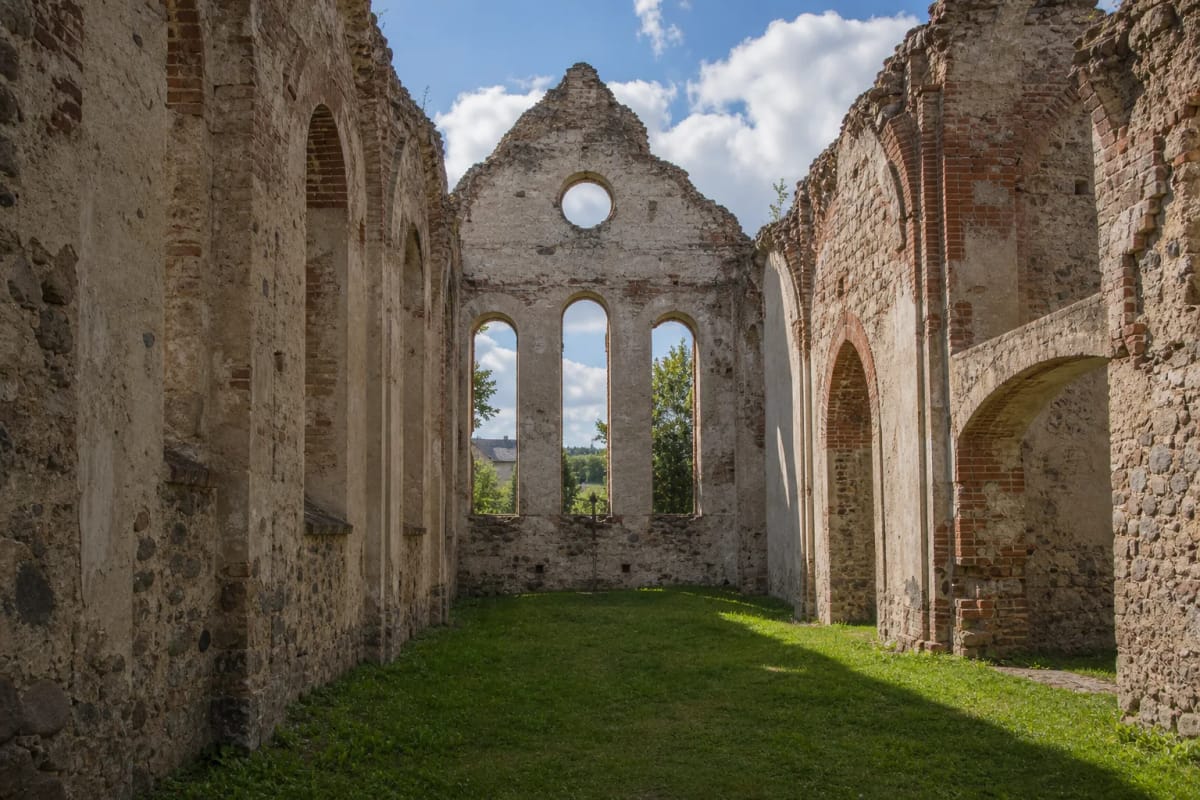
The Bartninkai Church Ruins stand in the centre of Bartninkai, in Suvalkija, about seventeen kilometres from Vilkaviškis. They are the conserved remains of the old church: tall, roofless masonry walls that make the region's dramatic history visible from a distance.
The masonry church of Bartninkai, dedicated to the Holy Apostles Peter and Paul, was completed in 1790. It was built by Prince Vincentas Puzinas, who owned the manor, while the parish had been founded in 1783. Until the middle of the twentieth century, this was an important local shrine.
The baptismal church of Jonas Basanavičius
The church has special national significance because of its link with Jonas Basanavičius, the patriarch of the Lithuanian national revival and a signatory of the Act of February 16. VLE states that he was born in 1851 in Ožkabaliai, in Bartninkai Volost, and was baptized in Bartninkai Church.
The ruins are therefore not only a sacred-heritage site but also a place of Lithuanian national history. They make most sense when combined with the nearby Basanavičius birthplace in Ožkabaliai, where a museum dedicated to him operates.
War and a second life
The church's fate was decided by the Second World War. In 1944, as the front passed through Bartninkai, the building was badly damaged. Soviet authorities did not allow it to be rebuilt, so the parish worshipped first in a temporary church and then in a wooden church built in 1950, while the old masonry remained standing as ruins.
In the early twenty-first century, the roofless walls were conserved and adapted for visitors. They were strengthened for safety, and today concerts, art festivals, film screenings, and other events take place between the open walls. The ruins have gained a second life as a striking cultural space.
How to visit
The ruins are an open, freely accessible site in the centre of the town, so they can usually be viewed at any time without a ticket. A normal visit takes 15-30 minutes; in summer, when events are held within the walls, it is worth staying longer.
Bartninkai fits well into a Suvalkija heritage route. The ruins are especially meaningful together with Basanavičius' birthplace in Ožkabaliai and other local sites. When visiting, protect the conserved masonry and keep a safe distance from vulnerable surfaces.