- Place
- Visaginas Municipality
- Region
- Aukštaitija
- Type
- Modern Catholic parish church built in 1992-1998 with a diamond-shaped worship hall, open bell tower, historic bell, and 29-stop organ
- Address
- 1 Santarvės Street, Visaginas
- Coordinates
- 55.59596, 26.43736
- Visit duration
- 30-45 minutes; approximately 1 hour when attending Mass
- Best time
- in daylight before or after scheduled worship; no separate tourist opening hours are published
Visagino Šv. Apaštalo Pauliaus parapijos bažnyčia, Visaginas Church of St Paul the Apostle
This is the Catholic parish church on Santarvės Street, not the former chapel or an Orthodox church
The Church of St Paul the Apostle stands at 1 Santarvės Street and belongs to the Ignalina deanery of the Archdiocese of Vilnius. The coordinates 55.595962, 26.437359 mark the church building and its grounds, not a car park or a certified step-free entrance. Its white mass, open bell tower, and tall cross rise through pines near Visaginas's pedestrian avenues.
The Catholic community celebrated its first Mass in 1989 in a temporary chapel fitted into the hall of a vocational-school dormitory at 9 Festivalio Street. Worship moved in July 1992 to the room now used as the municipal council chamber. Neither space is the present church on Santarvės Street, although map records and search results sometimes merge them under the label Visaginas Chapel.
Visaginas also has two separate Orthodox buildings: the Church of St Panteleimon at 4 Taikos Avenue and the Church of the Nativity of St John the Baptist at 73A Sedulinos Avenue. St Paul's is Roman Catholic, so navigation should be checked against the full name and the Santarvės Street address rather than the generic word church.
The dates 1992, 1996, 1998, 2001, and 2023 describe different stages of the church's history
The Catholic parish was founded on 15 November 1989, when the town was still called Sniečkus. It received St Paul the Apostle as its patron in 1992. That year a storm brought down part of the pinewood between Sedulinos Avenue and Santarvės Street, opening the present site, and building began to a design by Ramūnas and Jaunius Beinortas. An earlier location considered near the Banga cultural centre was never developed.
Christmas was celebrated in the new but incomplete church in 1996, and the specialist Visaginas Architecture Guide dates the building to 1998. Some municipal summaries instead use a 1995-2001 interval encompassing the main works and later fitting-out. The clearest reading is therefore that construction began in 1992, the church was substantially built by 1998, and finishing continued, rather than treating 2001 as its only valid date.
Archbishop Metropolitan Gintaras Grušas formally consecrated the church on 17 September 2023. Consecration is a liturgical dedication, not evidence that the building was finished only in 2023. The parish undertook a substantial interior refresh in 2024, repainting walls, the sanctuary, and sacristies, refinishing the sanctuary floor, and renewing furniture in several rooms.
The Beinortas brothers paired a diamond-shaped hall with a U-shaped parish house and sheltered courtyard
Architect brothers Ramūnas and Jaunius Beinortas gave the worship hall a diamond plan and placed a U-shaped parish house behind it. Together the volumes form a partly enclosed courtyard. The complex lies across a pedestrian alley and faces the centre of the second residential district, tying its composition to Visaginas's planned urban structure rather than a traditional old-town square.
The architecture guide reads the diamond as an open book. This is an interpretation of the design, not a literal decoration on the façade. From the front, the defining elements are a four-sided open bell tower incorporated into the centre, a tall cross, timber doors, and narrow vertical glazing. The side view reveals the stepped pitched roof and bands of windows.
The building is fitted into sloping ground, with technical and service rooms at the lower level and direct access from the courtyard to the upper parish level. White-rendered walls deliberately stand out against the pines. A circuit from the broad front steps to the side elevation and courtyard approach explains the composition best, but community rooms should not be entered without permission.
Roof lights, axial stained glass, and frescoes on the angled altar walls shape the interior
The ceiling follows the breaks in the stepped roof. Slender white metal members are compared in the architecture guide to the geometry of Lithuanian straw gardens, while timber boarding brings warmth to the otherwise pale room. Window bands in the roof and side walls spread daylight more evenly than a single large façade opening would.
Axial stained glass draws the eye towards the altar, while frescoes on the angled side walls fill the point of the diamond with colour. The reliable sources checked for this page do not name their artists, so those works should not be attributed from unsourced online claims. The relationship among roof geometry, glass, and altar is clearest from the rear of the nave.
At the opposite end from the altar, beneath the bell tower, an organ built by Laimis Pikutis was installed in 2010. It has two manuals, pedal, and 29 stops. On 10 April 2004, an old bell weighing about 1,200 kg arrived from the belfry of Vilnius Cathedral Basilica and was mounted on a specially designed swinging beam. The checked sources do not give a reliable casting date for it.
The current Mass schedule is the most useful guide to interior access
On 19 July 2026 the parish listed Sunday Mass in Visaginas at 10:00 in Polish and Russian, followed by a Lithuanian Mass at 12:00. Mass is at 18:00 in Lithuanian on Tuesday and Thursday, 09:00 in Polish on Wednesday and Friday, and 10:00 in Lithuanian and Polish on Saturday. No regular Monday Mass was listed.
The same parish schedule also contains services in Tilžė, Smalvos, and Turmantas, so visitors need the rows specifically labelled Visaginas. A language label identifies the principal language of the liturgy, not a restriction on who may attend. Times can change for feasts, parish celebrations, and special rites, making the official page worth checking before a journey planned around the interior.
Published priest-duty hours are not guaranteed tourist opening hours. The parish gives no separate daily visitor schedule and advertises no admission ticket. The most reliable options are to arrive shortly before or after Mass or contact the parish in advance. During worship, visitors should remain quiet, avoid walking around the sanctuary, and not photograph people without permission.
Allow 30-45 minutes and do not infer parking or accessibility details that have not been documented
Begin at the main façade to see the wide flight of steps, open tower, and roof silhouette, then follow the pedestrian paths around the building to understand the U-shaped parish wing and the change in ground level. If the church is open, 30-45 minutes is usually enough for a quiet architectural visit. Allow about an hour when attending Mass.
Municipal records refer to a church car park, but no authoritative visitor information publishes its capacity, guarantees spaces, or reserves it for sightseers. Follow signs on arrival, keep entrances clear, and expect greater demand on Sundays and during events. The map pin on this page identifies the church, not a parking bay.
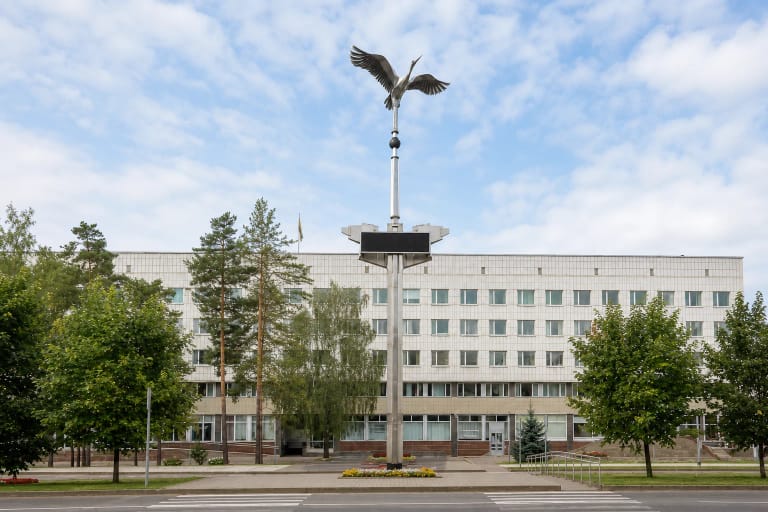
Broad stairs lead to the main entrance. Although the complex works with the slope and has an upper-level approach from the courtyard side, no official description of a complete step-free route, accessible toilet, or reserved accessible parking space was found. Anyone who needs a stair-free entrance or assistance should contact the parish before visiting. Lake Visaginas, the city museum, and the Crane monument can extend the route afterwards.