- Place
- Dusetos, Zarasai District Municipality
- Region
- Aukštaitija
- Type
- red-brick, Neo-Romanesque, slightly Historicist, three-nave parish church with two towers
- Address
- Taikos g. 2, Dusetos, Zarasai District
- Coordinates
- 55.74377, 25.83776
- Visit duration
- 30-60 minutes; longer if you can see the interior and the churchyard Stations of the Cross
- Best time
- in daylight before or after the officially published Masses, after checking interior access
Dusetos Church, Dusetos Holy Trinity sanctuary
Dusetos Church by Lake Sartai
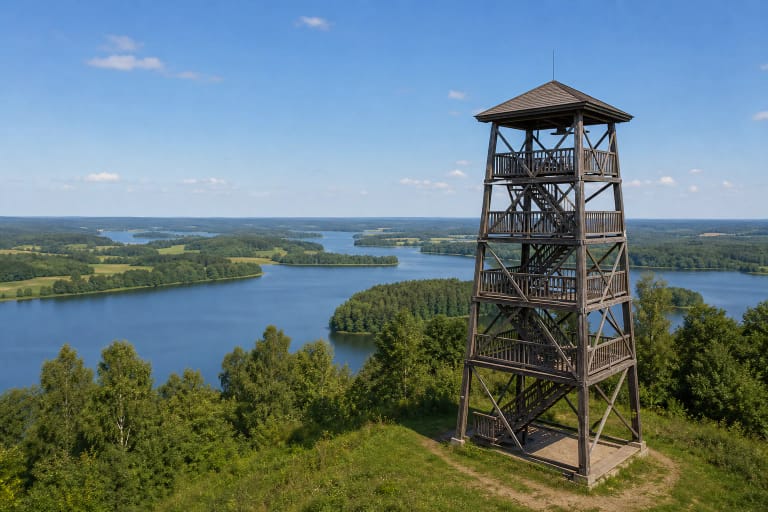
Dusetos Holy Trinity Church stands at Taikos g. 2 in Dusetos, on the southern shore of Lake Sartai. It is an active parish sanctuary in the Diocese of Panevėžys and one of Dusetos's historic landmarks. Its red-brick volume rises among trees, while the churchyard leads into the wider town and lakeshore landscape.
Visitors should distinguish two addresses. Google Maps and the official visitor listing give Taikos g. 2 for the church, while the Diocese of Panevėžys page gives K. Būgos g. 30 as the parish contact and legal address. These are not two different churches: choose the exact Dusetos Holy Trinity Church card for navigation. The coordinates 55.743774, 25.83776 mark the church site and churchyard, not a promise of a particular doorway.
From the first wooden church to the 1888 brick building
A wooden church stood in Dusetos by 1519, and in 1530 Jonas Radvila donated property to the Dusetos parish and charged the priest with caring for a school. Dusetos history is closely tied to the Radvila and Plater families, so the present church brings together parish, manor, and town memory.
When the older wooden sanctuary had deteriorated, Count Jonas Liudvikas Plater rebuilt it in 1774. That was a timber cruciform church with two-storey towers, six altars, and extensive wood sculpture by Dusetos carver L. Gogelis. The separate masonry bell tower that survives in the churchyard was built around the same period.
By the late nineteenth century the timber church was in poor condition, so parish priest Antanas Rumševičius initiated a new masonry building in 1886. The present church was built in 1886-1888 through parish funds and effort, and sources name Ustinas Golinevičius as architect. When it was blessed in 1888, some heritage from the earlier sanctuary moved inside, although the old organ went to Antazavė and some sculptures to Aviliai.
Neo-Romanesque brickwork and a separate Baroque bell tower
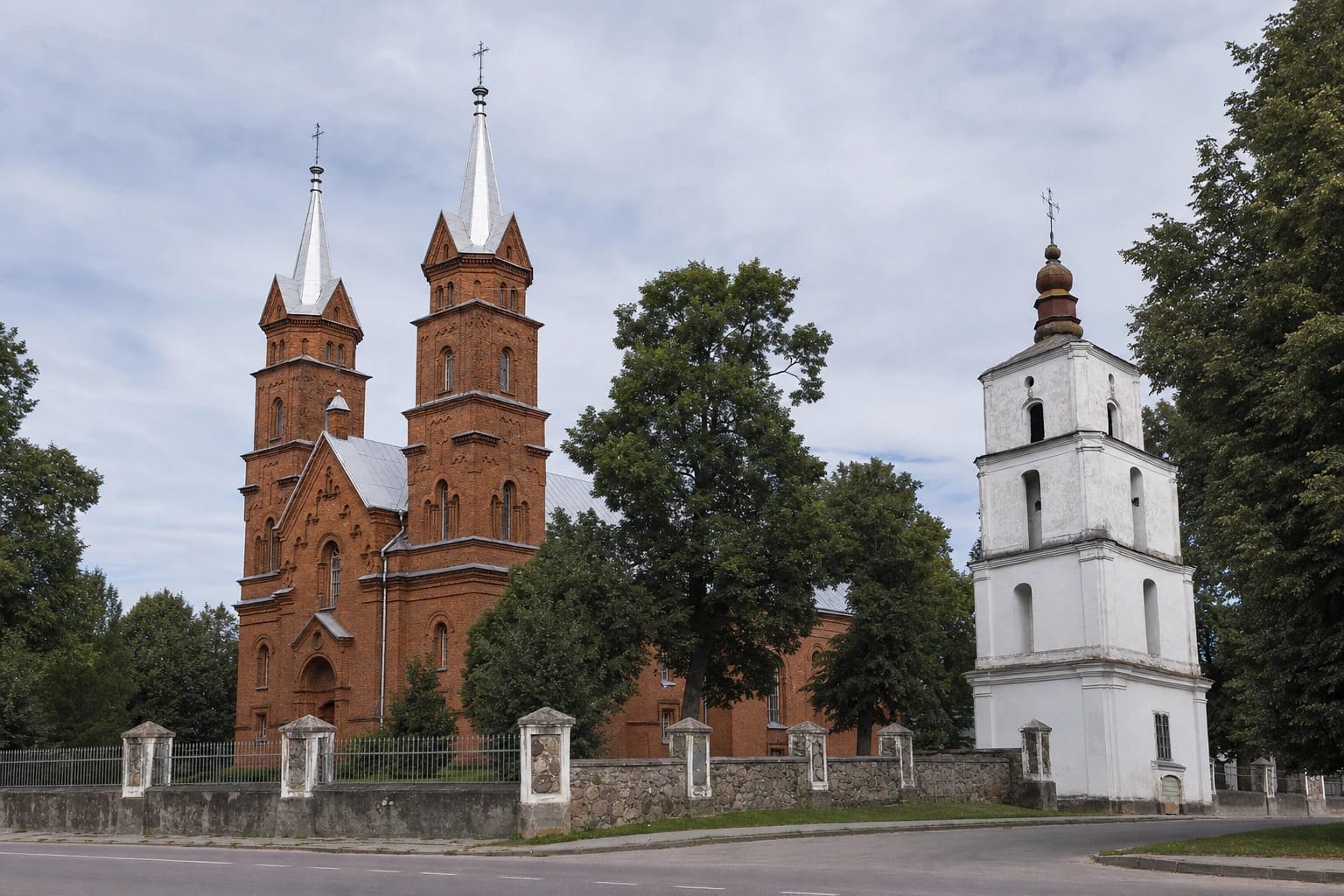
The present church is red-brick, Neo-Romanesque, and marked by eclectic deviations. Its rectangular volume contains three vaulted naves, a high roof, and two facade towers. Outside, look for the round-arched windows, brick detailing, and central gable rather than only the silhouette of the towers.
The separate bell tower stands in the western corner of the churchyard. It is a roughly 13 m high, rendered and whitewashed mid-eighteenth-century Baroque structure with a 4.5 by 4.5 m base. Its four levels taper upwards, paired pilasters mark the corners, and a Baroque-shaped turret with an openwork iron cross crowns the roof.
The bell tower's ground floor once held a Chapel of the Holy Cross, and in 1885-1886 it served temporarily as a small church while the brick building was rising. It was repaired in 1977 and 2018. Its authorship is less secure than the named architect of the later church: the municipal description links it to a design by architect A. Paraka, which is best repeated as a source attribution rather than as an independently proven fact.
Plater art, altars, and the nineteenth-century organ
The church retains three brick altars with some of the earlier L. Gogelis sculptures. The wooden central altar dates from the second half of the nineteenth century and carries forms transitional between Baroque and Classicism. In 1930 the interior was further decorated by Vladas Čižauskas, a church-decoration specialist from Šiauliai.
One of the most recognisable works is the Madonna and Child painting. The oil painting on canvas was mounted on wood, while chased metal fittings cover the clothing and background. The painting and fittings are not contemporary: the fittings were made in the first half of the eighteenth century and donated to the church by the Plater counts in 1746. This is a documented patronage detail, not a claim that the whole painting dates from that period.
The Dusetos organ was installed at the end of the nineteenth century by an unknown maker. It is described as a historic monument, but visitors should not expect independent access to the choir or instrument outside worship. The church and churchyard's artistic layers are best viewed quietly, without disturbing liturgy or photographing people without consent.
Masses and careful visiting
The Diocese of Panevėžys page lists Mass at 12:00 on Sundays and at 09:00 on Saturdays and weekdays. This is parish information, not a fixed tourist timetable: check the official page before travelling or contact the parish at +370 385 41 513 or +370 682 12 388.
The official visitor listing marks the site as year-round and free, but no guaranteed tourist opening hours, ticket system, or promised interior access is confirmed. You can view the exterior in daylight; enter outside Mass only when the doors are open and doing so does not interfere with parish life. Arrange larger groups, photography, or an organ visit in advance.
On 15 July 2026 the exact Google Maps card showed a 4.7/5 visitor rating. This is a mutable public average, not a heritage score. The card's Place ID is ChIJ95EP9XYC6EYRKsyRvFROSqQ.