- Place
- Dubingiai, Molėtai District Municipality
- Region
- Asveja Regional Park
- Type
- Wooden bridge across Lake Asveja
- Coordinates
- 55.05700, 25.44350
Wooden Dubingiai Bridge, Bridge across Asveja
A wooden bridge across Lithuania's longest lake
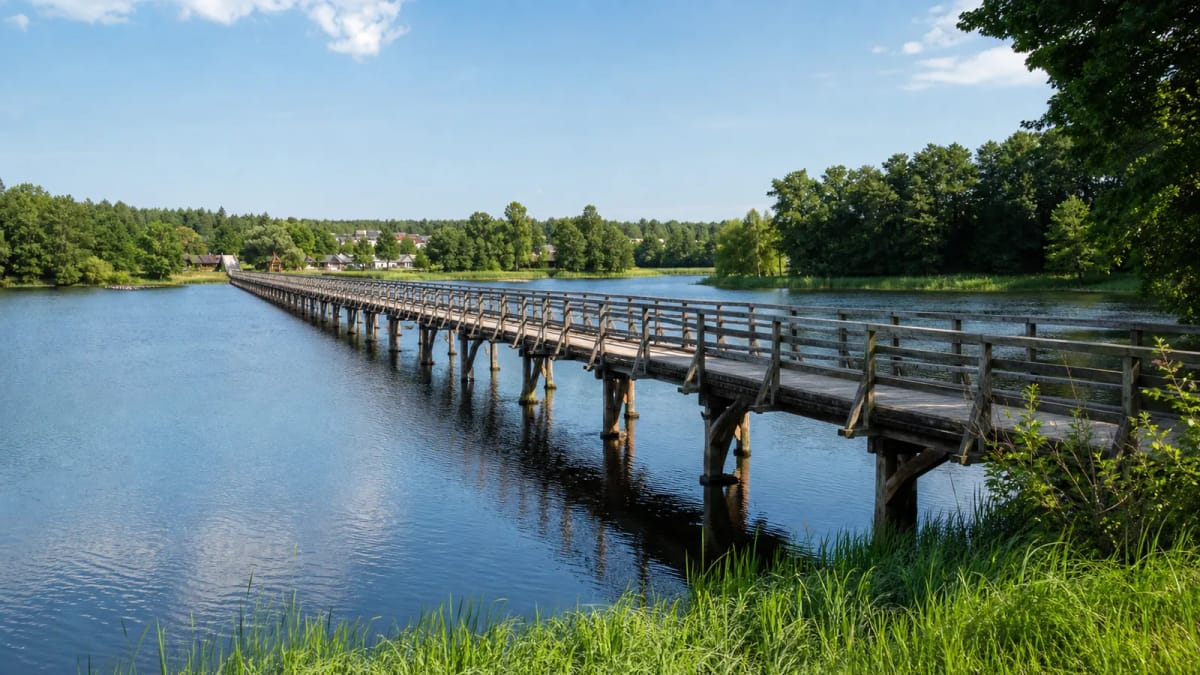
Dubingiai Bridge is unusual because it crosses a lake rather than a river: the narrow north-western bay of Lake Asveja at Dubingiai, through which the road to Giedraičiai passes. VLE states that Asveja, also called Lake Dubingiai, is of glacial-runnel origin; its shoreline reaches 72.5 km, and with bays it stretches 29.7 km, making it Lithuania's longest lake. The bridge stands where the opposite shores come closest.
In the VLE article on Asveja, the bridge is called Lithuania's first wooden bridge across a lake, and since 1995 it has been a cultural property. The narrow water crossing, lake on both sides of the road, and timber structure on piles create a view very different from ordinary concrete road bridges and have become one of the signs of Asveja Regional Park.
1934: A. Rozenbliumas and the president's initiative
VLE states that the current bridge was built in 1934 through the care of Lithuanian president Antanas Smetona and designed by engineer Anatolijus Rozenbliumas. Saugoma.lt relates that after visiting Dubingiai, Smetona noted the lack of a bridge there, and in about a year it was ceremonially opened. This explains why the object is tied to a specific interwar date and people, not to a vague ancient past.
Before the present bridge, other crossings joined the shores. VLE notes that through Count Mykolas Tiškevičius's care a ferry operated across Asveja, and the earliest Dubingiai inventories mention two old bridges across Asveja: the great bridge from the Vilnius side toward Castle Hill and the small bridge toward the town and Inturkė. Dubingiai Bridge is therefore the newest layer of a long tradition of crossing the lake. It was renovated in 2020.
Underwater piles of the old great bridge
The bridge area is also important for underwater archaeology. VLE states that research was carried out in 1998-1999 by archaeologist Zenonas Baubonis and in 2019 by Monika Dubinskaitė-Šmigelskienė, Rokas Kraniauskas, and Elena Pranckėnaitė. On the lake bed, at depths of 2.5-12 m, researchers found piles of the great bridge known from written sources (length 0.5-5.0 m, diameter 12-20 cm), log ends, hewn wooden bridge structures, and seventeenth-eighteenth-century pottery.
Saugoma.lt mentions 24 oak and conifer-wood piles found at 1.2-12 m depth, the remains of an older bridge that connected the former island with the shore. Visitors usually cannot see these finds, so it is worth knowing in advance that the submerged layer explains why this narrow point of Asveja mattered long before 1934.
Dubingiai and the Radziwiłł residence by the bridge
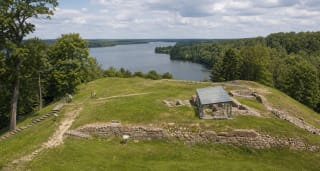
The bridge is best visited together with Dubingiai and its castle site. VLE states that Dubingiai stands on the high northern shore of Asveja, and to the south-west of the town, on a hill called Castle Hill, formerly an island, is one of Lithuania's largest castle sites. In 1412-1413 Vytautas the Great built a new Dubingiai castle here, and in the second half of the sixteenth century and early seventeenth century Dubingiai was one of the Radziwiłł residences and the centre of the Duchy of Dubingiai.
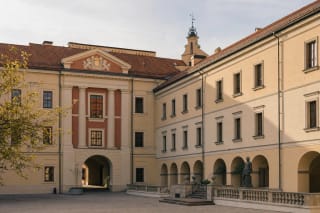
In the town itself, at the street junction, stands the former Dubingiai inn, where after reconstruction in 2008 the Asveja Regional Park visitor centre and administration were established. Walking from the bridge to the castle-site height quickly explains why settlement developed here: the narrow lake crossing and high shore were keys to both defence and communication for centuries.
Asveja Regional Park around the bridge
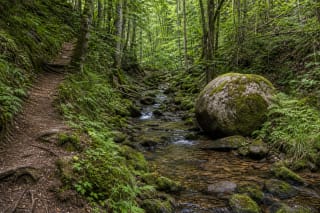
The bridge is part of the wider Asveja Regional Park, which protects the long, narrow glacial-runnel lake landscape. Around Asveja are the Jurkiškis Stream, Dubingiai Castle Site, and Liudgardas Slope nature trails, so the bridge often works not as a final destination but as a gateway into longer Asveja shore routes.
If you have more time, add a walk along the lake or one of the trails. Asveja here appears as one protected waterscape, where the wooden bridge, castle site, and wooded shores form a single whole.
Visiting and safety
Dubingiai Bridge is active public road infrastructure, so watch for cars and do not stop to photograph from the carriageway. The best way to see it is to stop safely in the town or by the shore and view the wooden construction from the side, where the full line over water is visible.
There is no ticket or separate opening time for the bridge, but nearby objects may have their own visiting rules: the visitor centre in the former inn keeps set hours. In summer Dubingiai has more travellers, so calmer photographs are more likely early in the morning or on weekdays.