- Place
- Biržai District Municipality
- Region
- Aukštaitija
- Type
- historic town square, Lithuanian statehood memorial, and wartime burial landscape
- Address
- Independence Square, beside the Church of St John the Baptist, Biržai
- Coordinates
- 56.20443, 24.75842
- Visit duration
- 20-40 minutes; 1.5-2.5 hours with Biržai Castle, the historic centre, and nearby cultural stops
- Best time
- daylight year-round; on national holidays only after checking the event programme and temporary traffic restrictions
Nepriklausomybės aikštė, Church Square
The exact square, and the Biržai places it is not
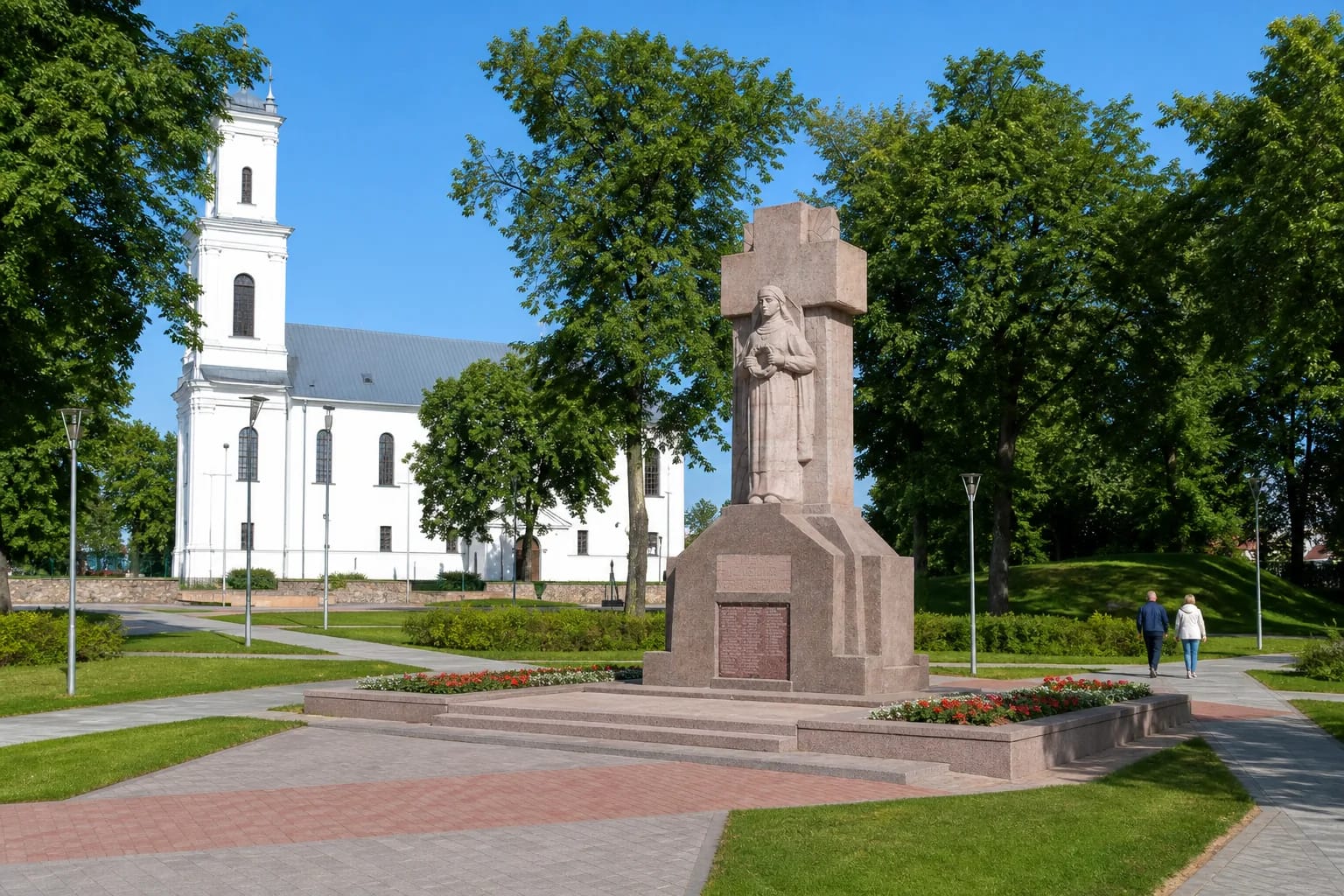
Independence Square lies in central Biržai beside Vytauto Street and the Church of St John the Baptist. The map point at 56.204425, 24.758421 represents the area around the principal Lithuanian independence memorial. It is not the sole entrance, the exact geometric centre of the whole square, or a car park.
Do not confuse this space with J. Janonis Square Park. That is a separate part of central Biržai associated with a different historic market area and the J. Janonis monument unveiled in 1976. Rotušės Street and the market or town-hall spaces discussed in historic plans are likewise not alternative names for Independence Square.
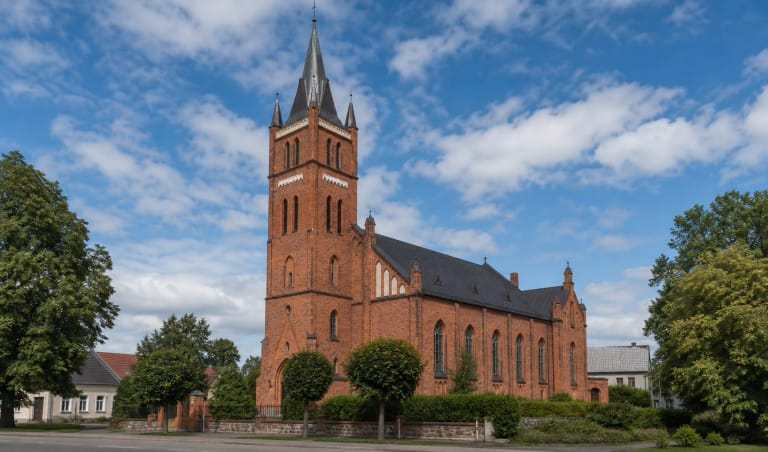
The square is shaped by the Catholic church, mature trees, geometric paths, the Lithuanian independence memorial, and a wartime burial plot. The Church of St John the Baptist is an active place of worship beside the square, not an amenity within it, so entering the building depends on the church's own arrangements.
From Church Square to the memorial of 1931
Before 1931, the small space beside the Catholic church was known as Church Square. Houses once defined its eastern edge along Vytauto Street, while today's open view resulted from several rounds of urban change and wartime loss. The present landscape should not be read as an untouched ensemble from one period.
The Cultural Heritage Register dates the monument's unveiling to 13 September 1931. It was initiated by the board of the Biržai 18th unit of the Lithuanian Riflemen's Union and designed by Robertas Antinis Sr. The 6.49 m composition shows a woman in Lithuanian folk dress holding a wreath as she stands against a cross.
The monument made the square a setting for ceremonies and parades. Local people nicknamed it Birutė, but the register records that word as a popular name and describes the figure simply as a woman in national dress. There is not enough evidence to present her confidently as the historical Duchess Birutė.
Destruction in 1946, excavation in 1988, and the 1990 copy
In 1946, the monument was blown up and buried where it stood. A Soviet military burial ground was already being established in the same space. The memorial seen today stands near the original point but not directly on it, so describing it as rebuilt in exactly the same place would be misleading.
Residents excavated the broken monument in 1988. A faithful copy followed in 1990, created by Robertas Antinis Jr., son of the original sculptor. The register also names artists Vygintas Ivoška and Algirdas Povilaitis among those who worked on the reconstruction.
The copy was restored in 2006-2007, when a granite panel carrying 60 names of volunteers, soldiers, partisans, and riflemen was installed on the pedestal. Original fragments went on display beside the church in 2011. In 2017, a separate plaque was unveiled for recipients of the Cross of Vytis and volunteers from the historic Biržai rural district who served in the 1919-1920 Wars of Independence.
The wartime burial layer and the obelisk removed in 2023
The Soviet military burial ground inside the square has its own Cultural Heritage Register code, 10817. The updated record says Soviet soldiers killed in battles around Biržai in 1944-1945 were buried here. It also considers it likely that some NKVD, MVD, or MGB troops killed in fighting against local Lithuanian partisans in 1945-1954 are among the burials, but this is explicitly an assessment of probability rather than a fully established identification.
During Soviet rule, an obelisk to the soldiers was erected on the surviving foundation of the demolished Lithuanian monument. The current register entry states that this obelisk was removed in 2023. Older photographs, visitor descriptions, and map imagery that still show it no longer represent the square's current appearance.
A 2025 heritage assessment refined the burial site's valuable properties around the human remains and ground relief. It did not list the foundations of the former monument nicknamed Birutė, the memorial panels, or the fence as valuable features. The area nevertheless remains a burial place. Stay on the paths, do not climb on memorial elements, and follow event organisers' directions during ceremonies.
The 2005-2010 paving design and the square's precise heritage status
The 2005-2010 renewal turned the ground pattern into an interpretation of local history. Narrow diagonal lines link the square symbolically with Biržai Castle as if tracing fire from the fortress, while broader bands broadly recall property boundaries that later divided this ground. These are modern interpretive devices, not exposed archaeological walls.
Independence Square had been a familiar spoken and written name since the 1931 memorial, but its legal naming date is much later. Biržai District Council formally approved the name and the square's geographical characteristics on 29 April 2021. One date marks the beginning of a civic tradition; the other records its administrative recognition.
The named square is not a single Cultural Heritage Register property with its own code. Instead, it contains two separately registered sites of local significance: the independence monument, code 42599, and the Soviet military burial ground, code 10817. The wider space also falls within the registered historic part of Biržai, code 17073, and the archaeological old-town site, code 3219.
Visiting, events, and careful movement through the site
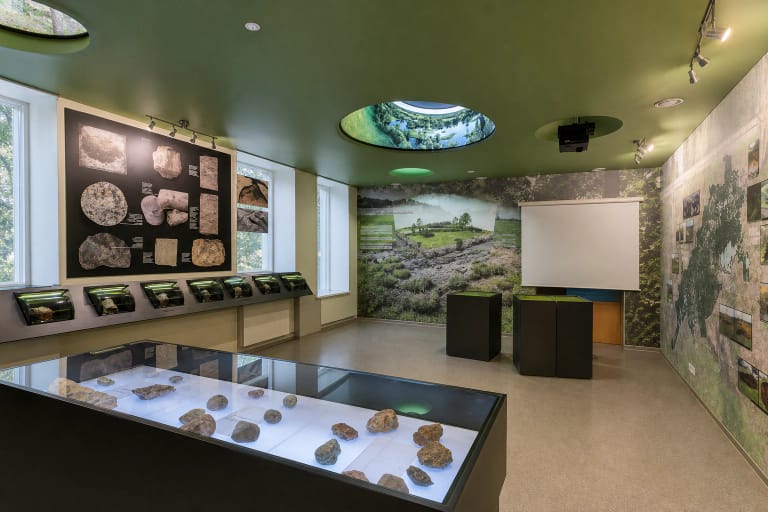
Independence Square is an open public space without gates, a ticket office, or a general admission charge. Allow 20-40 minutes for the monument and paving pattern. Add the church exterior, Biržai Castle, Rotušės Street, and the regional park visitor centre for a longer walk through central Biržai.
The square still hosts civic ceremonies. Biržai municipality's 2026 programme for the Day of the Restoration of the State of Lithuania scheduled a flower-laying at the independence monument. Fairs, runs, commemorations, and seasonal decorations depend on a particular programme, so stages, barriers, stalls, and traffic restrictions should be treated as temporary rather than permanent features.
The principal paths have firm surfaces, but the memorial platform includes steps and no recent independent accessibility audit of the whole area could be found. The map pin is not a parking marker. Use only signed spaces on surrounding streets, check temporary restrictions before a large event, and do not cut across the burial area away from designated paths.