- Place
- Telšiai, Telšiai District Municipality
- Region
- Žemaitija
- Type
- three-aisled masonry church with three apses, built as an Orthodox church in 1864-1867 and converted for Catholic worship in 1935-1936
- Address
- 2 Šviesos Street, Telšiai
- Coordinates
- 55.98351, 22.25659
Telšių Švč. Mergelės Marijos Ėmimo į dangų bažnyčia, Telšiai Minor Church, Church of Our Lady of the Assumption in Telšiai, Mažoji bažnytėlė
The Minor Church stands on Šviesos Street, not beside Telšiai Cathedral
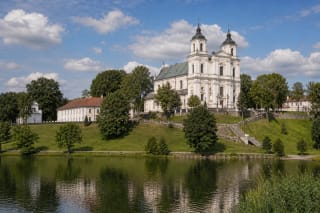
The church stands at 2 Šviesos Street on Vilnius Hill, one of Telšiai's seven traditional hills, at coordinates 55.983509, 22.256585. It is not the Cathedral of St Anthony of Padua: the cathedral lies roughly 650 metres west on Insula Hill, while the Minor Church's white single-towered silhouette rises in the eastern part of the centre. The direction of Lake Mastis and its waterfront opens beyond the renewed churchyard.
On 13 July 2026, the Diocese of Telšiai listed Sunday Mass at 8:30, 10:00, 12:00, 15:00 for young people, and 18:00. Mass is at 18:00 on weekdays and Saturday, with an additional Friday service at 12:00; Eucharistic adoration takes place on Friday from 17:00 to 18:00. Confessions are heard for half an hour before Mass and during services. Holiday times may change, so check the official diocesan page.
The parish publishes neither dedicated sightseeing hours nor an admission charge. A parish notice from 2024 advertised daily opening from 10:00 to 19:00, but it cannot guarantee identical access in 2026. Plan to see the interior before or after Mass, and call +370 687 85993 to arrange a group or specific accessibility assistance; a ramp reaches the side entrance.
A bell in the cathedral tower is the surviving witness to the parish founded here in 1536
The Diocese of Telšiai dates the first Catholic church on this site to 1536 and associates its foundation with Sigismund the Old, King of Poland and Grand Duke of Lithuania. The heritage register is more cautious: the parish was founded in 1536 and a church is believed to have been built then. Six peasant households and three taverns were granted to it in 1547, Eigirdžiai village followed in 1612, and a parish school opened that same year.
A bell cast in 1619 survives from the first wooden sanctuary and is now kept in the tower of Telšiai Cathedral. A second wooden church, erected here in 1700, suffered badly during the Great Northern War of 1700-1721 and received substantial repairs only in 1788, after war, plague, and famine. Its Holy Family altar was likewise moved to the Bernardine church, today's cathedral.
The documentary chronologies do not entirely agree. The diocese says the wooden church closed in 1814 and was demolished in 1828; the heritage register gives 1815 for closure, 1831 for demolition of the decayed building, and 1836 for removal of a temporary church. Both sources establish the central fact: Catholic worship disappeared from Vilnius Hill in the first half of the 19th century, and the Bernardine church became the parish centre.
After the 1831 uprising, an opulently furnished Orthodox Church of St Nicholas rose on Vilnius Hill
Tsarist authorities confiscated the parish land after the uprising of 1831. The diocesan history says the old municipal cemetery was also destroyed before new construction began. A masonry Orthodox Church of St Nicholas the Wonderworker, with a tower-belfry, was built here in 1864-1867. The heritage register associates it with a design by architect T. Tyšeckis; since the same record dates his life to 1824-1861, the attribution concerns design authorship rather than personal supervision of the later works.
According to the diocese, the local Orthodox population, including soldiers, numbered fewer than 200, yet the church of this western imperial district centre was furnished on a representative scale. Its interior held a hand-carved three-tier oak iconostasis with painted icons, bronze chandeliers and candlesticks, elaborate liturgical books, and gifts from the tsar. Five bells hung in the tower, while a separate timber belfry carried an exceptionally large bell known as the Tsar Bell.
The German imperial army removed the Orthodox bells for melting in 1915. They should not be confused with the Catholic bell of 1619 preserved at the cathedral. Nor does the 19th-century iconostasis remain in today's Catholic interior: in 1937, it and the other Orthodox fittings moved to the new Church of St Nicholas on Žalgiris Hill.
A 1932 court judgment and the return of 1935 transformed the former Orthodox church into a Catholic sanctuary
After Lithuania restored independence, ownership of the site confiscated under the Russian Empire became the subject of a long dispute. The heritage register says the Diocese of Telšiai filed suit in 1926 and that Lithuania's Supreme Tribunal awarded the Orthodox church and a 1.5-hectare plot to the Catholics on 14 March 1932, subject to compensation for the buildings. The diocese dates the final return of the land and structures to 15 June 1935.
The diocese first considered demolition and a completely new Catholic church, but economic conditions favoured adaptation. In four months, the exterior and interior character changed, pews and confessionals appeared, and three altars were installed: St John Bosco, the Crucifixion, and the high altar of Our Lady of Lourdes. Bishops Justinas Staugaitis and Pranciškus Bučys MIC consecrated the building under the Assumption dedication on 30 October 1935.
Compensation paid to the Orthodox community helped it build a new Modernist church with Cubist features on Žalgiris Hill in 1937. Telšiai therefore retains two directly connected buildings: the former 19th-century Orthodox church on Vilnius Hill now serves Catholics, while its old iconostasis and liturgical furnishings survive in the present Orthodox sanctuary.
Three apses, a domical vault, and one spire disclose the building's complex origin
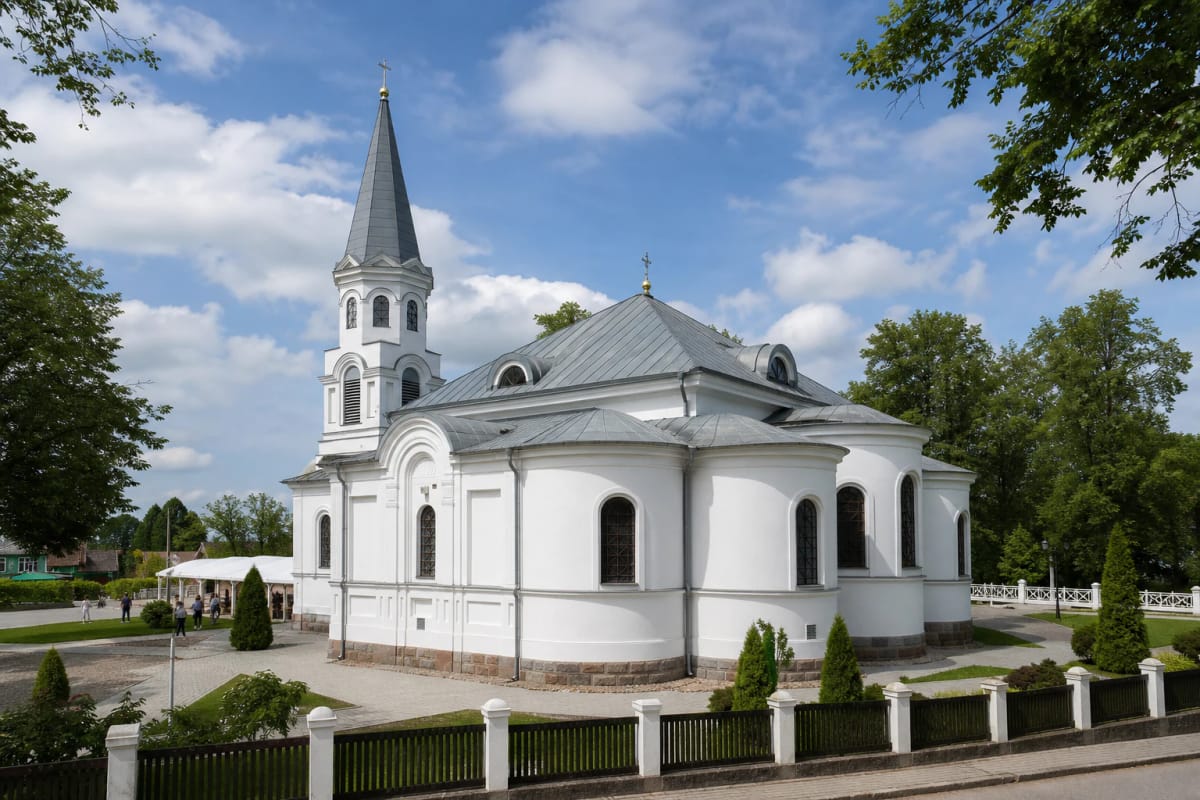
This state-protected heritage property of regional significance consists of a rectangular principal body, three semicircular apses, and a single-storey narthex carrying a two-stage tower with an octagonal pyramidal spire. A hipped roof covers the centre, gabled roofs the side aisles, and pyramidal sheet-metal roofs the apses. The heritage register gives 2,577 square metres for the protected property area.
The interior has three aisles and three sanctuary bays, a vestibule, organ gallery, and basement, with the sacristy below ground. A rendered brick domical vault spans the central aisle, a semi-dome with lunettes covers the principal sanctuary, and cross vaults cover the narthex and stair. Round-headed windows and apsidal volumes retain the building's Byzantine Revival origin, while the 1935-1936 conversion introduced Catholic façade and interior accents. A single pure style label consequently obscures more than it explains.
The principal interior landmarks are the high altar of Our Lady of Lourdes, the left-hand altar of St John Bosco with the saint among children, and the right-hand Crucifixion altar with a Jerusalem landscape. The light interior and modern liturgical altar no longer contain an iconostasis, so a visit makes clear how radically the building changed while keeping its fundamental masonry volume.
Parishioners defended the church under Soviet rule, then renewed it from floor to spire after 2012
Soviet authorities attempted to close the church in 1949 and 1953, but the Diocese of Telšiai says they retreated in the face of determined parish resistance. The episode explains why this modest central building means more to local people than an architectural curiosity. The affectionate name Minor Church distinguishes it from the cathedral while expressing a close communal attachment.
A parish-led programme after 2012 replaced the oak doors and windows, enlarged the sacristy, rebuilt the choir balcony, renewed engineering systems, and laid heated granite floors. The three altars and stained glass were restored, a new Assumption window was created, roof and tower timbers were repaired beneath new zinc sheeting, and work continued on the façades, churchyard building, and cross commemorating deportees.
Telšiai District Municipality's 2020 heritage report identifies the church by register code 4126 and records conservation of clergy graves in the churchyard. On 13 July 2026, the exact Google Maps listing had 714 reviews averaging 4.8 out of 5. It exceeds the required 4.5 threshold, although the public figure will change as new reviews appear.