- Place
- Biržai District Municipality
- Region
- Aukštaitija
- Type
- active Evangelical Reformed church and confessional heritage site
- Address
- Reformatų g. 3a, Biržai
- Coordinates
- 56.20780, 24.75850
Biržai Reformed Church
A northern Lithuania Reformation centre
Biržai Evangelical Reformed Church stands on Reformatų Street in a town whose Reformed history is closely tied to the Radziwiłłs. The parish beginnings are linked with Mikołaj Radziwiłł the Red, and the first church is mentioned in 1584. Biržai became one of northern Lithuania's most important Reformation centres, and the community remains active.
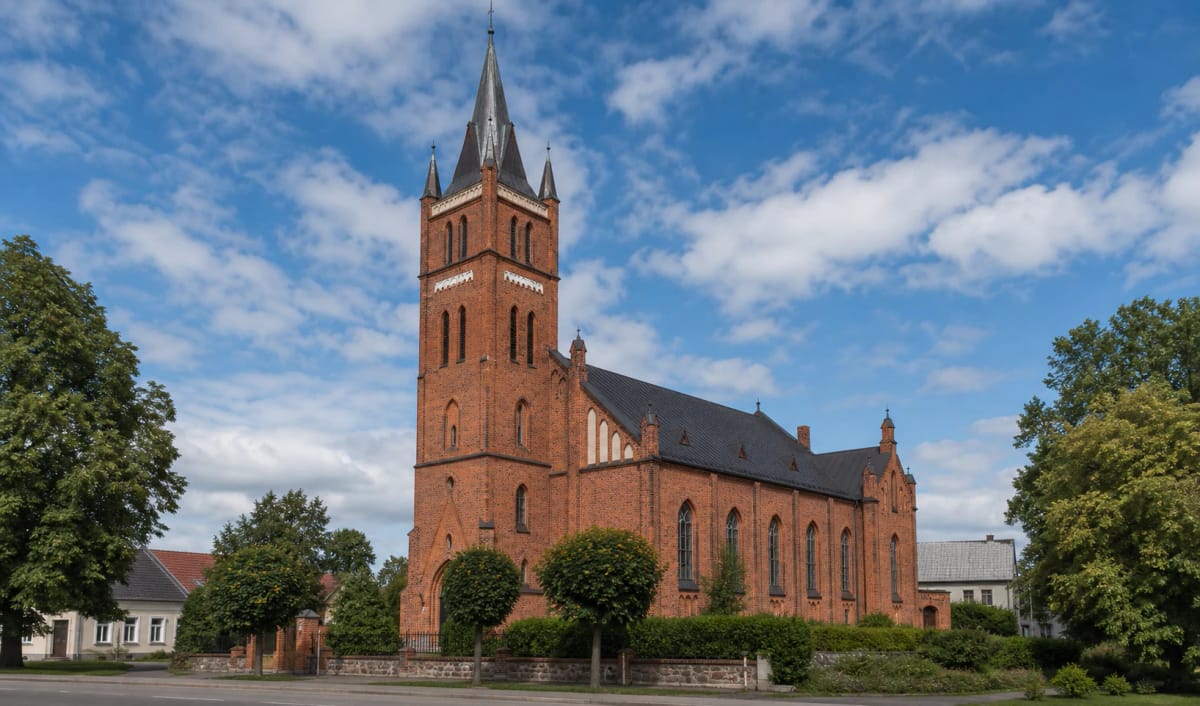
It is important to separate the community's age from the present building. The current church is not sixteenth-century: it was built in 1867-1874 to a design by Riga architect Heinrich Schell, approved on 16 February 1866.
Neo-Gothic red-brick church and interior
The Cultural Heritage Register describes the church as Neo-Gothic. It is rectangular in plan, single-naved, with a four-stage square tower and octagonal spire, a vertical red-brick silhouette that stands out clearly in Biržai. The complex includes the church, rectory, and fence with gates.
The wooden interior fittings are especially important: the eastern organ gallery with organ, north and south galleries, pulpit, oak presbytery railing, communion table, memorial boards, and hymn boards. These elements fit Reformed liturgy, where preaching and singing matter more than a highly decorated altar.
Radziwiłł beginnings, 1704 fire, and nineteenth-century building
The first Biržai Reformed church is mentioned in 1584, with construction supported by Krzysztof Radziwiłł the Thunderbolt. It burned in 1704 during the Great Northern War; a wooden church was built in 1705, then demolished around 1862 and replaced temporarily by prayer houses.
This sequence explains why the present nineteenth-century Neo-Gothic building still stands on a long confessional tradition site. It continues a community history several centuries old, while architecturally belonging to the period when the earlier wooden church had become too small and worn.
The 1930 bell and independence memory
Among the most valuable details is a bell cast in 1930 at the Bochumer Verein foundry in Germany, with an inscription commemorating Lithuanian independence in 1918-1928. It is an important sign of both community and statehood memory from the early twentieth century.
The dates are easy to confuse: the bell was cast in 1930, while its inscription refers to the ten-year independence commemoration, 1918-1928. Both layers should be named.
Visiting Biržai Reformed Church
The church is an active parish church. According to parish data, in the warm season, roughly from the second half of May to the first half of September, it is open on Sundays from 10:00 to 14:00; at other times opening should be arranged with parish staff or the pastor. A guide can be arranged in Lithuanian, Polish, or English, and there is no stable tourist ticket.
Even from outside, the church belongs on a Biržai route with the castle and Astravas Manor. It helps read Biržai as a town of confessional diversity and Radziwiłł political culture.