- Genre
- City-founding legend
- Source status
- chronicle tradition
- Motifs
- Gediminas, Iron Wolf, Lizdeika, Vilnius, dream, city founding
Gediminas' Dream and the Iron Wolf, Founding legend of Vilnius, Legend of the Iron Wolf
The legend
It is told that Grand Duke Gediminas once hunted near the confluence of the Vilnia and Neris. After the hunt he spent the night around Šventaragis Valley, near a hill overlooking rivers, forests, and a suitable place for a future castle.
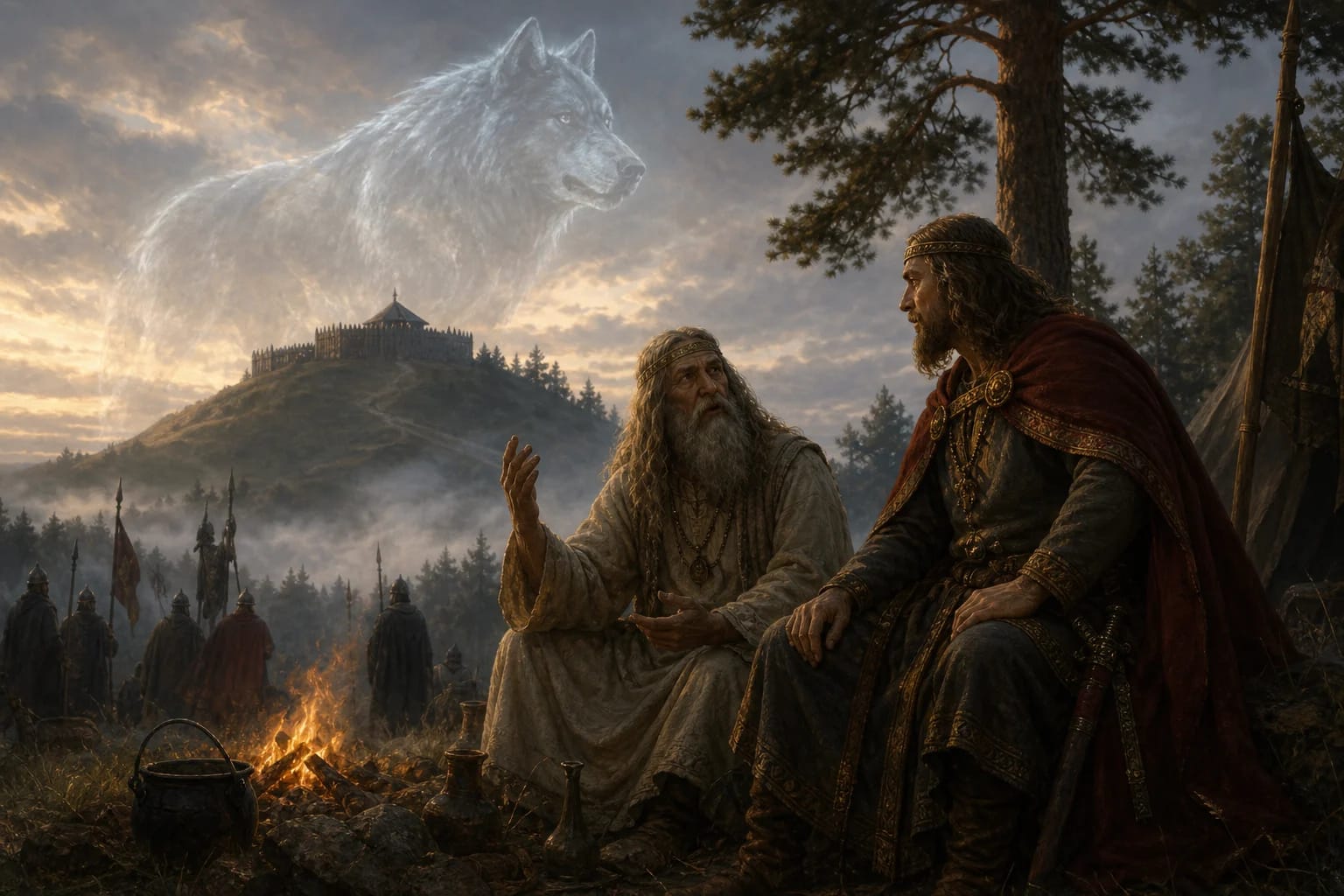
That night Gediminas dreamed an extraordinary vision. On the hill stood a huge iron wolf, not an ordinary forest animal but a sign cast from metal: hard, unbreakable, watchful. It howled so loudly that it seemed to contain the voices of a hundred wolves.
Gediminas called the priest Lizdeika to explain the dream. Lizdeika said the Iron Wolf meant a castle and city that should be built there, and that the wolf's howl meant the city's future fame. Gediminas followed the interpretation, and the legend explains Vilnius as a city born from a sign read correctly.
Interpretation: what does Gediminas' Dream mean?
The dream is a language of rulership. Gediminas is not only a warrior and hunter; he receives a sign, and state-building begins with the ability to understand that sign.
The Iron Wolf joins wild force and firm political form. The wolf carries forest, hunting, and war energy, while iron suggests weapons, smithing, fortress strength, and endurance. The wolf is the voice of the future city.
Lizdeika's role shows that political power needs an interpreter. The ruler sees, the priest explains, and the community builds. Vilnius' fame appears in the legend before the city itself exists.
History, sources, and recording
The Gediminas' Dream story belongs to the Lithuanian chronicle tradition. It is not a simple anonymous fairy tale but part of written historical memory, ruler genealogies, and explanations of the capital's origin.
The developed story of Gediminas, the Iron Wolf, and Lizdeika was recorded only in sixteenth-century Lithuanian chronicles, especially the Bychowiec Chronicle. That is about two centuries after Gediminas, so the dream scene should be read as a later founding legend, not as contemporary evidence.
Historically, Gediminas was a real Lithuanian ruler of the first half of the fourteenth century, and Vilnius became a permanent capital in his time. VLE treats the story of Gediminas as founder of Vilnius as probably reflecting the ruler's move from Trakai to Vilnius, while the dream episode itself remains a chronicle legend.
In the chronicles and later retellings the same core elements recur: the hunt, the night spent in the area of Šventaragis Valley, the iron wolf, Lizdeika's interpretation, and the prophecy of the city's fame. The details may vary, but the core of the plot remains clear.
VLE presents Lizdeika as a legendary priest connected with interpreting Gediminas' dream. That distinction matters: Gediminas is a historical ruler, while Lizdeika and the dream scene belong to the chronicle-legend layer.
In modern readings, Gediminas' Dream is often presented as the origin myth of the city of Vilnius. It does not historically prove one specific moment of the city's founding, but it explains how cultural memory wished to see the birth of the capital: through a ruler, a sign, a priest, and a voice.
Why this legend matters to Vilnius
Gediminas' Dream gives Vilnius a clear symbolic beginning. The city is not merely a settlement that grew by chance; it arises from vision, place, and a promise that its name will be widely heard.
The legend also explains why the Iron Wolf became one of Vilnius' most recognizable symbols, appearing in monuments, school stories, city branding, and contemporary culture.
It is best read not as a documentary foundation record but as political imagination: a text about rule, a capital, interpretation of signs, and the desire to see Vilnius as a city whose voice travels beyond its own hills.