- Place
- Akmenė District Municipality
- Region
- Samogitia
- Type
- state-protected neo-Gothic pseudo-basilica built in 1907-1912, with a 58.5-metre tower, historic interior, and Stations of the Cross chapels
- Address
- 5 K. Kasakausko Street, LT-85367 Akmenė
- Coordinates
- 56.24619, 22.74752
- Visit duration
- 30-45 minutes for the church and churchyard; 60-90 minutes if a tower and sacred-art display visit has been arranged in advance
- Best time
- a bright day for the contrasting facade materials and rose windows; book the tower in advance and preserve the congregation's quiet during worship
Old Akmenė Church of St Anne, Akmenė Catholic Church, Akmenė Church, Akmenė St Anne Parish Church
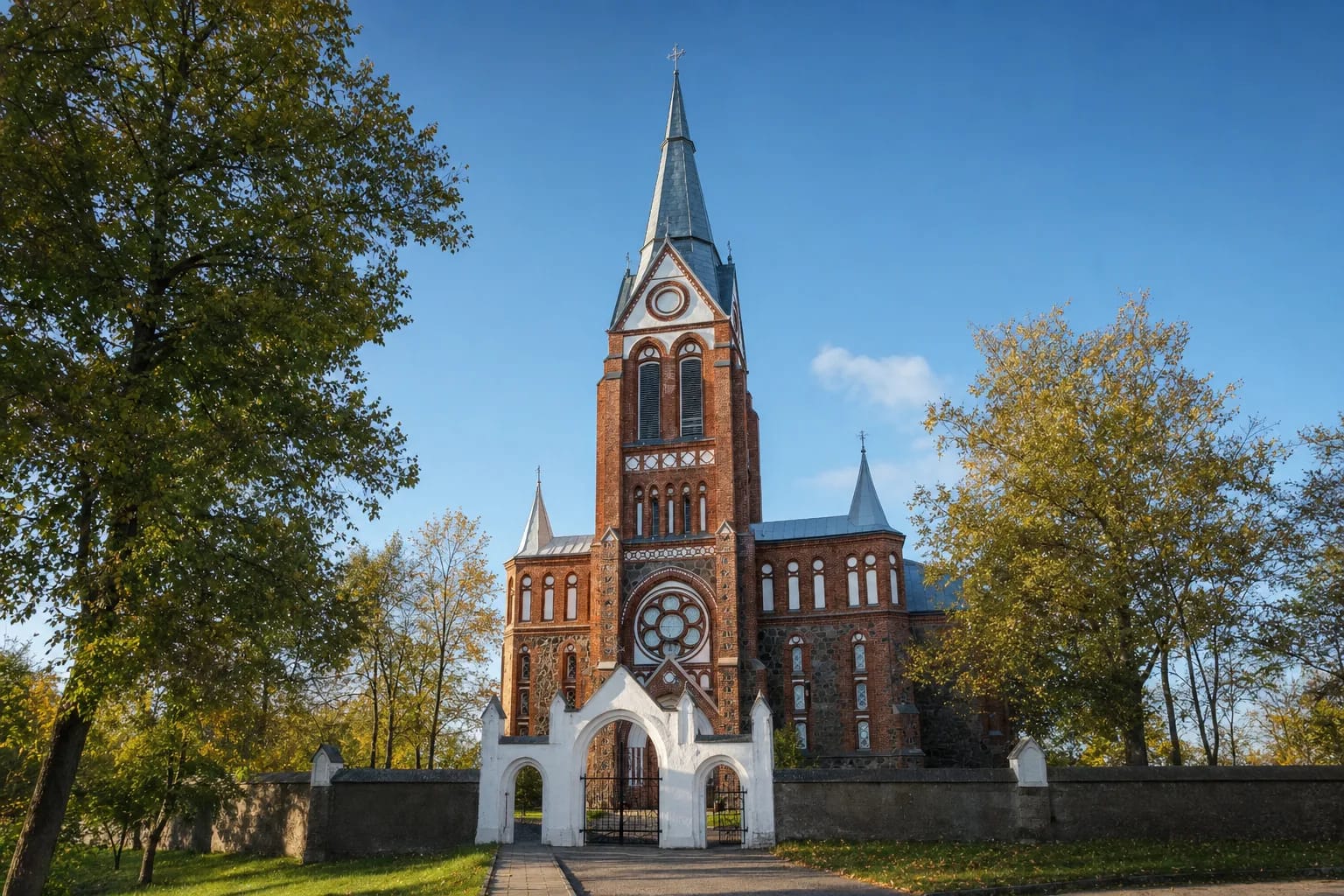
A colourful pseudo-basilica forms Akmenė's dominant vertical landmark
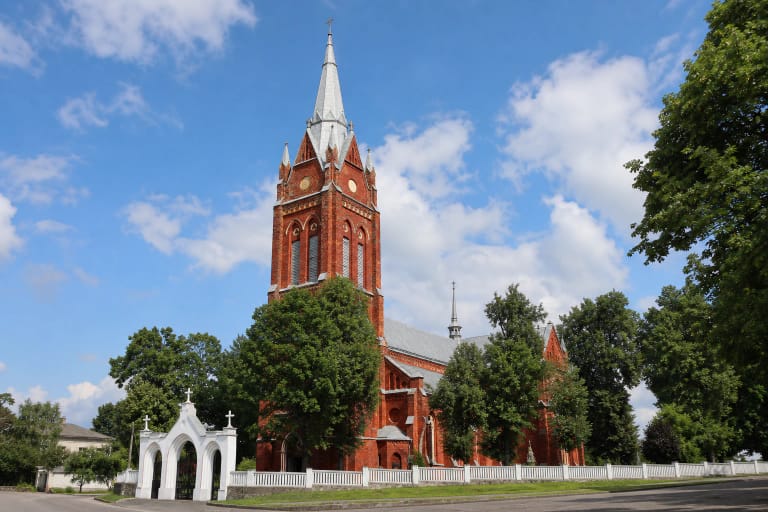
The church stands at 5 K. Kasakausko Street in central Akmenė, on the right bank of the Dabikinė. Official coordinates 56.246187, 22.747520 mark the building itself. White rendered gates frame a long approach through the churchyard towards the west facade. This remains an active Roman Catholic church rather than an architectural exhibition, so open access to the grounds does not mean that the doors or tower are always unlocked.
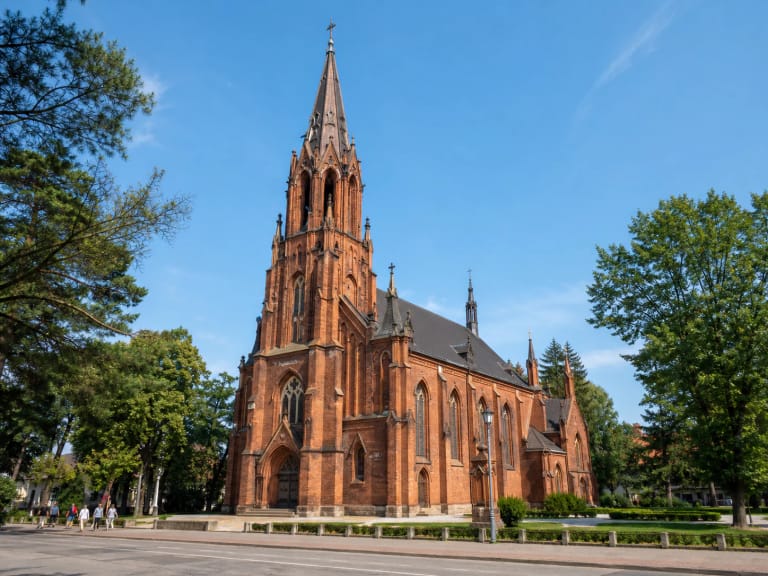
VLE classifies the building as a neo-Gothic pseudo-basilica. In a pseudo-basilica, the central nave rises above the aisles but lacks the continuous upper window zone of a true basilica. A transept creates the cross-shaped plan, while a single 58.5-metre west tower with an octagonal spire dominates the exterior. Five smaller turrets reinforce its vertical composition, but they are not five separate bell towers.
Contrasting materials make the facades exceptional. Large fieldstones are combined with red-brick bands and white rendered accents. Slender windows and a circular rose window fill the tower's great pointed recess, while patterned brick courses draw the eye upwards. Some popular texts call the building neo-Romanesque or neo-Romantic, but the Diocese of Telšiai and VLE use neo-Gothic. Its pointed openings and strong vertical emphasis best explain that prevailing classification.
The present church is the fourth building in a centuries-old parish tradition
The Diocese of Telšiai treats 1596 as the foundation year of Akmenė parish, linking it with Sigismund Vasa, Queen Anna Jagiellon, and Samogitian Bishop Merkelis Giedraitis. VLE notes that a wooden church already stood in the settlement then called Dabikinė in 1561. These statements are compatible: the existence of an earlier building is not the same as the formal endowment and organisation of a parish.
Swedish troops burned the first wooden church in 1705. A later wooden church deteriorated, and sources render the end of its life as either 1802 or 1806. A third wooden church then stood on the site of today's parish house, formerly the charitable hospital or špitolė, and served for about a century. The source notation 1802(6) signals genuine uncertainty and should not be flattened into a falsely precise year.
This sequence explains why the current masonry church is described as the fourth. The institution reaches back to the sixteenth century, but no part of the visible church should be mistaken for sixteenth-century masonry. The building encountered today belongs to the 1907-1912 campaign.
Construction in 1907-1912 is documented, while Strandmann's authorship remains an attribution
Parish priest Antanas Naudžiūnas secured permission for a new masonry church in 1906. Work began on 1 April 1907 and the foundation stone was blessed on 14 September. The local encyclopaedic record gives a length of 48.5 metres, width of 25.5 metres, and an interior height of 17.5 metres to the vaults. It also records a cost of 44,000 roubles and roughly 700,000 fired-clay bricks. Parishioners contributed money and labour, and the diocesan account stresses that the project finished without debt.
Vilhelmas Landovskis, a German master builder from Latvia whose surname also appears in Lithuanianised form as Landauskas, supervised construction. The work was completed on 1 October 1912. Canon Juozapas Skvireckas, later Metropolitan Archbishop of Kaunas, celebrated the first Mass on 20 October. Bishop Pranciškus Karevičius consecrated the church only on 12 August 1920, so completion, first worship, and formal consecration are three distinct dates.
Karl Eduard Strandmann is often named as architect, but the most dependable current sources remain cautious. VLE attributes the church to him, while the diocese says it was probably built from the design of his Palanga church. VLE's Strandmann biography likewise lists Old Akmenė among attributed rather than unequivocally documented works. The connection is architecturally significant, but this guide does not turn it into a surviving signed commission that no source presents.
Five altars, an 1818 organ, and bells repeatedly reshaped by war
The local encyclopaedic account identifies five altars. The high altar of the Holy Cross was donated by priest Dominykas Putrius and includes figures of Saints Dominic, Vincent, and John the Baptist. J. Balčiūnas made the side altar of St Anthony in Salantai in 1923. Altars of Our Lady of Mount Carmel, St Ursula, and St Anne were produced in Šiauliai in 1925, with artist J. Janulis and sculptor M. Mrozinskis named in the record.
A ten-stop organ built in Königsberg in 1818 was installed here after 1934. Its manufacturing date does not mean that it served this church from 1818; more than a century separates construction of the instrument from its arrival in Akmenė. An official municipal report records a consecration of the high altar on 23 July 2023, adding a recent liturgical layer to the historic interior.
All four bells then in the tower were taken during the First World War. Russian authorities requisitioned three, and the occupying German administration removed the last small bell. One replacement was bought in 1918 and another through parish donations; two new bells were cast in 2012. The tower therefore preserves a changing acoustic history rather than one untouched set from 1912.
The protected site includes the churchyard ensemble, not only the 58.5-metre tower
The church itself carries Register of Cultural Property code 16013, while the Church of St Anne building complex is code 29833. The municipality's heritage list includes the churchyard wall, main and secondary gates, and Stations of the Cross chapels within that complex. The white entrance, masonry enclosure, and small devotional structures are therefore integral heritage rather than incidental scenery around the main facade.
A masonry wall enclosed the churchyard in 1929, incorporating fourteen Stations of the Cross chapels. Their rhythm is best read by walking the perimeter slowly without disrupting worship or private prayer. Parish priest Antanas Naudžiūnas, who led construction, and priests I. Žeberskis and K. Jadviršis are buried in the churchyard, making it a place of burial as well as architecture.
Clergy associated with Akmenė connect the parish to wider Lithuanian cultural and church history. The Diocese of Telšiai names grammarian, temperance advocate, and Motiejus Valančius associate Kalikstas Kasakauskas; priest Jonas Staškevičius, exiled to Siberia; and future Bishop of Telšiai Antanas Vaičius. The street address itself preserves Kasakauskas's name.
Mass is public, but the tower display must be arranged in advance
On 20 July 2026, the Diocese of Telšiai listed Mass at 09:00 and 11:00 on Sundays and at 18:00 on weekdays and Saturdays. Confessions begin half an hour before Mass and are also heard during Sunday services. The feast of Our Lady of Mount Carmel is associated with 16 July and St Anne's feast with 26 July, both transferred to a Sunday. Holiday schedules and clergy commitments can alter times, so recheck the diocesan page before a dedicated journey.
The municipality says that the sacred-object display and panorama in the tower are available only by advance arrangement on +370 600 53161. A tower visit is not an automatic extension of every Mass. The official page publishes no fixed tower timetable, admission fee, stair count, or mobility-access statement, so ask about every practical requirement when booking.
Dress appropriately, silence phones, do not touch altars, and never enter closed liturgical areas. Ask before photographing a Mass, funeral, or wedding, and do not use flash without permission. The main churchyard path appears comparatively level, but no official step-free-access audit is published. The tower involves stairs and should not be described as an accessible alternative.