- Place
- Vilnius City Municipality
- Region
- Vilnius
- Type
- late-Baroque and Rococo Dominican church with a monastery ensemble
- Address
- Dominikonų g. 8, Vilnius
- Coordinates
- 54.68130, 25.28470
Vilnius Church of the Holy Spirit, Dominican Church
The Church of the Holy Spirit on Dominikonų Street
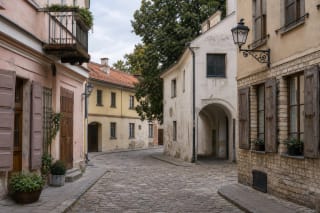
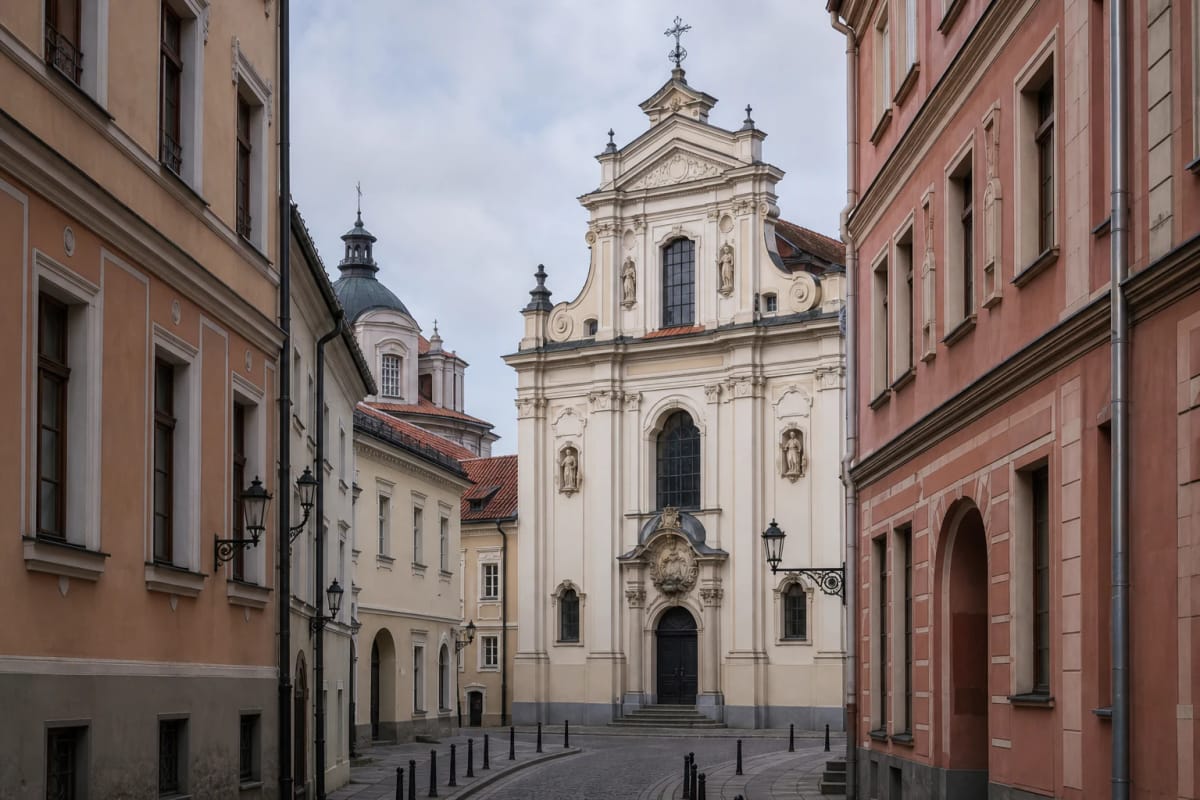
The Vilnius Church of the Holy Spirit, also known as the Dominican Church, is one of those old-town places where the restrained exterior does not reveal the scale of the interior. The narrow Dominikonų Street facade at Dominikonų g. 8, on the corner of Dominikonų and Šv. Ignoto streets, hides a large late-Baroque space that is best understood by stepping inside.
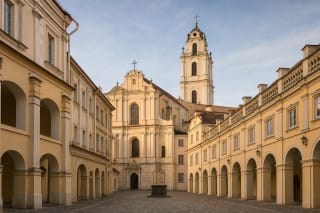
The place matters not only architecturally. The church and the former Dominican monastery beside it were for centuries the centre of the Lithuanian Dominican province. According to VLE, the Lithuanian Province of the Holy Guardian Angels was established here by the Church of the Holy Spirit in 1647 and included dozens of monasteries.
From Vytautas' time to the Dominicans: a short history
According to sources, the first wooden Church of the Holy Spirit on this site was built around 1408 and is connected with the initiative of Vytautas the Great. In the late fifteenth century, in 1494, Grand Duke Alexander gave it to the Dominicans, and a monastery began to form beside it. The site became the oldest and most important Dominican base in Vilnius.
The church burned and was rebuilt several times. Major fires are mentioned in 1610 and 1655, and in the mid-eighteenth century, in 1726, 1737, 1748, and 1749, fire repeatedly left little more than the walls. The present church is therefore not the work of one period, but the result of long rebuilding and Baroque decoration.
Late-Baroque and Rococo interior
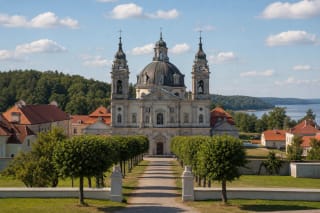
The essential present form of the church took shape in the eighteenth century. The main rebuilding and decorative works continued roughly until 1770, when the towers, dome with lantern, altars, and portal were installed. The plan is a Latin-cross basilica with three naves, and an octagonal dome with lantern rises above the crossing. The towers reach about 36 m.
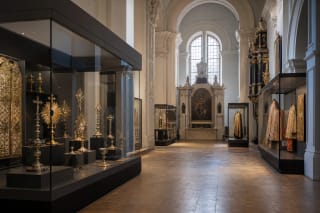
The interior is considered one of the most valuable late-Baroque and Rococo ensembles in Lithuania. It includes 16 artificial-marble altars, rich Rococo ornament, frescoes, and a collection of memorial paintings. Because of this harmonious coloured decoration, the church is often described as one of the most ornate sanctuaries in Vilnius.
The Casparini organ of 1776
One of the church's greatest treasures is its historic organ, built in 1776 by Königsberg master Adam Gottlob Casparini (1715-1788). It is among the most important surviving eighteenth-century organs in Europe, valued for its authentic late-Baroque sound and original construction.
The organ and acoustics make the Church of the Holy Spirit an important place for early music. Concerts are held here, and the instrument has become a subject of international organ-building research. If you want to hear it, follow parish and concert announcements.
Crypts and natural mummies
Beneath the church and monastery lie famous multi-level underground labyrinths, or crypts, where the specific microclimate naturally mummified some of the buried remains. During an archaeological inventory in 2011, 23 mummies were recorded, roughly one third men, one third women, and one third children; in total, several hundred burials are thought to lie under the sanctuary.
The crypts are not normally an open, freely visited space, so access is only organized and with permission. This is a sensitive burial place and should be approached with respect, not treated as entertainment.
Heritage status and visiting
The church and Dominican monastery ensemble are listed in the Cultural Heritage Register as state-protected heritage, and the church remains an active sanctuary of the Vilnius Archdiocese. Allow 20-60 minutes: the exterior works well together with Dominikonų Street, the Stikliai Quarter, and the Town Hall direction, while the interior and altar ensemble require a slower pace.
I do not present a fixed tourist opening schedule as an unchanging fact. Before going, check parish or Dominican information, especially if you want to enter outside service times, hear the organ, or arrange a crypt visit.