- Place
- Kaunas City Municipality
- Region
- Kaunas
- Type
- interwar fire station and modernist city-infrastructure building
- Address
- Nemuno g. 2 / I. Kanto g. 1, Kaunas
- Coordinates
- 54.89496, 23.90243
Fire station called Firefighters' Palace, Kaunas Firefighters' Palace, Firefighters' Palace, Palace for Firefighters in Kaunas
A fire station that looks like a palace
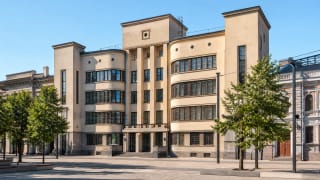
The Firefighters' Palace in Kaunas is one of the best examples of interwar city infrastructure. It is not a bank, ministry, or club, but a special-purpose fire station. Still, the name palace is not accidental: the building received an expressive facade that shapes an urban corner and gives a public service a representative scale.
AUTC writes that the curved building gave Kaunas Naujamiestis architectural variety and modernity. KVR's formal name is the fire station called Firefighters' Palace, unique code 32702. It is a state-protected single object of regional significance.
Where exactly it stands
AUTC gives the address as Kanto g. 1, while KVR gives Nemuno g. 2. This is the same city corner at Nemuno and I. Kanto streets, near the meeting point of Naujamiestis and the Old Town. Because the building has two facades and a corner position, both addresses can appear in sources.
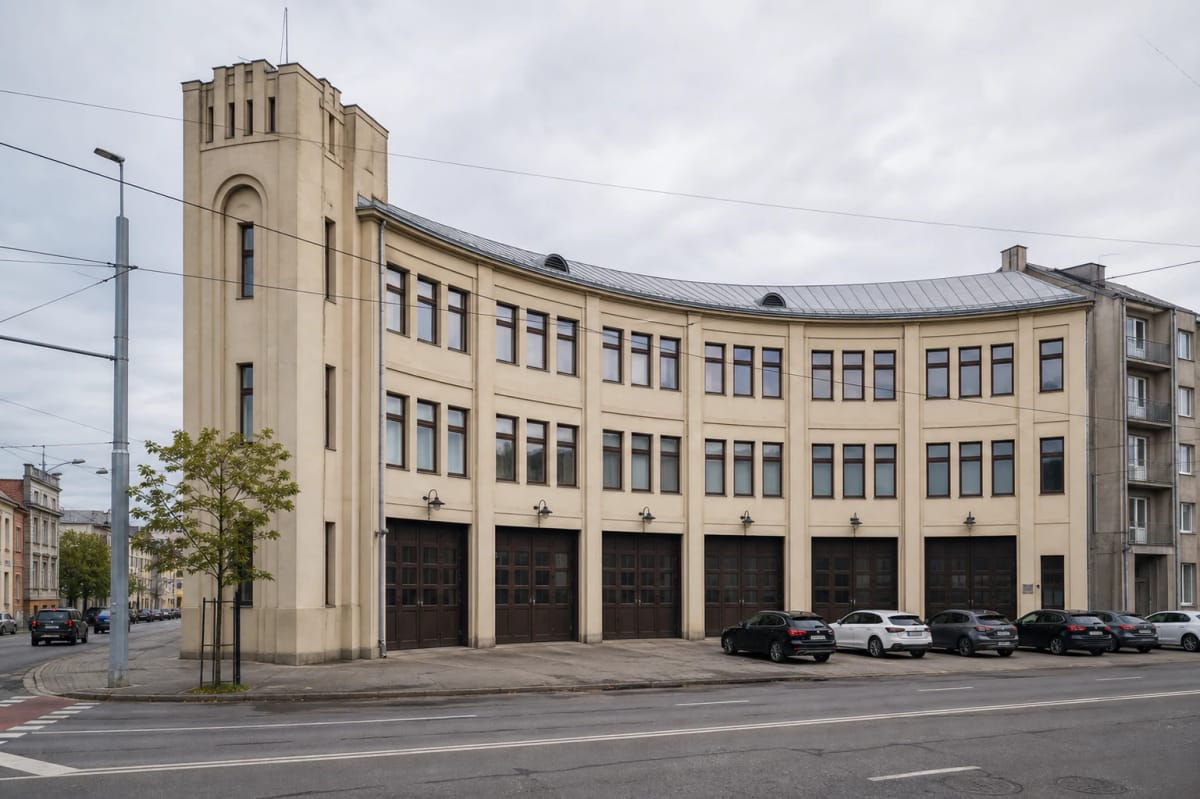
The AUTC map point is 54.8949573677, 23.9024346467. For visitors the most practical view is from the opposite side of the street, because only from a wider angle can the concave facade, garage-door rhythm, and tower vertical be seen well.
From marketplace to modern fire station
AUTC and KVR state that one of Kaunas's marketplaces, called the Milk or New Market, previously stood on the site. AUTC quotes descriptions of the market's problems: evening noise, illegal alcohol trade, and unknown people sleeping there showed that the place created administrative trouble for the city.
Building the fire station here was an urban change. In place of a disorderly market came a modern base for the city's safety service. It explains interwar Kaunas modernization well: the city organized not only representative squares, but also the daily work of infrastructure.
Construction in 1929-1930
AUTC metadata dates the building to 1929-1930, and KVR also states that the fire station was built in 1929-1930. VLE's article on Edmundas Alfonsas Frykas lists the Firefighters' Palace among his Kaunas projects built in 1930.
KVR gives authorship as follows: project author E. Frykas and structural engineer P. Markūnas. AUTC adds a broader team: contractors D. and G. Ilgovskis brothers built it, while architect J. Peras and engineer A. Jokimas supervised technical work. It was therefore not a one-person building but a complex city construction project.
How the fire station was funded
AUTC also highlights the funding logic. The building was expected to cost about 600,000 litas, and the money was planned to be collected through real-estate taxes. The period argument was simple: firefighters protect immovable property most directly, so its owners should contribute to the cost.
This detail matters because it shows the building as a municipal decision, not only as an architectural object. The fire station was a public investment in risk management, protection of urban property, and a professional service.
Curved facade and Art Deco features
KVR's valuable-features description identifies a three-storey irregular volume with a concave central part, rectangular towers at the Nemuno and I. Kanto street corner, and a closed courtyard in the north-western part. The building line forms an oval space in front of the facade.
In the facade composition KVR explicitly mentions functionalist and Art Deco stylistic features. The most visible elements for visitors are the curved facade line, dark garage doors, rhythmic upper-floor windows, stepped parapets of the corner towers, semicircular and rectangular niches, and vertical ornamental bands.
The ground floor was a service machine
KVR states that the first floor of the main wing was intended for the garage, and above it were firefighters' domestic and rest rooms. This explains the facade: the long row of garage doors is not a later accident, but the building's main function.
The building also preserves engineering equipment directly linked to firefighting. KVR mentions a metal firefighters' sliding pole, a fire-extinguishing-equipment dryer with a small basin, and the reinforced-concrete floor type. In other words, this modernism was not only style. It had to work quickly, practically, and reliably.
Mixed programme: shops, apartments, pawnshop
The Firefighters' Palace was more than a garage and tower. AUTC states that shops operated on the Nemuno Street side, apartments stood above them, and a pawnshop occupied the third floor. KVR adds that two apartments were intended for fire brigade commanders, while the third floor was adapted for public needs.
KVR also mentions the Vincas Kudirka Reading Room and Library and the Pedagogical Museum. This functional mixture is highly interwar: a city-service building was also commercial, residential, and a public cultural object.
Tower and war damage
The 25-metre tower rising above the building, as KVR states, was intended for observing the surroundings and drying fire hoses. It is therefore not a decorative urban fantasy; it has a clear service logic.
During the Second World War the palace was damaged when an aerial bomb hit a neighbouring building and the resulting fire spread to the Firefighters' Palace. KVR states that the second and third floors burned out, but they were repaired before the war ended. Later the building was reconstructed in the second half of the twentieth century.
A building that kept its purpose
One of the strongest features of this object is continuity of function. KVR directly states that the building has not changed its purpose up to the present day: the first team of the Kaunas Fire and Rescue Board is based here.
For that reason a visit should be respectful and practical. This is an active service building, not a museum or a freely visited interior. The best experience is the exterior, the urban corner, and recognizing the KVR-described elements from public space.
UNESCO modernism context
The Firefighters' Palace is part of the story of Kaunas modernism and interwar urban modernization. The UNESCO World Heritage property Modernist Kaunas: Architecture of Optimism, 1919-1939 covers the wider context of Kaunas modern architecture and urban development.
The building should not be called a separately inscribed UNESCO object. More precisely, it is an object in the interwar Kaunas modernism context, showing how capital-city modernity also appeared through firefighting, infrastructure, service speed, and the organization of urban safety.
How to view it today
Stand where the whole curved facade line is visible. Up close, notice the garage doors, stepped parapet of the tower, semicircular niches, facade bands, metal lamps, and small decor. If photographing, look for a wider angle because the building is long and concave.
Because this is an active fire station, do not block gates, the courtyard, or service entrances. A short stop combines well with the Central Post Office, Laisvės aleja modernism, and a Nemunas riverbank route.