- Place
- Dūkštos, Vilnius District Municipality
- Region
- Vilnius District
- Type
- active Gothic Revival parish church consecrated in 1856 and the historic sacred centre of Dūkštos
- Address
- Mokyklos g. 3, Dūkštos, Vilnius District
- Coordinates
- 54.82205, 24.96878
- Visit duration
- 30-60 minutes; longer when attending Mass or exploring the churchyard slowly
- Best time
- during the officially listed opening hours; a bright morning or late afternoon suits exterior photography
Dūkštos St Anne's Church, St Anne's Church in Dūkštos, Dūkštos Catholic Church
What to notice at Dūkštos Church of St Anne
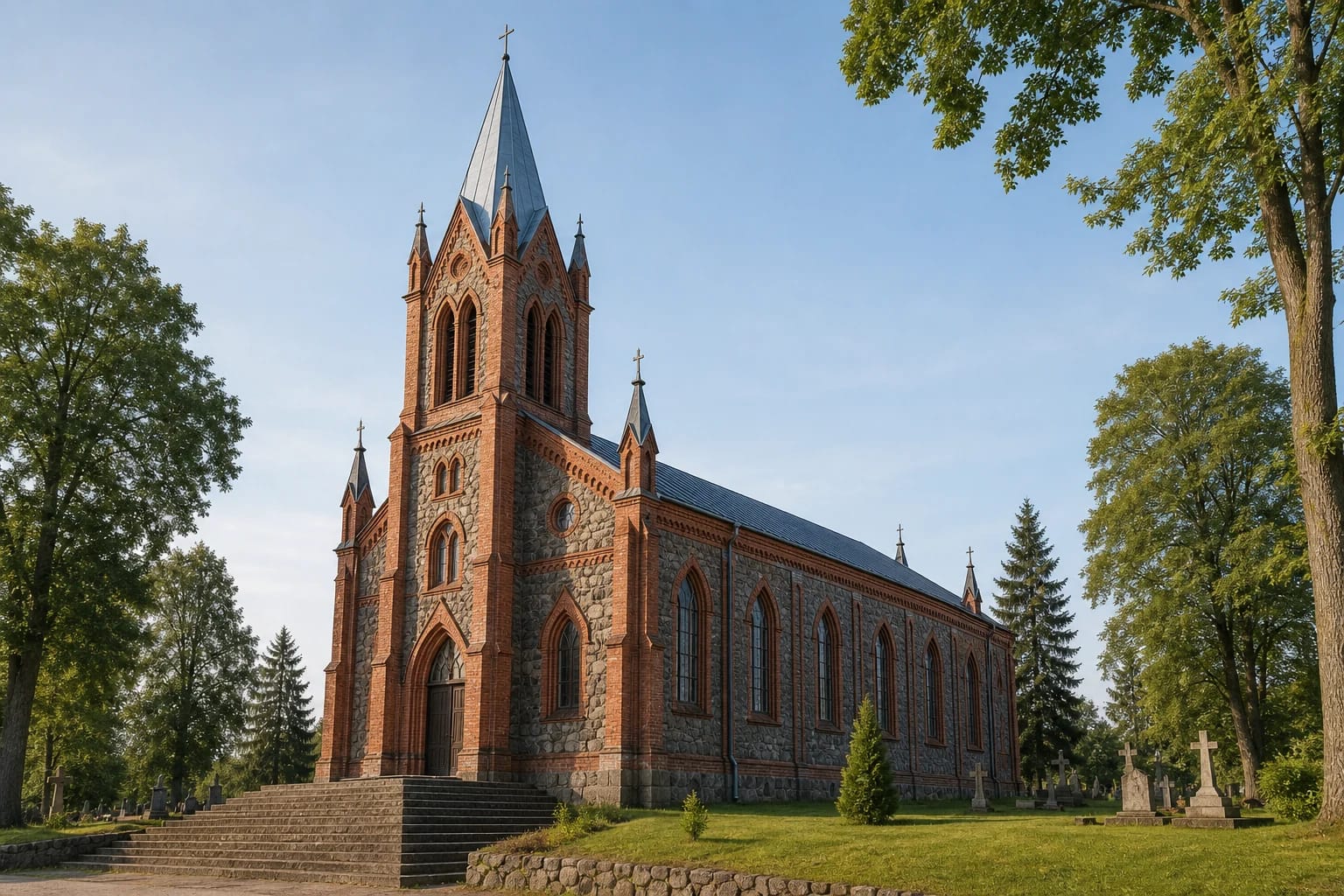
The church is defined by contrast in its materials. Large panels of irregular grey fieldstone are edged by deep red brick at the corners, openings, and horizontal bands. The repeated lancet windows and brick detailing give an otherwise weighty masonry building a distinctly vertical Gothic Revival character.
It is a rectangular, single-tower church without a strongly projecting apse. A tall central tower and steep spire dominate the principal façade, accompanied by smaller pointed pinnacles. Along the side, follow the rhythm of the high windows and miniature brick arches, which turn the fieldstone walls into a coherent architectural composition.
Mature trees and old grave markers surround the church. This is more than a photogenic setting: it remains both a religious and memorial space. Do not walk between graves simply to find a better angle, avoid touching monuments, and ask before photographing worshippers or a service.
The 1647 beginning and the Piarists in Dūkštos
Sacred use of the site is traced to 1647. The official Vilnius District culture map calls the early building the first church, built partly in masonry and partly in timber; some historical summaries call it a chapel erected by estate owner Darata Giedraitytė-Daubarienė. The safest reading is that both descriptions refer to the same early predecessor rather than two separate buildings from 1647.
By 1716, the Dūkštos sanctuary was recorded as a filial church of Maišiagala. The Dūkštos estate later passed into Piarist hands, and in 1772 the order rebuilt the deteriorating church. It maintained a school and a refuge for retired monks beside it, making the site a place of education and communal care as well as parish worship.
The school explains why a small settlement developed an ambitious religious centre. When the Vilnius Piarist monastery was closed in 1842, the old Dūkštos church remained with its congregation but was already in poor repair. A new masonry church was therefore planned in its place.
The 1850-1856 church and Moniuszko's contribution
The present masonry church was built from 1850 to 1856 to a design by architect Tomasz Tyszecki, with Piarist priest Joachim Dembiński overseeing the effort. It was consecrated in 1856. That date marks the arrival of today's building, not the beginning of worship on the site.
The Vilnius District culture map records that composer Stanisław Moniuszko contributed a substantial sum towards construction. This is a documented financial connection. It should not be stretched into claims that he designed the church, built its organ, or worked here regularly unless separate evidence is found.
Nineteenth-century writer Władysław Syrokomla expressed surprise at finding such an imposing, beautiful, and richly appointed church in a neglected small settlement. His reaction helps explain its scale today: the Gothic Revival tower and elaborate brick dressings still feel unusually ambitious for the village.
From Catholic church to Orthodox church and back
After the 1863 uprising, the Russian imperial authorities confiscated the church from Catholics. The Vilnius governor proposed transferring it to the Orthodox Church in 1867; closure was ordered in 1868, and official narratives place its Orthodox conversion across 1868-1869. The one-year variation can reflect the separate dates of the decision, consecration, and actual use.
Parishioners did not accept the loss. In 1868, a peasant named Jackus Klimas carried their petition to the tsar in St Petersburg asking for the church's return. He was arrested, as were several people who had signed the appeal. Later attempts to secure a place of Catholic worship in the cemetery chapel also failed to restore the parish church.
During the First World War, the Orthodox priest and some settlers left for Russia, and the building stood empty. In 1918 it was repaired, reconsecrated for Catholic worship, and made a parish church again. This was not a brief denominational interruption but roughly half a century of loss and eventual return for the local community.
2026 opening hours, Masses, and precise navigation
On 21 July 2026, Vilnius Archdiocese listed opening hours of 5-7 pm on Wednesday and Friday, 9-11 am on Thursday, and 9 am-noon on Saturday and Sunday. Polish-language Masses were listed at 6 pm on Wednesday and Friday, and 10 am on Thursday, Saturday, and Sunday. Schedules can change, so check the archdiocese page before a special journey.
There is no admission ticket because this is an active parish church, not a museum. For a visitor wishing to see the interior, use the published opening hours while yielding to Masses, funerals, and other rites. Broad steps lead to the main entrance, so ask the parish in advance about any step-free alternative.
Two official sources give different street addresses: the municipal culture map says Mokyklos g. 3, while Vilnius Archdiocese says Pijorų g. 1. Both describe the same church site in central Dūkštos, but the safest navigation is the exact Google Maps listing with place ID ChIJs13X8VGI3UYRMCQ5TIm3wn0. It showed 4.8 out of 5 from 186 reviews on 21 July 2026.