- Place
- Kėdainiai District Municipality
- Region
- Kaunas Region
- Type
- Bernardine monastery, church, and sacred town ensemble
- Address
- Vytauto g., Dotnuva, Kėdainiai district
- Coordinates
- 55.35090, 23.88840
Dotnuva Bernardine Monastery, Dotnuva Capuchin Monastery
Bernardine Heritage in Dotnuva
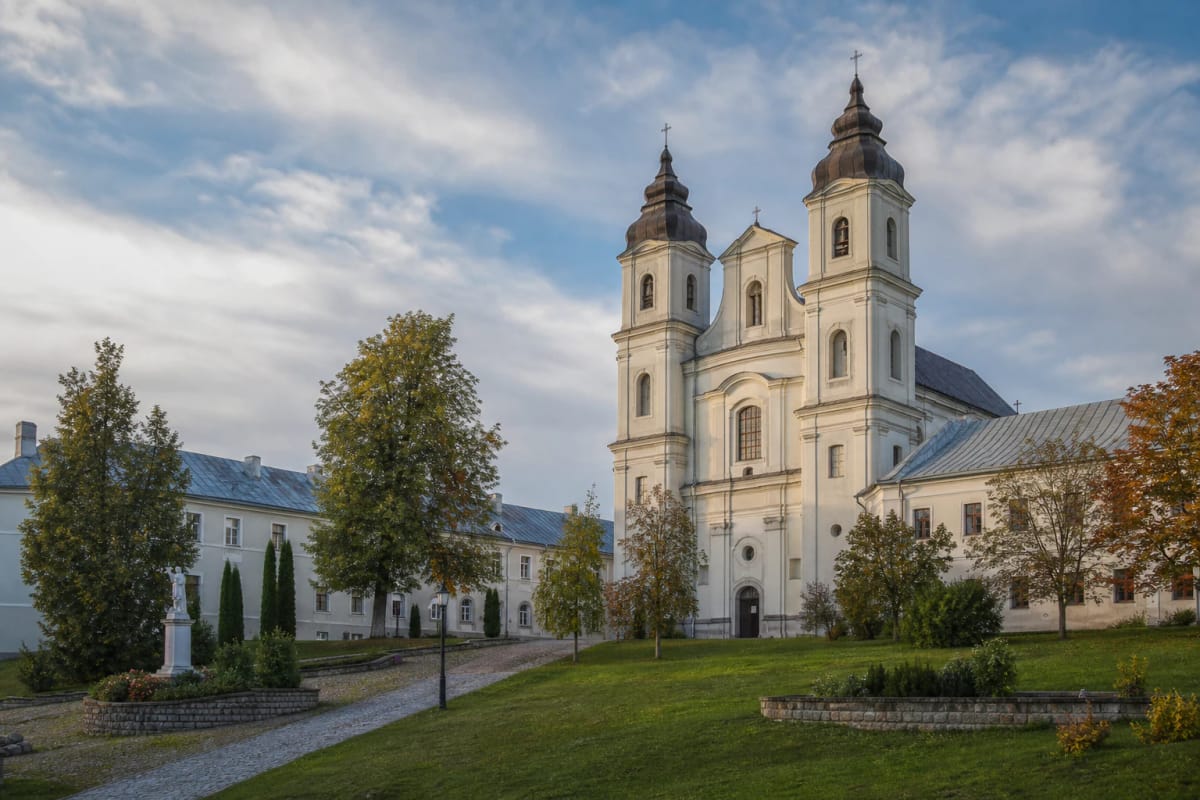
Dotnuva Monastery Ensemble is one of the town's main historical landmarks and shapes the center of Dotnuva's linear, non-urban plan. According to the Register of Cultural Property, Jonas Vladislovas Bžostovskis and Konstancija Mlečkaitė invited the Bernardines to Dotnuva in 1699, and the foundation was announced on August 16, 1701.
The church is titled the Annunciation of the Lord to the Blessed Virgin Mary. The monastery's beginning is linked with 1701; masonry buildings began rising in the second half of the eighteenth century, and the main masonry church and monastery works took place in 1773-1810. This long construction sequence means the ensemble should be read as the work of several generations.
School, Fairs, and Town Life
The monastery was not only a place of prayer but also a center of education. According to VLE, a three-class school opened beside it in 1796; in 1822 it had 276 pupils, was soon reorganized as a five-class school, and in 1803-1835 operated as a county school.
In 1777 the ruler of the Polish-Lithuanian Commonwealth, Stanisław August Poniatowski, granted Dotnuva the right to hold a weekly market and four annual fairs. The monastery thus became the axis of town life, around which spiritual, economic, and trade activity revolved.
Uprisings, Closure, and Capuchins
The Dotnuva Bernardines actively participated in the 1830-1831 and 1863-1864 uprisings. For this, Russian authorities closed the monastery school in 1835 and the monastery itself in 1864; two monks were exiled to Siberia and one was imprisoned. After the 1863 uprising, tsarist authorities severely restricted monastery activity in general.
At the end of the twentieth century the ensemble gained a new spiritual layer. In 1990 a Capuchin monastery was established in the former Bernardine monastery, and it was restored and renovation began under Tėvas Stanislovas (Algirdas Mykolas Dobrovolskis), who became Capuchin guardian. The place is therefore important both for early monastery history and for the renewal of Lithuanian religious life in recent times.
What to Look For
First observe the relationship between the church, monastery, and town space. The ensemble forms the center of Dotnuva, so it is best understood by walking around the buildings and reading their scale and relationship to the town street network.
If the church is open, it is worth entering, but this is an active sacred and monastic site. Respect services, silence, and the rhythm of the local community.
Practical Visiting
The Register of Cultural Property does not provide standard museum opening hours or tickets, because this is a sacred ensemble with an active monastery. Interior visits, tours, or groups should be arranged with the local parish or Capuchin community.
A short stop can take 45 minutes, but if you plan the interior, prayer, or a conversation with the local community, allow more time. Dotnuva combines well with nearby Paberžė and other Kėdainiai-region sites.