- Place
- Gadūnavas, Telšiai District Municipality
- Region
- Samogitia
- Type
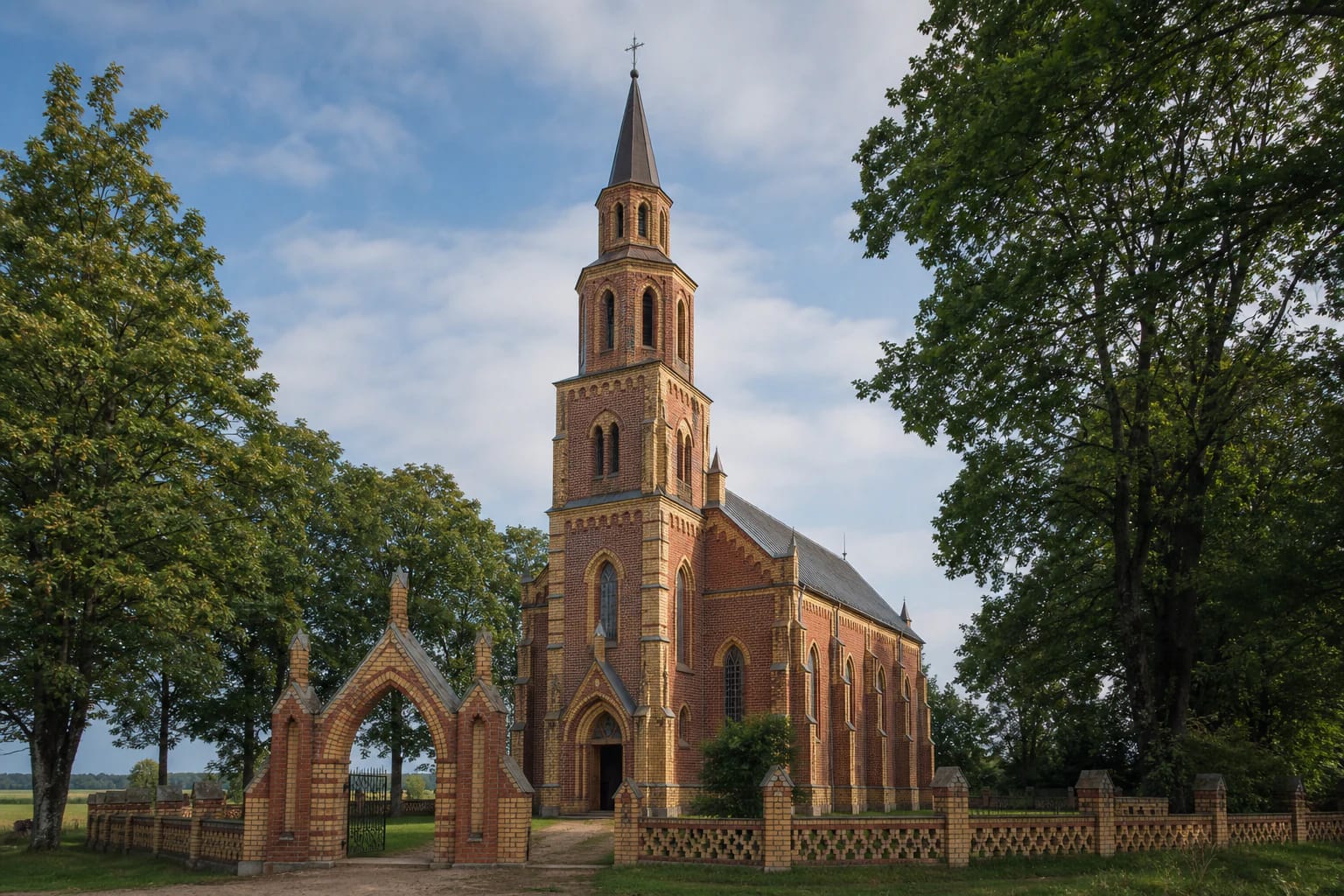
- three-aisled, single-tower Gothic Revival church completed in 1901, with two-tone brickwork, coordinated interior fittings, and a masonry gateway
- Address
- 31 Bažnyčios Street, Gadūnavas, Telšiai District
- Coordinates
- 56.06560, 22.21505
- Visit duration
- 25-40 minutes for the exterior and churchyard; around 45-60 minutes if the church is open and the interior can be viewed quietly
- Best time
- before or after the 14:00 Sunday Mass once the official schedule has been checked; soft side light best reveals the two-tone masonry
Gadūnavas Church, Sacred Heart Church in Gadūnavas, Gadūnavo Švč. Jėzaus Širdies bažnyčia
A multi-stage tower unlike a conventional Gothic Revival spire
A single tower of unusually complex composition controls the silhouette of Gadūnavas Church. Its lower section is rectangular, the volume becomes octagonal higher up, and a narrower top stage resembles the turret of a Romantic castle. This systematic change of form makes the tower recognisable even among Lithuania's many single-tower churches of the late nineteenth century.
Two shades of brick give the building another rare quality. The contrasting masonry does not disguise the structure; it emphasises portals, surrounds, and the divisions of the façade. The large pointed main portal is repeated at a smaller scale in side entrances, while pinnacles rise above portals, gables, the tower, and buttresses.
The church has no true transept. Small projections with restrained gables merely suggest one along the sides of its rectangular plan. Walk around the churchyard to understand this feature, the rhythm of the side elevations, and the masonry gate composed to match the church.
The church completed in 1901 grew from the place around which the town itself formed
The histories of Gadūnavas settlement and its church are inseparable. VLE records that Jurgis Gadonas built a church beside the village of Degeniai in 1783. The settlement that grew around it adopted its founder's name and became Gadūnavas. The sacred site was therefore not an addition to an established town but one of the reasons the place developed.
The present masonry church was completed in 1901, as brick Gothic Revival spread rapidly through Lithuania. It replaced the earlier timber sanctuary but preserved the same religious centre. Gadūnavas is especially rewarding because a common period style was not reduced to a stock design: the architect created an unusual tower and a carefully articulated two-tone exterior.
According to VLE, Gadūnavas was a local administrative centre from the second half of the nineteenth century until 1914. The substantial church therefore reflects not only parish ambition but an era when today's small settlement held greater importance for the surrounding district.
Inside, Gothic Revival is coordinated from vaults to confessionals
The interior has three aisles. Octagonal piers divide them and support cross vaults articulated by ribs. This union of structure and decoration continues the vertical Gothic Revival logic outside, so the space reads as a single architectural conception rather than a neutral shell filled with later furniture.
Architectural researchers stress that almost every fitting was coordinated with the building: Gothic Revival altars, pulpit, confessionals, and smaller details. The high altar stands beneath a canopy. Its carving and scale reward slow observation, but only when doors are open and a visit does not disturb the liturgy.
The Diocese of Telšiai states that the church is undergoing renewal: granite floors have been laid, electrical wiring replaced, and interior work begun. This information will change as the project advances. Do not touch altars, pulpit, or other heritage objects, and respect any barriers on site.
An old Nativity scene preserves traces of unidentified local makers
A Lithuanian Museum of Education exhibition documents early twentieth-century wooden Nativity figures kept at Gadūnavas Church. The old set is incomplete and no longer used in the liturgical display, yet its survival reveals a layer of local sacred art quite different from the professionally coordinated Gothic Revival fittings.
The makers are unknown. Museum researchers observed that visible body parts were carved most carefully, while areas hidden beneath textiles received simpler treatment. The detail reveals a practical approach to folk sculpture: makers concentrated their skill on what a viewer would actually see in the Nativity scene.
This is not a permanently accessible museum exhibit with guaranteed viewing. Do not plan a journey on the assumption that the figures will be on display, and never enter storage areas. The Lithuanian Museum of Education's digital exhibition is the reliable way to study their history.
Sunday Mass offers the most reliable chance to find the interior open
On 27 July 2026, the Diocese of Telšiai listed Sunday Mass in Gadūnavas at 14:00, with confessions half an hour beforehand. The Feast of the Sacred Heart of Jesus is celebrated on the final Sunday of June. Check the official parish page before travelling because schedules and unlocked-door periods can change.
No visitor ticket or regular tour timetable is published. The exterior and gateway can be viewed from lawful public access, but the interior may be locked outside worship. Contact the parish in advance for a group, photography, or a specially arranged visit.
The Google Maps listing showed 4.8 out of 5 from 53 reviews on 27 July 2026. The coordinates mark the church site itself rather than the general centre of Gadūnavas. Park without blocking the gateway, and never photograph worshippers during a service without their consent.