- Place
- Joniškis District Municipality
- Region
- Joniškis District
- Type
- single-towered Historicist church substantially rebuilt in 1893-1901, incorporating an older masonry sanctuary and retaining seven altars and relics of St Martinian
- Address
- 2 Bažnyčios Street, Joniškis
- Coordinates
- 56.24149, 23.61666
- Visit duration
- 40-60 minutes for the church and churchyard; 2-3 hours together with the synagogues, town square, and Joniškis museums
- Best time
- daylight for the architecture and churchyard; for the interior, arrive before or after a listed Mass and check parish information in advance
Joniškis Assumption Church, Joniškis Church, Joniškio Švč. Mergelės Marijos Ėmimo į dangų bažnyčia
The official title distinguishes the city church from a different church in another Joniškis
The Register of Cultural Property gives the full Lithuanian name Joniškio Švč. Mergelės Marijos Ėmimo į dangų bažnyčia, meaning the Church of the Assumption of the Blessed Virgin Mary in Joniškis. The Diocese of Šiauliai abbreviates the same dedication in its parish listing. This is the church in the town of Joniškis, not the Church of St James the Apostle in Joniškis, Molėtai District, and the Annunciation title occasionally found on unofficial maps is incorrect.
The parish publishes the current address as 2 Bažnyčios Street, while the heritage register retains 10 Miesto Square for the protected plot. Both records describe the same church and churchyard from different sides of the town centre. Coordinates 56.241491, 23.616655 come from the geometry of the KVR protected site and mark the monument itself, not a parking bay.
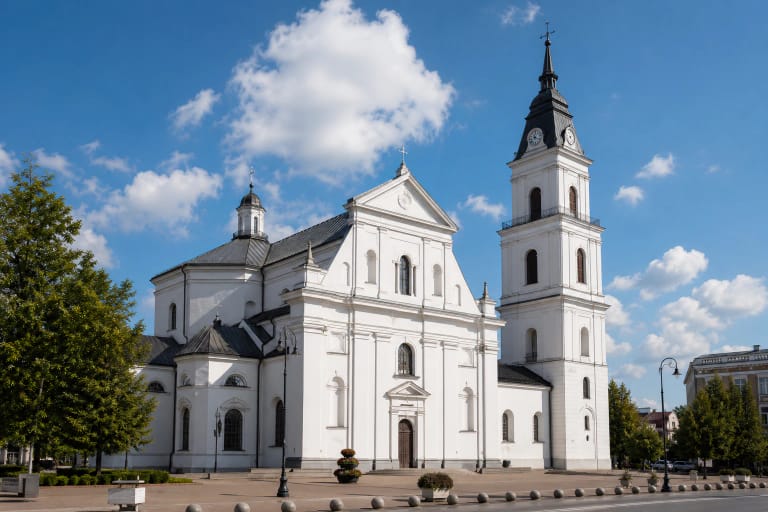
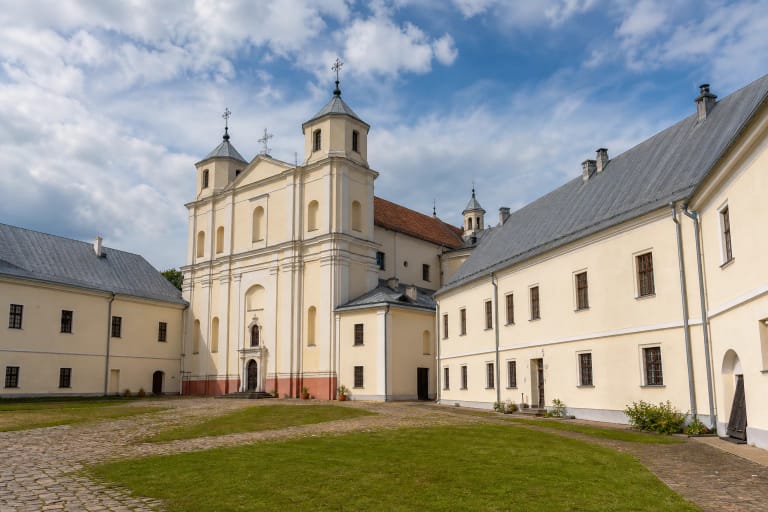
This is an active parish church rather than a museum operating identical hours every day. The high tower is easy to see from the square, but the exterior makes more sense after a walk around the churchyard, where the transept, apse, sculpted niches, and proportions of the sole western tower come into view.
The dates 1526 and 1536 describe different beginnings, while the first masonry church followed in the early 17th century
The story begins in 1526, when the first church was built in the area. Documents from 1536 formally confirmed the church and parish, so the two dates used by sources are complementary rather than contradictory. A school was already recorded beside the church in 1530, showing that the young parish quickly became a centre of local education as well as worship.
The centre shifted after late 16th-century fires, and a masonry church built in 1601-1605 became the predecessor incorporated into the present sanctuary. Swedish forces damaged it in 1655-1656, and repairs followed in the first half of the 18th century. This is the church's older physical layer and should not be confused with the exterior created at the end of the 19th century.
A town fire devastated the church in 1748, after which it was rebuilt in 1749-1755. Another fire caused damage in 1788, followed by repairs in the early 19th century, 1837, 1847-1853, and 1867. This sequence explains why the monument cannot be reduced to a single building campaign.
The 1893-1901 reconstruction created today's silhouette, but its authorship is not a one-man story
The heritage register dates the decisive rebuilding to 1893-1901, while VLE gives 1895-1901 for the principal construction phase. Parish priest Liudvikas Šiaučiūnas drove the project. Joniškis District Municipality marks 125 years since completion in 1901 during 2026, making that the clearest date for the finished exterior massing.
KVR's construction history names Liepāja-born architect Karl Eduard Strandmann and architect-engineer Piotr Serbinowicz. VLE phrases Strandmann's attribution more cautiously, as probable and shared with others. It is therefore more accurate to acknowledge both specialists and local building supervision than to credit the entire church to one author.
Some local accounts extend the work to 1905 or 1906. The difference becomes understandable when the completion of the reconstructed building is separated from later altars, painting, and interior fitting. Further campaigns repaired the church in 1933-1935, 1946-1952, 1963-1971, 1981-1983, and 1999-2001.
One 59.83-metre tower, a cruciform plan, and three clocks installed in 2017 define the Historicist design
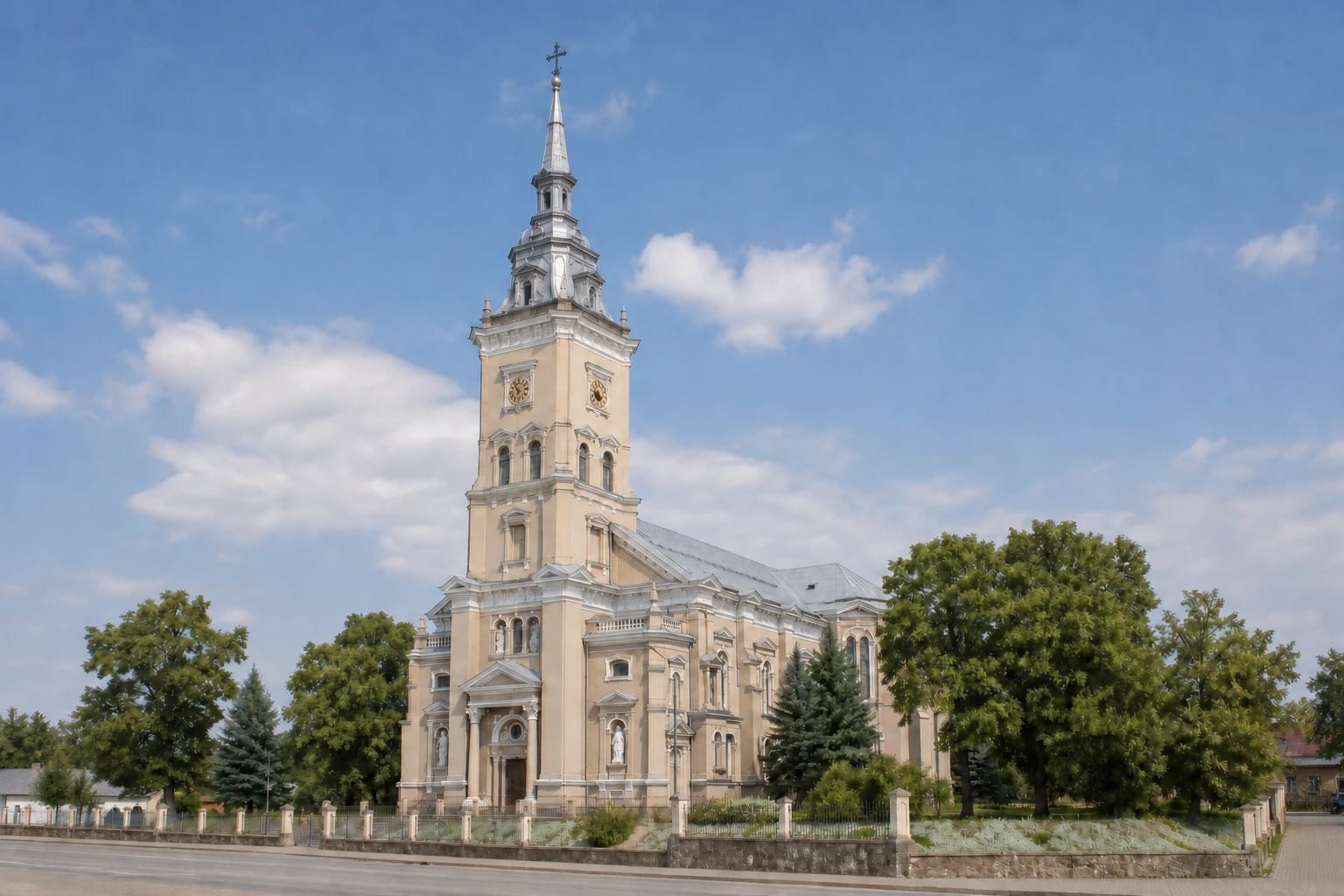
Joniškis Church has one tower, not a twin-towered façade. Its three-aisled hall follows a Latin-cross plan, with a transept, semicircular apse, north chapel, south sacristy, and masonry dome above the crossing. A square, three-stage western tower crowned by a helmet, spire, and cross rises to 59.83 metres.
Dressed fieldstone forms the foundation and plinth, while ceramic-brick walls are rendered. Timber trusses support the roofs. Cross and barrel vaults cover different interior zones around the masonry dome. Grey sheet-metal roofs, warm-toned render, and pale trim articulate a complex silhouette still governed by a single vertical tower.
Sculptures occupy niches across the façades, and KVR attributes many of them to Vincentas Jakševičius. Painted religious compositions survive on the tower and apse. Three mechanical clocks, illuminated at night, were installed on the town-facing sides of the tower in 2017; they strike the hour and finally filled circular recesses prepared when the building was reconstructed.
Seven altars, relics of St Martinian, and a painting by Adomas Varnas reward close attention
An ensemble of seven Neo-Baroque altars took shape around 1905. KVR individually protects the high Crucifixion altar and altars dedicated to the Heart of the Virgin Mary, Sacred Heart of Jesus, Assumption of the Virgin, and St Martinian, together with the chapel altar, pulpit, and font bearing a relief of the Baptism of Christ. Colourful Mettlach floor tiles complement the rhythm of painted walls and rendered vaults.
Relics of St Martinian, a metal-clad devotional image, and votive offerings testify to a long local cult. Martinian is not St Martin of Tours: he is a distinct Roman martyr associated with the Joniškis altar and relic tradition. Also look for Adomas Varnas' Guardian Angel, painted around 1930, and early 20th-century scenes from the life of Christ across the interior walls.
Four 18th-century brass bells dated 1767, 1789, 1791, and 1797 are recorded at the church. Joniškis Public Library associates the large organ with the Liepāja builder Carl Hermann. Not every object can be seen from every public area, and neither the organ gallery nor the tower is automatically open for unaccompanied visits.
Mass times help with planning, but they are not guaranteed sightseeing hours
On 20 July 2026, the Diocese of Šiauliai listed Sunday Mass at 10:00 and 12:00. Saturday services were shown at 10:00 and 17:00 in winter or 18:00 in summer. On other weekdays, morning Mass is at 9:00 except Monday, with evening Mass at 17:00 in winter or 18:00 in summer. The diocesan page does not define the exact seasonal boundary, and feast-day arrangements can differ, so check the official listing before travelling.
No separate tourist opening hours or admission charge are published. This usually means that a quiet visit to an open church has no ticket, not that its doors are guaranteed to remain unlocked all day. For a group, dependable access, or a special visit, call the parish at +370 426 52644 or +370 686 02083; donations and arranged services should not be confused with an admission ticket.
Official local visitor information marks the church as adapted for people with mobility impairments, but this research could not verify the precise accessible door, thresholds, or toilet provision, so confirm individual requirements by phone. Park only where signs around the square and adjoining streets permit. During Mass, avoid flash photography and movement through the nave; ask before close photography of altars, relics, worshippers, or ceremonies.