- Place
- Kaunas City Municipality
- Region
- Kaunas
- Type
- interwar administrative palace with an occupation-memory layer
- Address
- Vytauto pr. 91, Kaunas
- Coordinates
- 54.89722, 23.92494
Former Kaunas County Municipality Palace, Building in Kaunas, Vytauto pr. 91, Former Chief Police Commissariat, Former Kaunas County Municipality Palace
One of the great administrative palaces
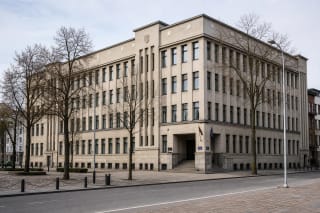
Kaunas County Municipality Palace stands at Vytauto pr. 91, near the eastern part of Laisvės aleja and the direction of the railway station. AUTC presents it as one of the largest administrative buildings erected in Lithuania during the interwar years. Its scale alone shows that this was not an ordinary office house.
In interwar Kaunas, administration had to inhabit buildings that spoke of state order, professionalism, and permanence. This palace did exactly that: it was large, restrained, materially expensive, and clearly adapted for several institutions.
What operated here in the interwar period
AUTC and the Cultural Heritage Register state that the building housed the Kaunas county board, the office of the Kaunas city and county governor, the Kaunas city and county police commander, and the State Security Department. It was an administrative node where local government, police, and state security met.
The basement held institutional archives, courier apartments, the boiler room, and other technical spaces. In the courtyard stood a two-storey garage with drivers' apartments and a printing house. This programme shows that the building functioned as a self-contained administrative mechanism, not only as a beautiful facade.
Architect and dates
AUTC dates the building to 1932-1934, while the register text emphasizes a 1933 construction moment. In VLE's article on Vytautas Landsbergis-Žemkalnis, the County Municipality Palace is listed among his Kaunas projects.
The register names engineer-architect Vytautas Landsbergis-Žemkalnis as project author and Anatolijus Rozenbliumas as structural engineer. This is an important combination: architectural representation here works with modern structural logic, not only facade finish.
Representative facade
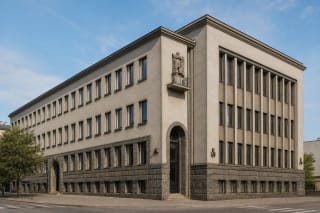
The main impression comes from contrast. AUTC mentions a natural dark-grey granite plinth and stairs, black polished labradorite portals, dark artificial-granite pilasters, and light granite facades. These materials create an official, almost bank-like solidity.
The register specifies that the facades preserve two-colour granite-render finish, grey granite plinth facing, black polished labradorite portal slabs, and profiled granite stairs. This is not decoration for its own sake. The materials were meant to emphasize the seriousness of administration.
Modernism without lightness
The building has functionalist and modernist features, but it is not light or playful. Four floors with attic and semi-basement, wings joined at a right angle, central projections, a strong cornice, and dense window rhythm create a firm official city corner.
AUTC notes that even more representativeness was considered: large stairs from the Laisvės aleja side were proposed in place of the pavement. The Kaunas City Municipality Construction Commission rejected the idea because it would not have suited the layout of Laisvės aleja. The result is a more restrained but still highly monumental version.
Modern construction
AUTC emphasizes that the building was modern not only in appearance but also in construction. Although built of brick, some internal load-bearing walls were replaced by a reinforced-concrete frame structure, and iron columns were installed in important places in the exterior walls.
The register also lists ceramic-brick masonry walls strengthened by reinforced-concrete frames and steel uprights, as well as reinforced-concrete floors. This matters because the building did not stop at a modern look; its structure was adapted for large administrative use.
Interior details
Although visitors can most reliably access the exterior, the register shows that the building's value continues inside. It mentions mosaic-concrete stairs, ornamented metal railings, profiled wooden handrails, revolving doors, parquet, relief geometric ceiling decoration, and rounded ceiling coves.
These are details of interwar administrative comfort. The plan was corridor-based and practical, but the representative nodes were carefully considered through materials, proportions, and technology. Even after later repairs changed some elements, the register still records a surviving interwar layer.
Soviet security memory
This building should not be visited only as a modernism object. The register states that in 1940-1941 and 1944-1991 the building belonged to Soviet state security structures. Here people resisting the occupation were imprisoned, interrogated, tortured, and killed, and the genocide of Lithuanian residents was planned and carried out.
A memorial plaque on the southern wing facade, mentioned in the register's valuable features, recalls this layer. When stopping at the palace, give time not only to the facade proportions but also to the memorial message. Here the ambition of a modernist state meets the violence of occupations.
Current use
OSM still marks the object as the Kaunas County Chief Police Commissariat, and VLE's biographical list also links the building with later chief police commissariat use. However, the official Kaunas County Police website currently lists the institution's address as Radvilėnų pl. 1C.
For this page, the most accurate presentation is as the former Kaunas County Municipality Palace and a building later used by police and security structures. Do not infer current interior access or institutional function from older map labels.
UNESCO modernism context
The palace lies in the modernist heritage environment of Kaunas Naujamiestis, related to the UNESCO World Heritage property Modernist Kaunas: Architecture of Optimism, 1919-1939. The register also states that the object is within the Kaunas city historical part called Naujamiestis.
The most accurate wording is that this is a building in the urban context of Kaunas modernism, not a separately inscribed UNESCO object. Its significance in that context is the infrastructure of the administrative capital, the monumental scale of public authority, and later transformation into a memory site.
How to view it
Begin from the corner so both wings and their relationship with Vytauto prospektas and the approaches to Laisvės aleja are visible. Then walk along the facade and look separately at the dark portals, plinth, vertical window rhythm, projections, and cornice.
This is a short but important stop on a Kaunas modernism route. If you walk from the station toward the centre, the palace is one of the first signs that you are entering the interwar administrative axis of Naujamiestis. If you come from Vienybės Square, it closes the chain of Donelaičio and Laisvės aleja institutions on a heavier note of memory.