- Place
- Klaipėda City Municipality
- Region
- Klaipėda
- Type
- working 1855 hand-operated pedestrian swing bridge and industrial heritage structure
- Address
- Žvejų g. 22, Klaipėda
- Coordinates
- 55.70673, 21.12679
- Visit duration
- 10-20 minutes; longer with the castle site and harbour walk
- Best time
- daylight year-round; check temporary arrangements before major events or vessel movements
Chain Bridge, Grandinių tiltas, Kettenbrücke, Swing Bridge, Castle Harbour swing bridge
One bridge, several names
The bridge stands at Žvejų g. 22 over the narrow cut connecting the Danė with the former Klaipėda Castle moat and today's Castle Harbour. It is the small pedestrian bridge beside the castle site, not Biržos Bridge across the Danė, the large Pilies Street bascule bridge, or a modern footbridge.
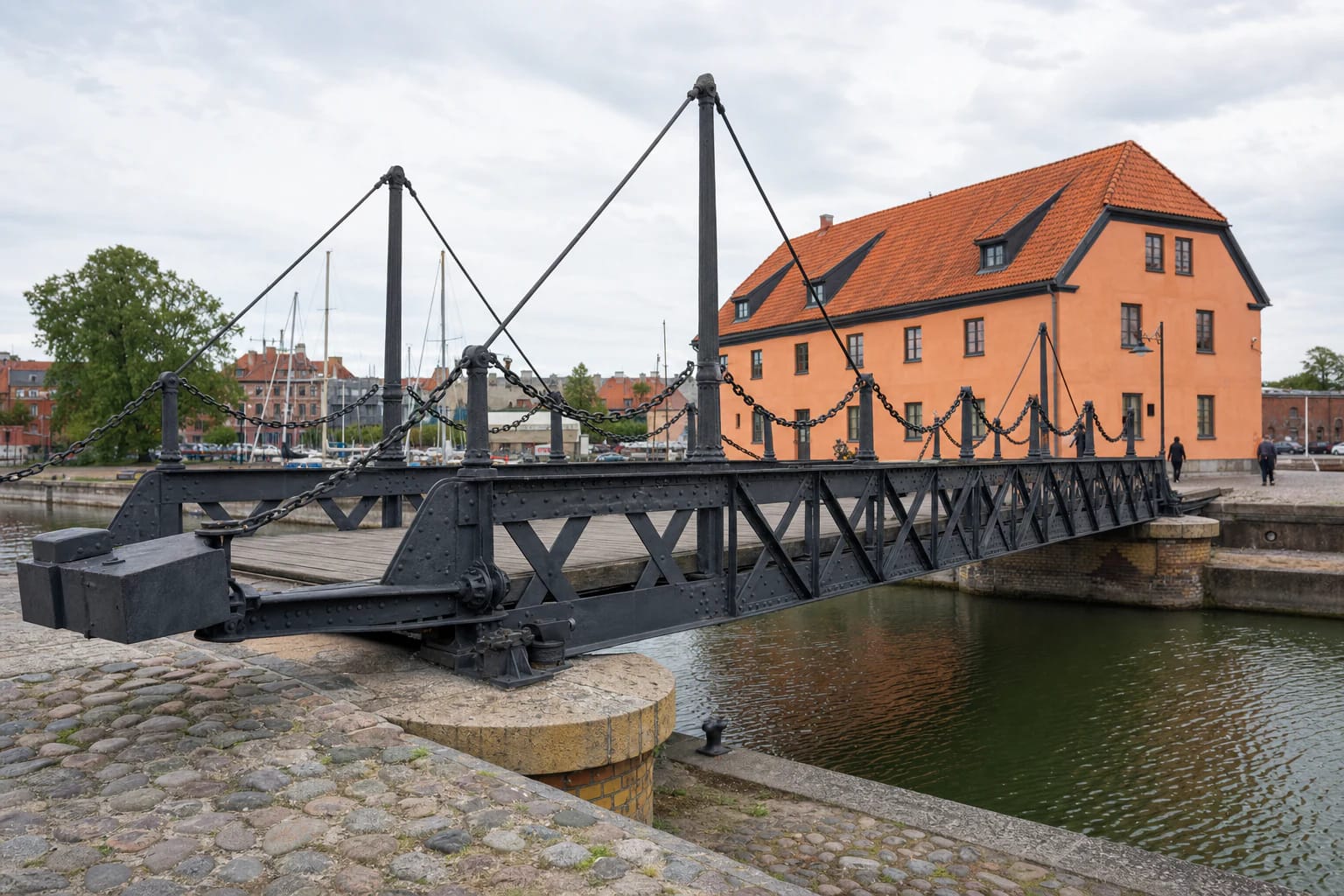
The assigned Google Maps card uses the English name Chain Bridge. That is not a separate nearby object but a historic name for this same bridge. Chains decorate its riveted-iron structure, so before the Second World War it was called Grandinių tiltas in Lithuanian and Kettenbrücke in German.
From the castle moat to the 1855 iron bridge
The Cultural Heritage Register records that in the second half of the eighteenth century the castle ditches, no longer needed for defence, began to carry boats and timber. A narrow channel was dug with funding from merchant Johann Gottlieb Graun, and a wooden pedestrian bridge crossed it in 1809. In 1839 that crossing became a lifting structure worked by chains and levers.
The present metal swing bridge was installed in 1855. The register does not name its original designer or manufacturer. The structure was restored in 2008-2010 while retaining its working technical principle; KVR identifies the individual company of Povilas Ramonas as the conservation-project author.
How the hand-operated mechanism works
KVR gives exact dimensions of 21.05 m long, 4.37 m wide, and 2.67 m high. Two connected riveted wrought-iron trusses form the load-bearing structure. The pivot divides the bridge into a 16.19 m long arm and a 4.92 m short arm fitted with a ballast counterweight. The deck was reconstructed in oak, while cast-iron columns and metal stays support the cantilever.
Above the western support, a bearing, vertical pivot, pinion, and rack form the turning mechanism. A T-shaped key works the rack by human power; official Klaipėda information says two people turn the bridge. In its 2025 condition record, KVR rates different mechanism elements from poor to satisfactory, so a scheduled turn or demonstration should never be assumed.
Working Castle Harbour infrastructure
Klaipėda's tourism information centre lists the site as accessible around the clock, but that describes an open-air place rather than guaranteeing a connected pedestrian crossing at every moment. When the long arm swings away from the eastern support, the channel opens to vessels and pedestrians cannot cross. Vessel movements, maintenance, barriers, and event safety plans can all change the bridge's position.
For the 2026 Sea Festival, the organiser has published a special arrangement for July 25 and 26. The bridge follows its usual schedule from 09:00 to 18:00, then remains positioned for pedestrians from 18:00 to 01:00 except for a planned vessel opening from 21:00 to 21:15. This applies only on those event dates and is not a general seasonal timetable.
Check the object name when looking for updates. Notices about lifting Pilies Bridge or Biržos Bridge concern other Klaipėda crossings and do not confirm the position of this small swing bridge.
How to look and cross safely
Before stepping onto the bridge, make sure its long arm is fully seated on the eastern support, the pedestrian barriers are open, and operators are not beginning work. While it moves, stay behind barriers, never jump onto the span, and keep clear of the pivot, rack, supports, and gaps beside the quay. These areas present pinch and fall hazards.
The oak boards and cobbles can be slippery after rain, and chain railings are not a solid wall. Walk bicycles, keep children close, and assess surface joints and operational barriers on site if using wheels or a mobility aid. If the bridge is turned or closed, use another public pedestrian route and wait only outside the marked work area.