- Place
- Kėdainiai, Kėdainiai District Municipality
- Region
- Aukštaitija
- Type
- active secondary school in the historic complex of a seventeenth-century Protestant higher school
- Address
- 62 Didžioji Street, Kėdainiai
- Coordinates
- 55.28825, 23.97614
- Visit duration
- 15-30 minutes for the facades; about 45-60 minutes only when access to the courtyard or historic interior has been arranged
- Best time
- in daylight for the exterior; arrange any interior visit with the school outside lessons and examinations
Gymnasium Illustre, Šviesioji Gymnasium, Kėdainiai Gymnasium, Kėdainiai Reformed School
This is a working school, not an open-access historic museum
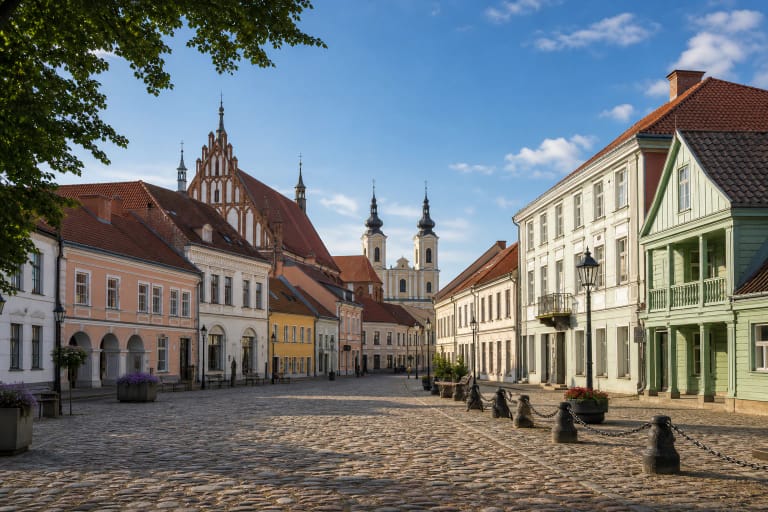
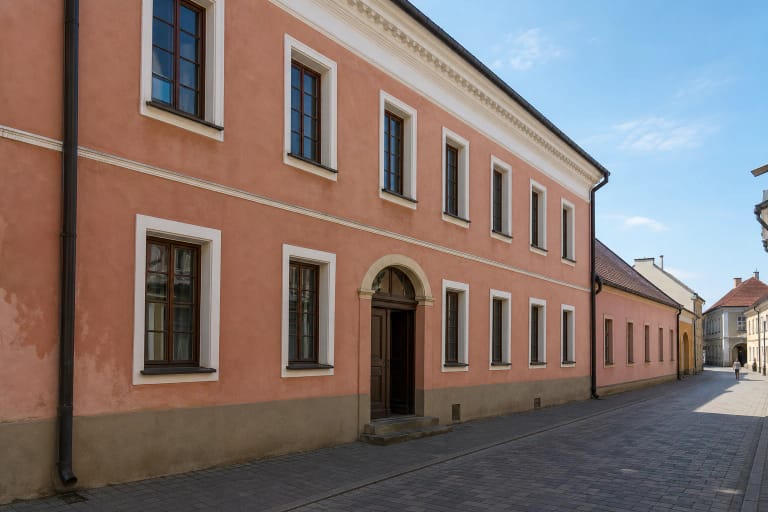
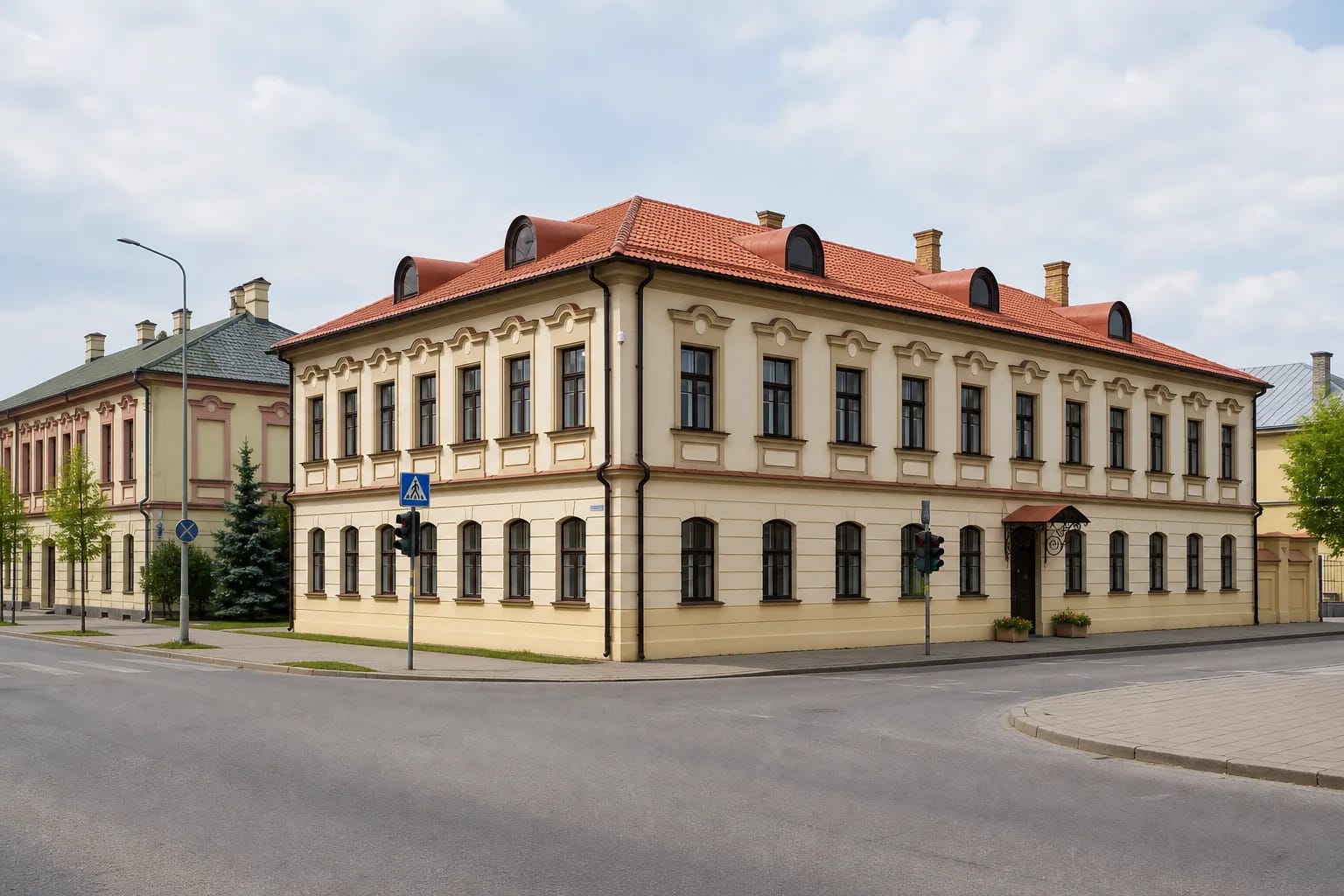
Šviesioji Gymnasium occupies the corner of Didžioji and Josvainių streets in Kėdainiai Old Town. Its street facades can be viewed from public pavements, but the classrooms, cellars, and arcaded courtyard belong to the school's internal grounds. No permanent tourist timetable or general visitor ticket could be found on 18 July 2026.
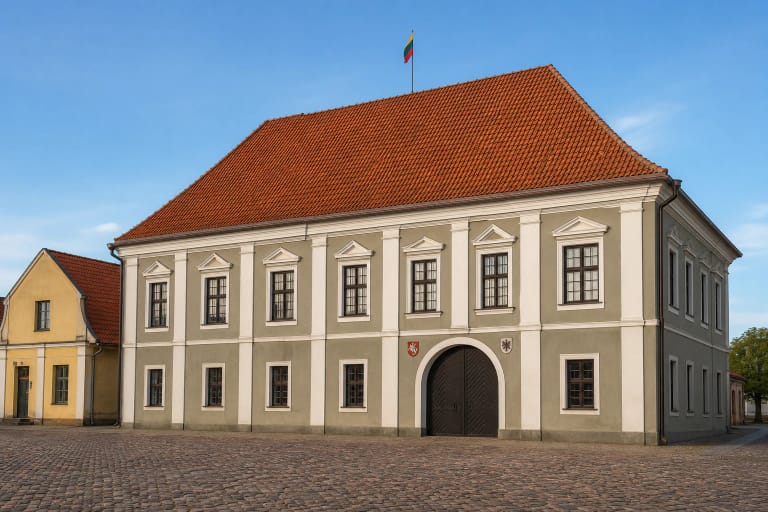
From the street, look for the long, muted-yellow two-storey facades, their rhythm of tall windows and decorative plaster surrounds, the red roof, and the principal entrance at the corner. The most important interior feature cannot be seen from the junction: a two-level arcaded courtyard covered after restoration. An exterior photograph therefore shows only part of the historic complex.
The map pin marks the historic school building itself, not a visitor entrance or car park. Minors study here and lessons and examinations take place throughout the academic year. Anyone hoping to enter the courtyard or cellars must contact the administration in advance and follow the access rules in force that day.
A parish school founded in 1625 became a Gymnasium Illustre in 1647
Krzysztof II Radziwiłł founded an Evangelical Reformed parish school in Kėdainiai in 1625. When the Reformed school in Vilnius was closed in 1640, Kėdainiai became the most important Protestant school in the Grand Duchy of Lithuania. Janusz II Radziwiłł reorganised it in 1647 as a Latin humanist gymnasium known as the Šviesioji, or Gymnasium Illustre.
The institution and its building do not share one simple founding date. The school's official chronology says it moved to Didžioji Street in 1631, when reconstruction began on the former house of mayor Petras Zigmuntavičius Skominas. The school library's history associates the new gymnasium building with 1652. It is therefore clearest to treat 1625 as the institution's foundation, 1647 as its elevation, and the mid-seventeenth-century dates as stages in creating the complex.
Teachers came from Kėdainiai and other parts of Europe. They included the philosopher Adam Rassius, the physician, philosopher, and fortification specialist Adam Freytag, and the Lithuanian writer Steponas Jaugelis Telega. Pupils studied Latin, Greek, Polish, German, French, Hebrew, and other languages. Latin and Polish served as principal teaching languages, with Lithuanian also used for explanations.
The cellar press made Kėdainiai a centre of Lithuanian book culture
At Janusz Radziwiłł's invitation, the printer Joachim Georg Rhete came from Danzig, modern Gdańsk, to Kėdainiai in 1651. His press operated in the gymnasium's vaulted cellars from 1651 to 1655. It was not an accidental school workshop, but part of a Radziwiłł plan to combine a Reformed church, an advanced school, and a publishing centre in one town.
In 1653 the press produced 'Knyga nobažnystės krikščioniškos', commonly rendered in English as the 'Book of Christian Piety'. The volume was prepared by Samuelis Tamošauskas, Samuelis Minvydas, Jonas Božimovskis the Elder, and Steponas Jaugelis Telega, all connected with the gymnasium. The school's history describes it as a 682-page publication and the only seventeenth-century Lithuanian book printed somewhere other than Vilnius or Königsberg.
Visitors should not expect an original seventeenth-century printing press to remain in place. The vaulted cellars and their documented use identify the historic setting, while surviving books and printing artefacts belong to library and museum collections. The site of production must be distinguished from a reconstructed print shop or an exhibition of original volumes.
Wars, imperial repression, and two armies repeatedly displaced the school
The gymnasium closed when war with Sweden began in 1655 and reopened in 1661. It came under Vilnius University in 1803, but the imperial Russian authorities closed it for ten years in 1824 after links between pupils and the Philomath and Filaret circles were uncovered. Following later reforms, it again functioned as a gymnasium in the mid-nineteenth century.
After the 1863 uprising the school was closed once more and the buildings were assigned to the Russian imperial army. Sources disagree by one year: the school's official chronology gives 1864, while AUTC records an imperial order dated 15 June 1865. Both support the same sequence of suppression followed by military use.
Kėdainiai Gymnasium was restored in 1922, but in 1937 it moved to a modern building beside the town park. That newer school was destroyed in 1944. The Soviet army occupied the old Didžioji Street complex from 1944 until 1991, leaving today's building as a witness both to a long educational tradition and to two separate periods of military occupation.
Restoration in 2000-2002 returned the school and enclosed the arcaded court
The historic buildings were restored in 2000-2002. The gymnasium returned in 2002 and adopted the Šviesioji name. Cultural Heritage Department documentation from 2025 identifies the protected complex under cultural-property code 1400. The project retained historic volumes and facade elements while adapting the old structure for modern teaching.
Its most memorable internal space is the courtyard, where two levels of galleries open through arches inspired by Renaissance forms. A glass roof now turns the court into a bright school atrium. That enclosure belongs to the modern restoration and adaptation, however; it should not be described as a surviving seventeenth-century glass structure.
Vaulted cellars recall the printing years, while the exterior reflects later rebuilding as well as the original school. Calling the whole complex pure Renaissance would flatten its history. It changed between the seventeenth and nineteenth centuries, was adapted for military use, and was restored for education at the start of the twenty-first century. Its significance lies in those surviving layers together.
How to include the gymnasium in a Kėdainiai Old Town walk
For a short stop, follow the public pavements along the Didžioji and Josvainių street facades. Notice the corner entrance, decorative window surrounds, and roofline. Traffic moves through the junction, so compose photographs from the pavement rather than stepping into the road for a wider view.
If the school announces a guided tour, open day, or public event, allow another 30-45 minutes for the courtyard and the printing story in the cellars. At other times, do not follow pupils through controlled doors or ask for an unplanned tour during lessons. Check the official school website or make arrangements with the administration before travelling.
Accessibility is likely to vary between parts of the historic complex. Pavements beside much of the exterior are level, but no reliable audit covering every interior room, cellar, and gallery was found. The route continues easily on foot to Kėdainiai Regional Museum, the town hall, Great Market Square, and Old Market Square.