- Place
- Kelmė, Kelmė District Municipality
- Region
- Samogitia
- Type
- Neo-Gothic three-nave masonry church on a Latin-cross plan with one facade tower
- Address
- 18 S. Nėries Street, Kelmė
- Coordinates
- 55.63372, 22.93263
- Visit duration
- 30-45 minutes; longer for Mass or an arranged interior visit
- Best time
- before an officially announced Mass or afterwards, when parish activity will not be disturbed; check a separate programme for the Feast of the Assumption
Kelmė Church, Kelmė Assumption Church
A red-brick sanctuary in central Kelmė, not the town's Reformed church
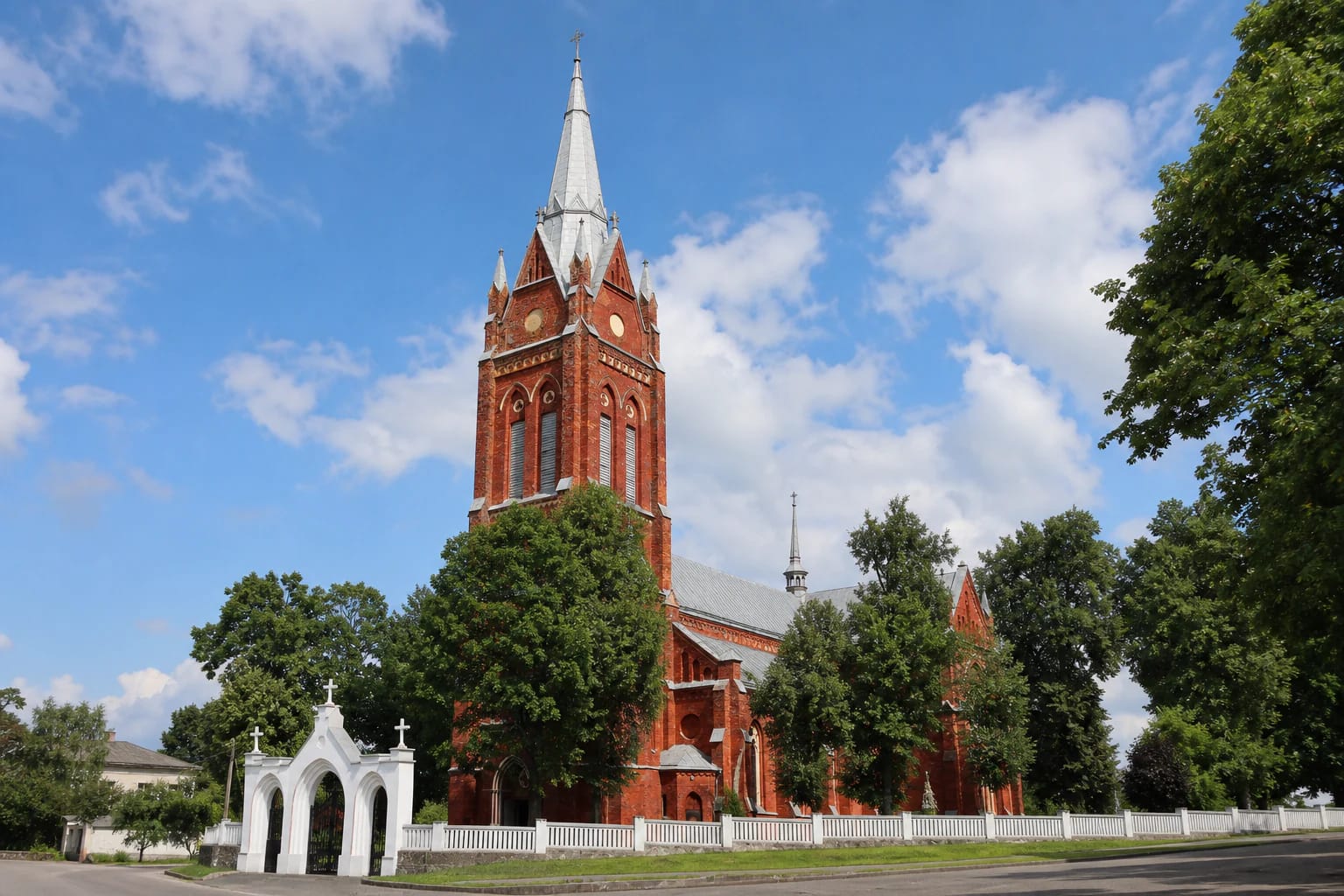
Kelmė Church of the Assumption of the Blessed Virgin Mary stands on S. Nėries Street in the town centre and serves the Catholic parish. Its red-brick Gothic Revival mass is marked by one tall facade tower, a pale pointed spire, and smaller corner pinnacles. It is not Kelmė's Evangelical Reformed Church on Vytauto Didžiojo Street: these are different buildings belonging to different denominations and historical traditions.
The practical site address is 18 S. Nėries Street, although the Diocese of Šiauliai parish directory gives 10 Bažnyčios Street as a contact address. Coordinates 55.6337194, 22.9326278 mark the church site inside the churchyard, not a particular gate or entrance. On 15 July 2026, the exact Google Maps card with Place ID ChIJO16r4cPQ5UYRVfq9kQ37LPY displayed 4.7/5. New reviews can change the rating, so the date and place ID belong with the figure.
Predecessors: a Vytautas foundation tradition, the Reformation, and fires
The early history of Kelmė parish is not expressed identically in every source. VLE and part of the local historical tradition connect the foundation with Vytautas in 1416, while a Kelmė Regional Museum virtual exhibition dates the first Catholic church to 1484 and presents 1416 as an older tradition associated with Motiejus Valančius. Other local accounts call 1484 the second church and date an altar endowment to 1512; the museum gives 1507. The safest wording is therefore that Kelmė had a very early parish, not that one uncontested date identifies the first timber building.
At the end of the sixteenth century, the parish became entangled in the Reformation conflict around the Gruževskis family, which ruled Kelmė. The Kelmė Regional Museum account says that after 1590 the Catholic community was left without a priest and that Protestant supporter Jonas Gruževskis replaced the old building with a pine-log church. Other accounts say Evangelical Reformed worship began in 1596, a recovery lawsuit began in 1606, and the church returned to Catholics in 1608; Dalia Ramonienė's Lituanistika summary gives the period as 1596-1609.
The church burned in 1613, was rebuilt in 1672, and was remodelled in 1745-1746, when it acquired Baroque forms characteristic of Samogitia. These fires and rebuilding phases belong to the earlier timber buildings, not to the surviving red-brick sanctuary.
The present church: a 1901 start, 1908 consecration, and disputed attribution
In 1901 the old timber church was demolished, worship moved to the Verpena chapel, and the foundations of a new masonry church were blessed. The parish history version repeated in the regional description says that, under parish priest Petras Janušauskas, the church was built in 1908 and consecrated that same year. The source does not give the exact day of consecration.
The architect requires careful wording. VLE dates Kelmė's architecture to 1901-1912 and names Carl Edward Strandman, while Dalia Ramonienė also attributes the present church to the Swedish-born Strandman. A local parish and tourism description says that a masonry project by J. P. Dzekonskis was approved in 1900 and that architect Nikolajus Andrejevas supervised the work. The sources do not provide one document explaining all three roles, so Strandman's authorship is best described as the attribution established by VLE and art-historical literature, while Dzekonskis and Andrejevas remain roles recorded in the local account.
The result is a building campaign rather than one simple date: work began in 1901, the parish account gives completion and consecration in 1908, and VLE uses the broader 1901-1912 range. That distinction matters because it prevents the church's history from being reduced to an unsupported one-line claim about 1908.
A Gothic Revival plan, a single tower, and a churchyard wall
This is a Gothic Revival three-nave church on a Latin-cross plan, with a three-sided apse and one tall facade tower. Pointed-arch windows, buttresses, decorative brick bands, and circular facade accents articulate the red-brick walls. The pale, steep tower spire and smaller corner pinnacles make the church a landmark in central Kelmė, while the small turret at the crossing of the roofs is part of the church volume.
A masonry churchyard wall with arched gates surrounds the building. The visit therefore begins before the doors: walk around the facade, look at the rhythm of the lower aisle walls, and distinguish the gate architecture from the main tower. The Register and municipal documents describe this heritage as a church-building complex in which the church and the churchyard fence with gates are separately identified.
The sources checked do not identify a separately documented standing belfry, so the small roof turret should not be described as an independent bell tower. Nor should the diocesan Bažnyčios Street contact address automatically be treated as a rectory or visitor entrance: 18 S. Nėries Street is the public site address for the church.
A 1913 organ, Historicist furnishings, and Kelmė's church art
Inside, three aisles are divided by piers, while the main and side altars, pulpit, and confessionals are fitted to the vertical Neo-Gothic space in a Historicist manner. This is not an empty architectural shell but the liturgical interior of an active parish, so interior viewing should be quiet and should not interrupt prayer.
The official regional cultural description records a 1913 organ made by the Latvian firm Emil Martin & Co, with a Romantic disposition and a Neo-Gothic case. VLE's Kelmė entry highlights Sofija Romerienė's painting of the Sacred Heart of Jesus, thought to date from around 1918, Antanas Valeška's 1931 composition of Vytautas receiving the Kelmė church project, and Zenonas Petravičius's St George, thought to have been painted during the Second World War. These dates and attributions belong to the sources and do not guarantee that every work will always be visible from the same place.
The Kelmė Regional Museum's surviving 1918-1940 photographic exhibition adds another layer by showing the church and parish in interwar town life. Historical photographs should be read as records of an earlier period, not as a promise that every detail in them remains unchanged today.
Mass times help plan a visit, but no tourist opening hours are published
The Diocese of Šiauliai lists Mass at 10:00 and 12:00 on Sundays, at 10:00 and 18:00 on Saturdays, and at 18:00 on weekdays. This is a liturgical schedule, not a guarantee of tourist opening hours. Check the official diocesan page or contact the parish before travelling because the timetable can change.
No separate daily tourist hours, admission price, detailed accessibility statement, official parking information, or photography rules were reliably published. We therefore do not invent them. If step-free access, interior photography, a group visit, or a look at the organ matters, ask the parish in advance. During Mass, enter as a participant, remain quiet, and do not photograph people or the liturgy without permission.
In a 2025-2027 project, Kelmė District Municipality says that visitor infrastructure around cultural objects is insufficient and plans public toilets, benches, bicycle stands, and information solutions. This is a planned project, not a promise that every amenity is already installed. The church combines well with Kelmė Manor, but the manor museum's hours and tickets are not conditions of entry to this church.