- Place
- Klaipėda City Municipality
- Region
- Klaipėda
- Type
- industrial-heritage building complex
- Address
- Liepų g. 47 and 47A, Klaipėda
- Coordinates
- 55.71604, 21.14428
Klaipėda Gasworks, Klaipėda gasworks building complex, Former Klaipėda gasworks
Industrial heritage on Liepų Street
The Klaipėda Gasworks Complex is one of the city's most interesting industrial-heritage sites. It stands on Liepų Street, where, alongside representative urban architecture, you can also see the infrastructure buildings without which the city would not have modernized in the second half of the nineteenth century.
The canonical Cultural Heritage Register name is the Klaipėda gasworks building complex (code 4694), state-protected as an object of regional significance. That matters because the site is not one attractive building but several gasworks elements that once had different functions.
The 1860-1861 gasworks and J. Hartmann's design
The factory buildings were constructed in 1860-1861 and were the first large industrial structure after the 1854 fire that devastated Klaipėda. The design was prepared by J. Hartmann, director of the Königsberg gasworks, and gas production began in October 1861.
On the day the works opened, 386 street lamps and 1,086 lamps in private apartments were lit in the city. In 1861 the complex consisted of fourteen buildings of various sizes: steam-boiler and apparatus rooms, purification, cooling, and pressure-regulation sections, gas stores, workshops, warehouses, and the master's residence.
Gas holders and the 1892-1894 rebuild
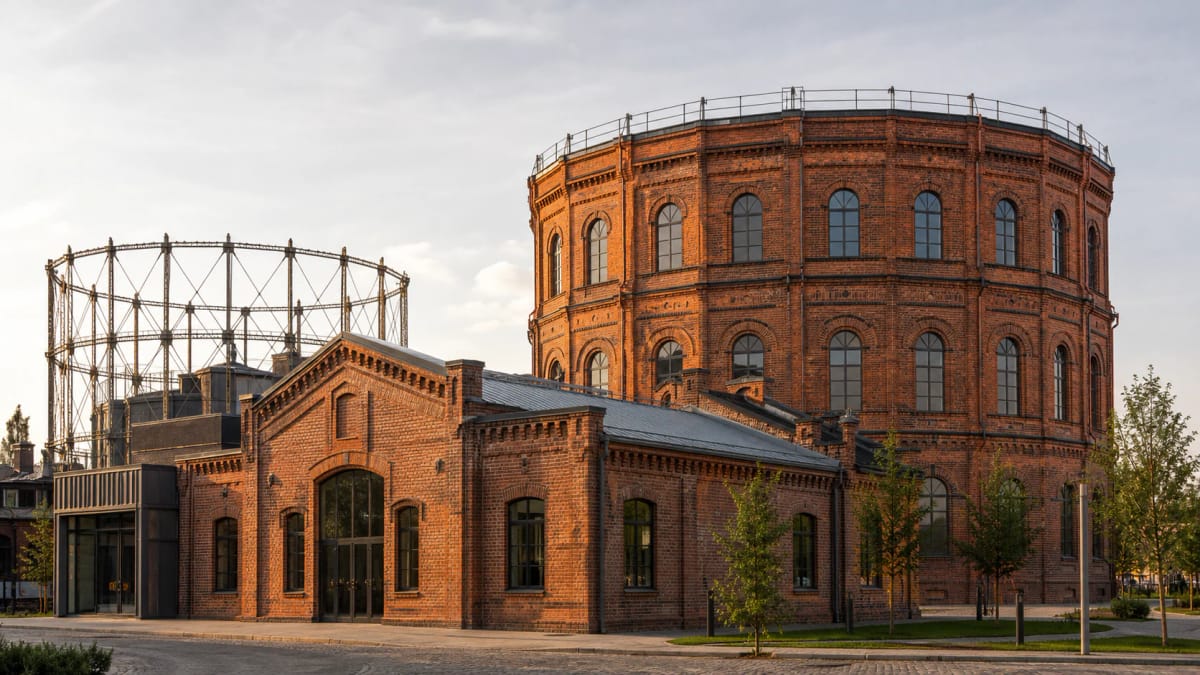
The most architecturally interesting building in the complex is the red-brick gas-holder standing at the corner of the plot. The gas was kept in metal reservoirs concealed under a masonry casing, so the technical apparatus took on the form of a representative brick building.
As demand grew, a second gas holder was built in 1867, and in 1892-1894 the complex was substantially rebuilt to a design by the engineer Schaar: the second holder was raised to two storeys and its capacity increased from about 710 to 1,600 cubic metres. The buildings thus reflect not only the initial phase but also a later stage of the city's technical development.
From gas production to housing
After the Second World War, gasworks activity stopped. In 1946 residents moved into the buildings, in 1961 part of the structures was demolished, and the rooms of the first gas holder were used as housing until 1981.
This layer shows how industrial heritage in Klaipėda often survived not through protection but because sturdy masonry buildings were adapted to other needs. That is precisely why the complex has kept its gasworks structure to this day.
Revival: a culture space and the MEMEL Auto Museum
In 2014 the complex was acquired by a private owner, and from 2018 restoration work began, turning the old gas store into a culture and commerce space. In this way an industrial-edge site is being returned to the city's cultural life.
One of the complex's current layers is connected with the MEMEL Auto Museum, which displays vintage cars. As a result, old energy infrastructure and a new function built around automobile culture meet on the same site.
Visiting the gasworks complex
The exterior can be viewed from public spaces, but visitors should respect the boundaries of the buildings' current uses and any ongoing works. If you plan to visit the MEMEL Auto Museum, check the official ticket and opening-hour page in advance, as the schedule may change.
The gasworks is worth combining with a Liepų Street route, the Klaipėda Central Post Office, and other infrastructure-heritage sites. It is a good way to see Klaipėda not only as a port, but also as a nineteenth-century city that modernized through technical systems.