- Place
- Kavarskas, Anykščiai District Municipality
- Region
- Anykščiai District
- Type
- sacred tufa spring and Lourdes grotto by the Šventoji
- Coordinates
- 55.43580, 24.93000
Kavarskas St. John the Baptist Spring, Kavarskas tufa spring, Kavarskas Lourdes, Lithuanian Lourdes
Two sacred places by the Šventoji
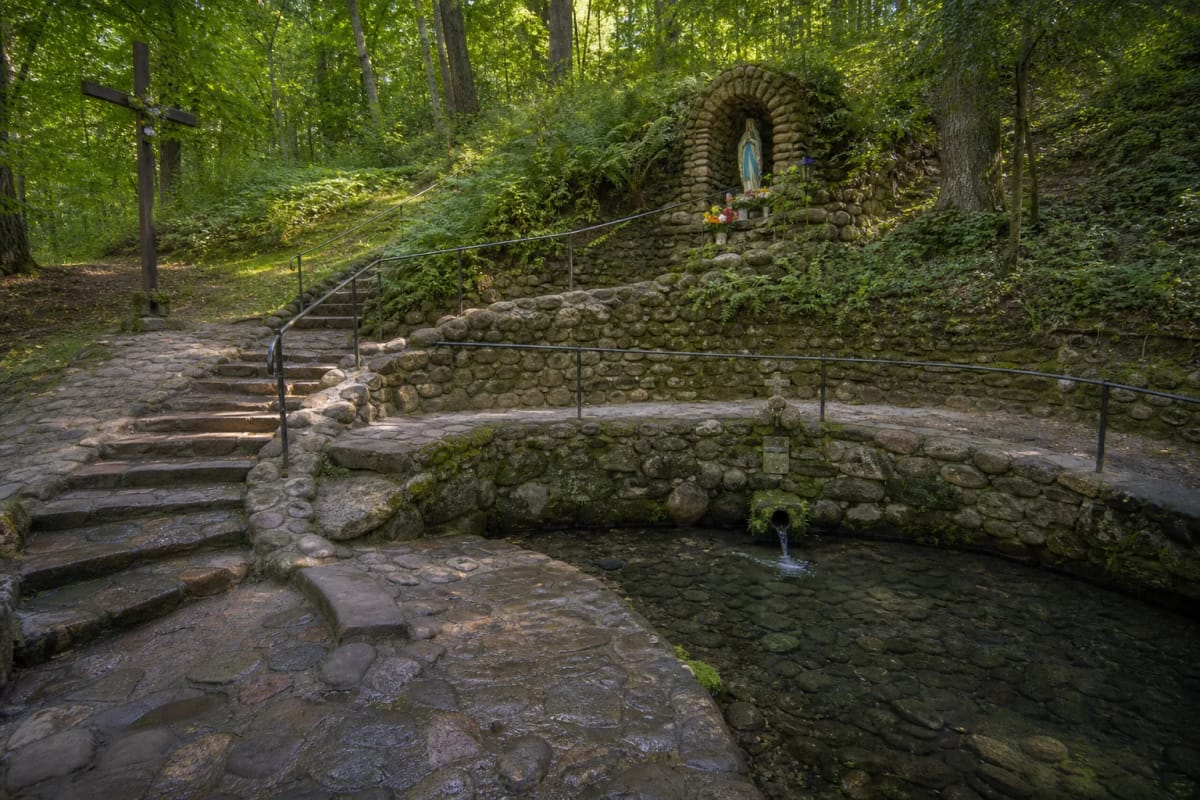
In Kavarskas, Anykščiai District, two closely related sacred places should be distinguished. The first is St. John Spring, flowing from the slope of the right bank of the Šventoji near the church; it is an old sacred site and natural-heritage object. The second is the Lourdes grotto built into the slope of the town cemetery, about a kilometre from the church.
In the press, the Kavarskas spring is sometimes called "Lithuanian Lourdes", but that is a journalistic name, not an actual grotto beside the spring. The most accurate approach is to speak about two related places: the documented, protected spring and the separate cemetery Lourdes grotto, which people visit as one tradition of prayer and water.
St. John Spring: tufa water and natural heritage
VLE states that Kavarskas St. John Spring is a freshwater spring and sacred site on the eastern edge of the town, flowing from a suffosion cirque formed in the Šventoji slope, about 21 m long and 14 m wide. It is a hydrogeological natural-heritage object protected since 1985, and it has been recognized as cultural property since 2009. The spring is even shown in the Kavarskas coat of arms.
The spring water is fresh, cold, and does not freeze in winter, while the calcareous tufa deposited from it is a rare geological feature. The spring is therefore valuable in two ways: as natural heritage and as a place that has mattered to local people for centuries.
Sacred site and belief in the water's power
VLE states that before the Second World War a sculpture of St. John the Baptist stood above the spring; around 1950 it was moved to the churchyard, and in 1990-1991 the spring surroundings were arranged and a St. John the Baptist chapel-post was erected. In 2012 a stone masonry wall, roof, and concrete steps were installed, making the spring easier to reach.
Belief in the water's healing power is connected with the spring. VLE presents this carefully, as a belief and tradition rather than a proven fact: people drink the water and wash with it believing in its strengthening qualities. This page therefore treats healing power as folk belief, not a medical claim.
Kavarskas church and the St. John feast
The spring is closely linked with Kavarskas Church of St. John the Baptist. VLE states that the historicist brick church was built in 1857-1887; it is the town landmark and parish centre. The sacred site and church together form the sacred core of Kavarskas.
The spring is especially heavily visited during the St. John indulgence feast, celebrated on 24 June or the nearest Sunday; poetry celebrations also take place there. This date coincides with Joninės, so the feast by the spring joins church and calendar traditions.
Visiting: how to reach it and what to see
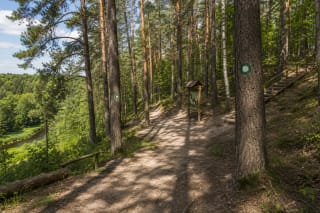
The spring is an open sacred and natural site without a ticket. Water can be drawn year-round, and built steps lead down to the spring. A visit usually takes 20-40 minutes; allow longer if you also visit the church and the cemetery Lourdes grotto.
Kavarskas stands by the Šventoji, so it fits well into a wider Anykščiai-region route. When visiting the sacred site, behave respectfully: this is a place of prayer and memory, not only a tourist stop.