- Place
- Kėdainiai, Kėdainiai District Municipality
- Region
- Aukštaitija
- Type
- active late Gothic masonry church with an eighteenth-century presbytery and historic art collection
- Address
- Šėtos g. 10, Kėdainiai
- Coordinates
- 55.28699, 23.98575
- Visit duration
- 25-45 minutes for the architecture, interior, and view from the churchyard
- Best time
- daylight for the Gothic brickwork and town view; for the interior, shortly before or after a public service
St George's Church in Kėdainiai, Old St George's Church of Kėdainiai
The oldest masonry of Kėdainiai above the eastern valley slope
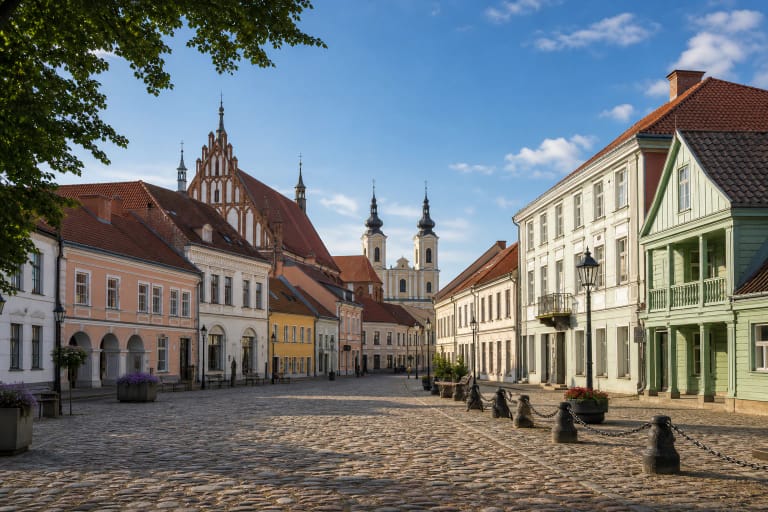
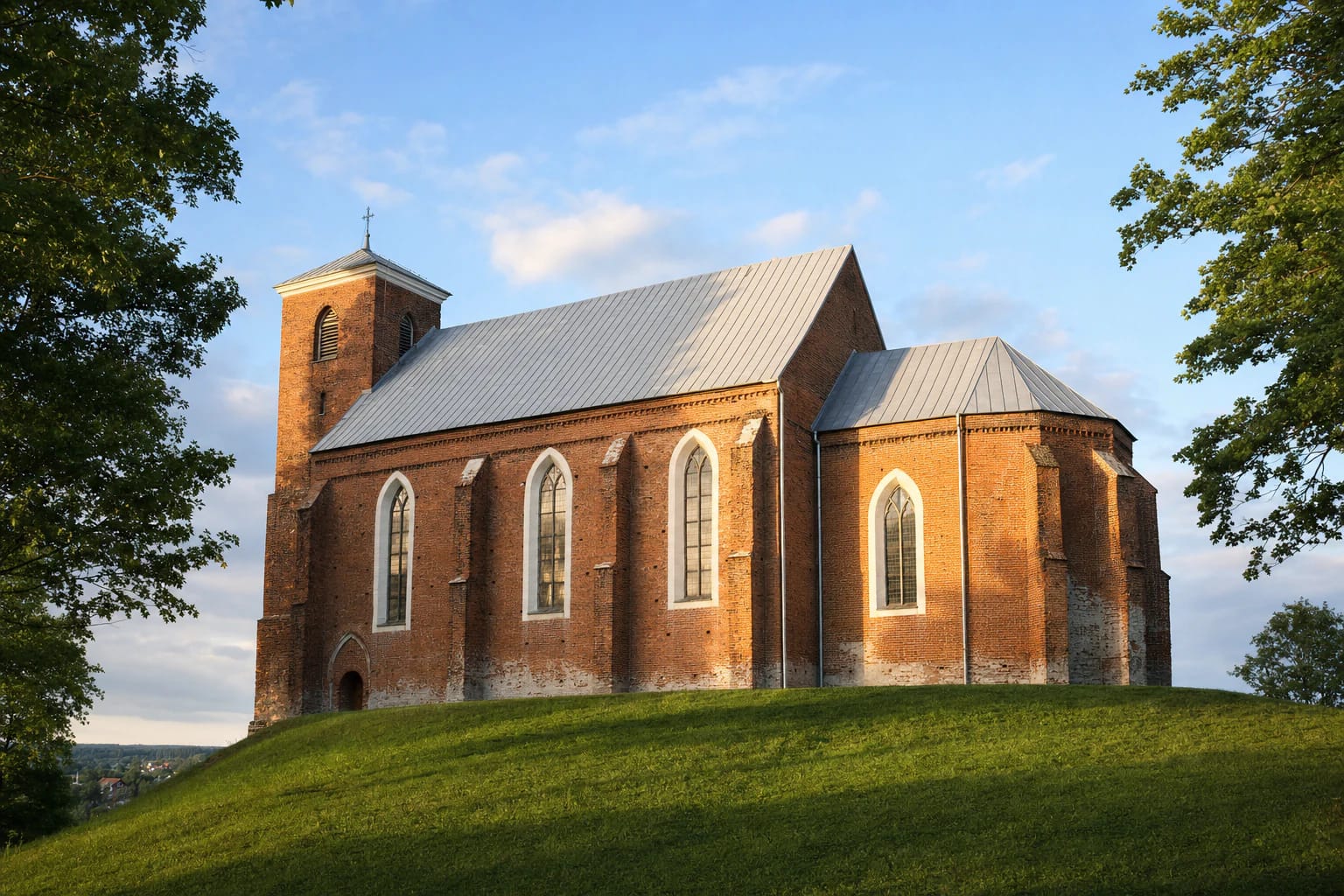
St George's Church does not stand within the fabric of Great Market Square but on the higher eastern side of the Nevėžis valley. The historic-centre roofs open below the churchyard, and the red-brick mass is clearly visible from the opposite bank. Its position recalls an early Kėdainiai that developed on both sides of the river before the Radvila town flourished in the seventeenth century.
The church is often called the oldest building in Kėdainiai. More precisely, it is regarded as the city's oldest surviving masonry building. VLE dates its core to the second half of the fifteenth century, while the official parish history places it in the first half. A careful guide should therefore use the broader fifteenth-century date rather than claim one uncontested construction year.
Reading the Gothic building
The exterior is defined by exposed red brick, buttresses, and tall pointed-arch windows. Its present volume is not a single medieval rectangle: the principal body is joined by an elongated presbytery ending in a half-octagonal apse, a two-storey sacristy, and a square belfry at the main facade that also serves as a porch.
The parish gives an irregular principal body of roughly 23.2 by 23.6 metres. Inside, a pointed Gothic arch divides the hall-like nave area from the presbytery, although the presbytery matches the central nave in height and width. The connection shows how a medieval sanctuary could be enlarged without losing its main spatial axis.
The Reformation and a seventy-year dispute
Around 1549, town owner Ona Kiškaitė transferred the church to Protestants. This was more than a local quarrel: Kėdainiai was developing into one of the Grand Duchy of Lithuania's major Reformed centres, and the religious choices of its magnates reshaped ownership of sacred buildings.
Catholics began legal action for the church's return in 1600. It was restored to them in 1627 after a long case and reconsecrated in 1662. These events form a documented part of the town's confessional history, not a romantic story of one brief confrontation.
The church was enlarged with its present presbytery and high altar in 1758 and reconstructed again in the nineteenth century. Later architecture and art therefore sit alongside the Gothic core.
Paintings, the 1632 bell, and a historic organ
VLE highlights the late seventeenth-century paintings The Betrothal of the Virgin and The Meeting of Jesus and St John, eighteenth-century images of Our Lady of the Rosary with a revetment and the Virgin and Child, and nineteenth-century paintings of St Michael the Archangel and St Anthony. A wooden altar and sculpture ensemble combines works from the seventeenth to nineteenth centuries.
A brass bell dated 1632 is particularly notable. Researchers associate it with bell-founder Jakob Kenig and a possible route to Kėdainiai as a wartime trophy from what is now Belarus. The date and bell itself are more securely documented than every stage of that reconstructed journey, so the provenance deserves cautious wording.
An unknown maker built the organ in the late eighteenth century, after 1782. Leon Grabowski rebuilt it in 1882, and the Vilnius organ workshop led by Rimantas Gučas restored it in 1978. Most pipes are newer, making this a repeatedly altered historic instrument rather than an entirely original eighteenth-century organ.
Since 29 September 2019, a first-class relic of Blessed Archbishop and Martyr Teofilius Matulionis has been kept beside the Crucified Christ altar. This is a modern pilgrimage layer, not part of the church's medieval origins.
Services, access, and visitor etiquette
This is an active parish church without an admission ticket, but its doors are not guaranteed to stay open like a museum. On 27 July 2026 the parish listed Mass at 5:30 pm on weekdays except Monday evening, at 10 am on Saturday, and at 10 am and noon on Sunday. Recheck the schedule and feast-day arrangements before travelling.
The churchyard occupies a slope, and gradients or older paving may be uncomfortable for visitors with reduced mobility. No fully verified step-free route through the whole interior was found, so discuss individual access with the parish in advance.
The exact Google Maps listing showed an average of 4.6 out of 5 from 99 reviews on 27 July 2026. The figure changes. Do not photograph worshippers without consent, touch altars or relics, or continue sightseeing during a service.