- Place
- Kaunas City Municipality
- Region
- Kaunas
- Type
- interwar modernist Evangelical Reformed church
- Address
- E. Ožeškienės g. 41, Kaunas
- Coordinates
- 54.90048, 23.90790
Evangelical Reformed church building, Reformed Church in Kaunas, Kaunas Reformed Church, Kaunas Evangelical Reformed Church
A modernist church among city trees
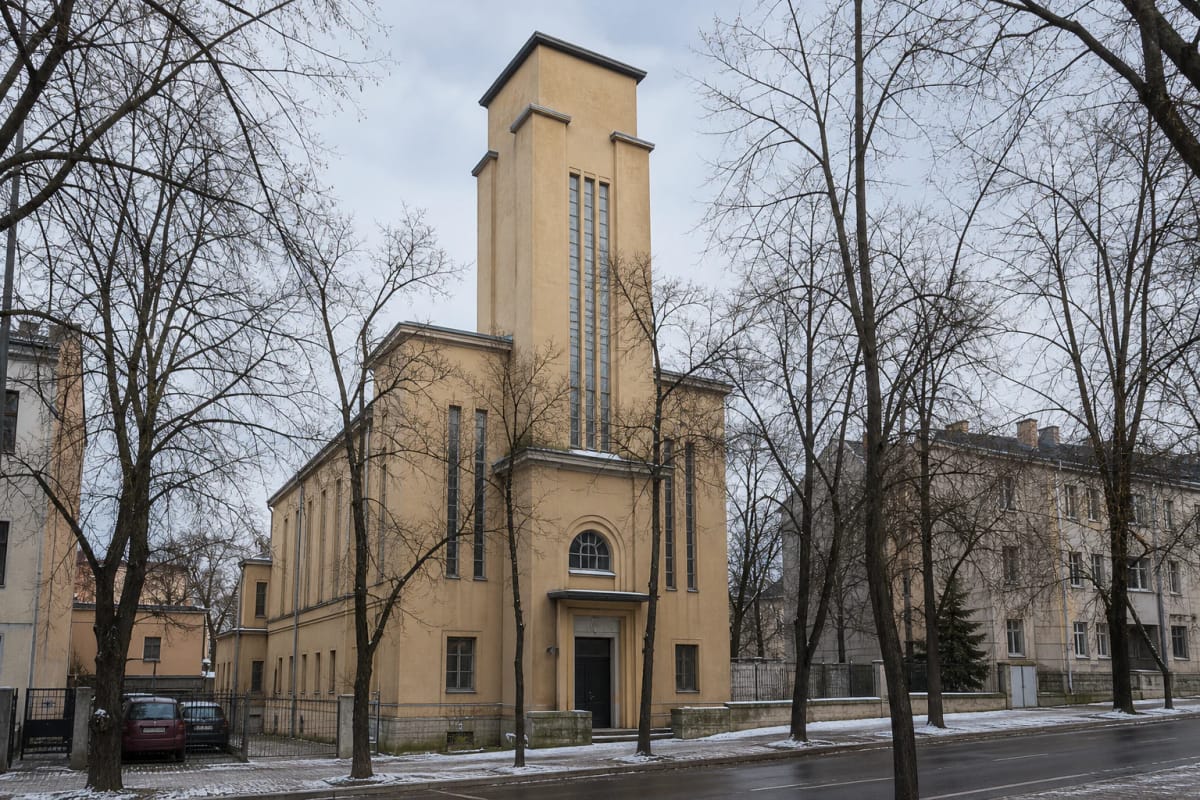
Kaunas Evangelical Reformed Church stands at E. Ožeškienės g. 41 on a Naujamiestis slope, slightly away from the busiest Laisvės aleja axis. From the street it looks restrained: yellowish plaster, rectangular volume, central tower, narrow vertical windows, and a small entrance portal.
That restraint is its value. AUTC calls the building one of the few examples of interwar modernist sacred architecture. It is not the romance of historicist towers, but an attempt to place a small community's church into the modernizing language of 1930s Kaunas.
Why the first design was not built
AUTC writes that after the Reformed community bought a plot on Ožeškienės Street, Vaclovas Michnevičius, a productive creator of historicist sacred architecture, prepared a neo-Gothic church design in 1934. It included traditional neo-Gothic elements, a single-nave T-plan church, and a graceful two-stage tower.
Although the city construction commission had approved the design, the Construction Council later decided that a church of that form could not be built. AUTC connects this turn with the modern-city image important to the temporary capital. In other words, a traditional sacred image collided here with Kaunas's modernization expectations.
Karolis Reisonas's solution
The new project was prepared in 1937 by Karolis Reisonas, who was then head of the city construction department. AUTC emphasizes that Reisonas kept some planning decisions but shifted the building stylistically into modernist tendencies.
The register dates the church as built in 1937-1940 according to Reisonas's project, while AUTC metadata gives a broader 1937-1947 interval covering the longer construction and postwar completion/adaptation history. For content purposes, the safest wording is: the main interwar project and construction took place in 1937-1940, the exterior was finished in 1938, and the later history was not a normal path to church consecration.
How the church was planned
The register describes a compound volume: a symmetrical rectangular-plan main three-storey block with semi-basement, a square three-stage tower on the central axis of the main southeast facade, and a two-storey presbytery part on the northwest side.
Importantly, the worship hall was not placed on the first floor. The register lists a parish hall on the first floor and the worship-hall space across the second and third floors. AUTC writes that a similar planning decision was already present in Michnevičius's design, while Reisonas gave it modernist expression.
Facade signs to notice
On the main facade, the three key elements are the central tower, the recessed portal with reinforced-concrete canopy, and the arched window above the entrance. The register lists these among valuable facade features, together with corner projections and the overall facade treatment.
AUTC explains the narrow vertical windows especially well: they convey the architectural spirit typical of 1930s Kaunas and give the comparatively small church volume a sense of upward movement, visually increasing the building. That is the best way to read the site from the street.
The tower that lost its top
The register states that in the early 1940s the upper part of the tower, the belfry with cross, was demolished. AUTC also mentions that the upper part of the tower was demolished after the war. The present tower therefore looks flatter and heavier than the original composition intended.
In 2026, information published on ref.lt from Kaunas city stated that the Heritage Maintenance Programme planned to finance reconstruction of the Evangelical Reformed church tower, allocating more than 57,000 EUR. The tower visible today is therefore not only a heritage detail but an active restoration question.
An interior whose history was interrupted
AUTC emphasizes a dramatic fact: exterior construction was completed in 1938, the interior was still being fitted out for about two years, but because Soviet occupation began, religious services never took place in the newly built church.
The register protects interior and structural fragments: round semi-basement columns, choir balcony with plastered masonry parapet, worship hall across two storeys, fragments of polychrome painting, and some wooden window and door elements. These remnants matter because the interior history did not naturally unfold as that of an operating interwar church.
Soviet adaptation
After nationalization the building lost its sacred function. AUTC states that it was turned into a warehouse for tobacco and beer factories, while the register specifies the companies Kova and Ragutis. In adapting it for production or storage, additional windows were cut and the interior structure was changed.
In 1952, according to the register, the building was handed over to the USSR Ministry of Internal Affairs Kaunas Special Secondary School. Later it housed a canteen and sports hall. Because of this use, the register today mentions a partly altered room plan and a 1954 reconstruction in which the former flat roof of the main volume was replaced by a three-pitched roof.
Return to the parish
AUTC mentions the 1990 position of the Kaunas council for Lithuanian cultural heritage protection that the building should be returned to the parish and restored according to Karolis Reisonas's project. The actual return to believers took much longer.
The register facts section states that in 2019 the church was handed over to believers. This date matters for current visiting logic: the building is not merely an abandoned modernist object or former school sports hall; it is again a living parish space.
Current parish and visiting
The Lithuanian Evangelical Reformed Church's Kaunas parish page lists the address E. Ožeškienės g. 41 and regular services every Sunday from 11:00. It also publishes notices about Bible studies, prayer evenings, concerts, and other parish activities.
The interior should therefore not be planned as a constantly open museum. The most reliable options are to attend a service, join a parish event, or arrange a visit in advance. The exterior can be viewed from the public street, while respecting the rhythm of an active religious community.
Restoration plans
A 2026 Kaunas city notice published by ref.lt states that the reconstruction project includes roof and facade works, restoration of interior spaces, and rebuilding the tower. Most attention is given to the tower, whose wooden floors and covering are damaged and some structures are in emergency condition.
The notice also says that Soviet-era partitions are planned to be removed, spaces clarified, a lift installed to the second-floor worship hall, and tower adaptation for panoramic viewing considered. Until these works are completed, tower access should be described as a possibility or plan, not an operating service.
Heritage status
In the Cultural Heritage Register the object is called the Evangelical Reformed church building. Its unique code is 37587, status is state protected, significance level regional, and type single object. The register date is January 3, 2014.
Protected features include volume, tower, semi-basement, plan structure of the parish and worship halls, main-facade portal with reinforced-concrete canopy, arched window, narrow-window rhythm, structures, choir balcony, and fragments of polychrome painting. The object is within the Kaunas city historical part called Naujamiestis.
UNESCO modernism context
The church is in the modernist heritage environment of Kaunas Naujamiestis, related to the UNESCO World Heritage property Modernist Kaunas: Architecture of Optimism, 1919-1939. It should not, however, be called a separately inscribed UNESCO church.
Its value in this context is clear: Kaunas modernism was not limited to banks, ministries, and residential buildings. Even a small religious-minority church had to negotiate with the image of a modern city, and its current restoration shows how this heritage returns to public memory.
How to view it
The best point is on the opposite side of E. Ožeškienės Street, where you can see the central tower, entrance, arched window, and side window band. Trees often cover part of the facade, but they also help convey the scale of an interwar Naujamiestis street.
Compared with the Resurrection Basilica, this church looks smaller and quieter, which makes it very good for observing architectural details. Look not for grandeur but for the solution: how a modernist volume, narrow windows, and flatter forms changed the traditional image of a church.