- Place
- Kupiškis, Kupiškis District Municipality
- Region
- Aukštaitija
- Type
- Monumental Gothic Revival hall church built in 1900-1914, with twin towers, five altars, and sacred art from the eighteenth to twentieth centuries
- Address
- 1 Gedimino Street, Kupiškis
- Coordinates
- 55.84196, 24.97601
Kupiškio Kristaus Žengimo į dangų bažnyčia, Kupiškis Ascension Church, Church of Christ's Ascension in Kupiškis
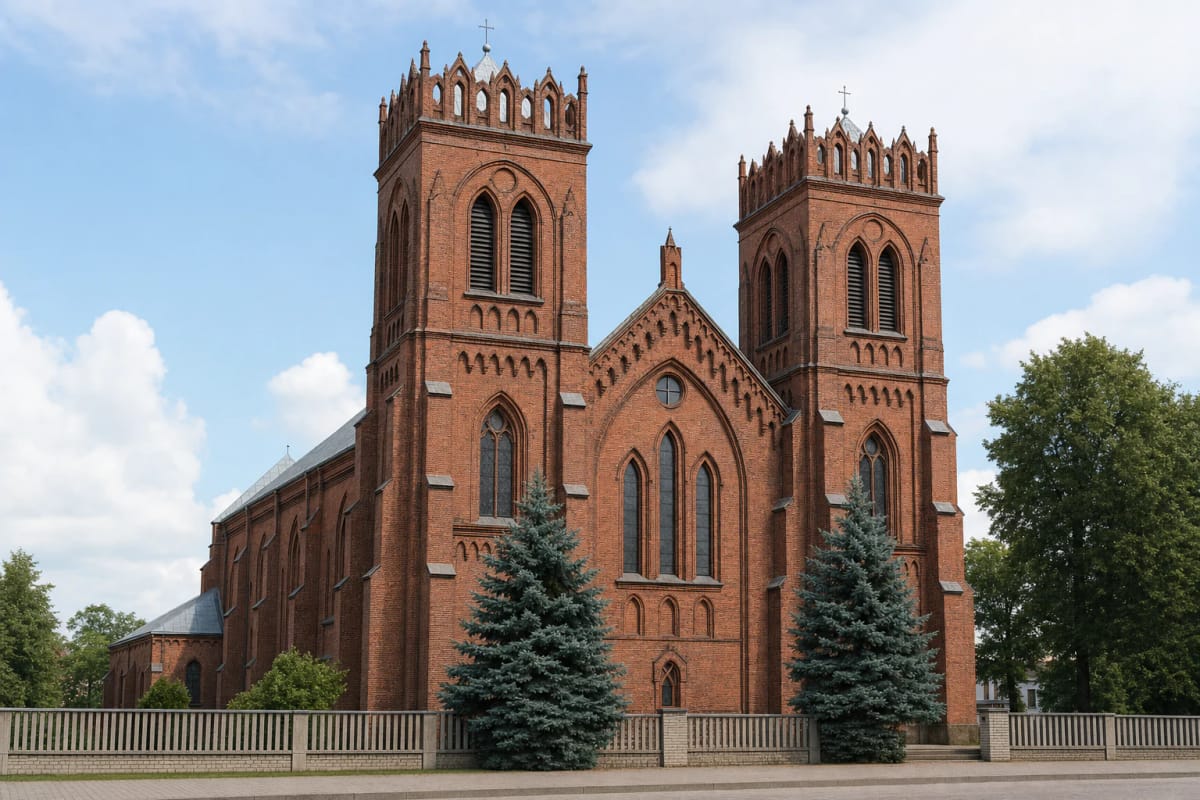
The twin-towered church is the defining landmark of the Kupiškis skyline
Kupiškis Church of the Ascension of Christ stands in the town centre at 1 Gedimino Street, coordinates 55.8419649, 24.9760086. Kupiškis Museum occupies the former parish school directly across the street, making the two buildings an unusually meaningful pair for understanding the town. This is an active parish in the Diocese of Panevėžys rather than a museum display.
The three-aisled hall church measures 60 m long and 43 m wide, while both towers rise to 60 m. The official parish history records more than 700 seats, two sacristies, reinforced-concrete vaults, and 22 crosses decorating the building. Its scale justifies describing it as one of Lithuania's largest churches apart from cathedrals, although the sources do not establish an exact national size ranking.
The silhouette is formed not by tall needle spires but by openwork crowns of stepped Gothic Revival gables, each enclosing a small metal roof. A lower triangular gable and a huge pointed window field fill the space between the towers. The monumental mass recalls twin-towered Baroque churches, while the openings, buttresses, pinnacles, and patterned brickwork are Gothic Revival.
Sources count the church of 1616, the work of 1746, and the sanctuary of 1791 in different ways
Kupiškis elder Benediktas Tyzenhauzas financed the first timber church in 1616, when the parish was also established. The Diocese of Panevėžys calls the work of 1746 construction of a new timber church, whereas a peer-reviewed art-historical study interprets it as a major repair of the 1616 building and its rededication to Saint Michael the Archangel. Some accounts therefore count the present building as the fourth church, while the specialist study calls it the town's third Catholic sanctuary.
That place of worship burned in the Kupiškis fire on 14 August 1781. A new timber church with three aisles and three altars was completed in 1791 and dedicated to the Guardian Angels. By the late nineteenth century it was worn and too small for the growing congregation, and the imperial Russian authorities finally granted permission for a larger masonry church in 1897.
The parish story also belongs to the wider cultural history of Kupiškis. A parish school opened in 1781, while poet and priest Antanas Strazdas served here in 1790-1791, 1798-1801, and 1814. These periods are documented and should not be confused with local legend or later retelling.
Construction in 1900-1914 enclosed the old church, but the architect's authorship rests on a later manuscript
Canon Stanislovas Janulevičius, parish priest and dean of Kupiškis, organised construction of the present church. It was built in 1900-1914 around the timber sanctuary of 1791, which remained in use until it was dismantled from within in 1903. This arrangement preserved a place of worship during the opening years of the long building campaign.
The design is traditionally attributed to engineer Konstantinas Rončevskis, a professor at Riga Polytechnic Institute who lived from 1875 to 1935. Art historians nevertheless stress that the sole known written evidence for this attribution is a typescript prepared by parish priest Vladislovas Kupstas in 1947; no signed design or direct archival confirmation has been found. The Kupiškis church is considered probably the largest realised architectural work associated with Rončevskis.
The First World War interrupted the interior work and damaged the recently completed shell. The parish history says that German troops established a field hospital inside and burned furniture and floor timber for heat, while Russian artillery shattered windows, damaged walls, and pierced the vaults; three bells were taken to Russia in 1915. Work resumed in 1919, and Bishop Pranciškus Karevičius consecrated the church under the Ascension dedication on 7 September 1921.
The five altars appear unified even though they were made at different times and under very different conditions
Aleksandras Zaborskis's workshop in Šiauliai made the oak Gothic Revival high altar and the two altars in the side aisles early in the twentieth century. Antanas Pšeslanskis painted the Ascension for the high altar, followed by the Immaculate Conception and Guardian Angel paintings for the side altars in 1913 and 1914. All three compositions were conceived to harmonise with the red-brick Gothic Revival architecture.
The altars of Saint Thérèse of the Child Jesus and the Crucified Christ now seen in the side chapels are not the furnishings installed in 1930-1932. Kupiškis craftsman Jonas Lašukas made the present Gothic Revival altars around 1958-1960 from drawings brought from Panevėžys. Under Soviet rule, the work remained secret and the pieces were assembled inside the church at night so officials would not notice a major renewal of sacred furnishings.
More of the woodwork has identifiable makers. Vladas Čižauskas installed the Gothic Revival pulpit in 1944, while local joiner Jonas Jakutis made pew-kneelers, confessionals, and part of the presbytery and sacristy furniture around 1920. Additional seating followed the old models around 2000, so an interior that looks stylistically unified at first spans almost the entire twentieth century.
Older sculpture, the Paltarokas relief, the 1970 organ, and Bochum bells reveal several heritage layers
Some artworks were transferred from the preceding timber church. VLE singles out a Crucifix dated 1884, three nineteenth-century wooden saint figures, and Petras Rimša's bronze relief of Bishop Kazimieras Paltarokas from the first half of the twentieth century. Older crosses, candlesticks, textiles, and liturgical vessels also survive, so the interior cannot be dated simply to the completion of the building in 1914.
The first organ in the new church was burned during the First World War. Two harmoniums served in the interwar period, and a larger organ was installed in 1970. Juozas Lekarevičius and his son tuned the original one-manual instrument in 1988, added a second manual, and gave its case Gothic Revival pinnacles so it would harmonise with the altars.
Three steel bells cast in Bochum, Germany, in 1930-1932 replaced the set lost in 1915. They bear the names Saint Anne, Guardian Angel, and Saint John; women of Kupiškis donated towards the largest, Saint Anne bell. All three survive, with restrained decoration limited to reliefs recording their names, donors, location, dates, and foundry.
Mass times provide the most reliable interior access, and there is no separate visitor ticket
For 2026, the Diocese of Panevėžys listed Mass at 18:00 on weekdays, 11:00 on Saturday, and 12:00 and 18:00 on Sunday. The Sunday evening service moves to the parish chapel in winter, so it does not guarantee access to the main church interior. No separate tourist schedule is published; arrange a quiet visit at another time on +370 622 12525 and recheck the official page before travelling.
The building is an active place of worship, and the official parish page publishes no visitor ticket or admission charge. Photography and movement during services must not disturb the congregation. Steps are present at the principal entrance and no complete step-free route is publicly described, so contact the parish in advance about a suitable wheelchair entrance or individual assistance.
On 13 July 2026, the Google Maps entry under the exact Lithuanian name Kupiškio Kristaus Žengimo į dangų bažnyčia carried 328 reviews averaging 4.8 out of 5. The map gave 1 Gedimino Street and coordinates 55.8419649, 24.9760086. Rating and review count change over time, so the verification date is recorded here.