- Place
- Lyduvėnai, Raseiniai District Municipality
- Region
- Samogitia
- Type
- historic railway bridge over the Dubysa
- Coordinates
- 55.50667, 23.08811
Lyduvėnai Bridge above the Dubysa valley
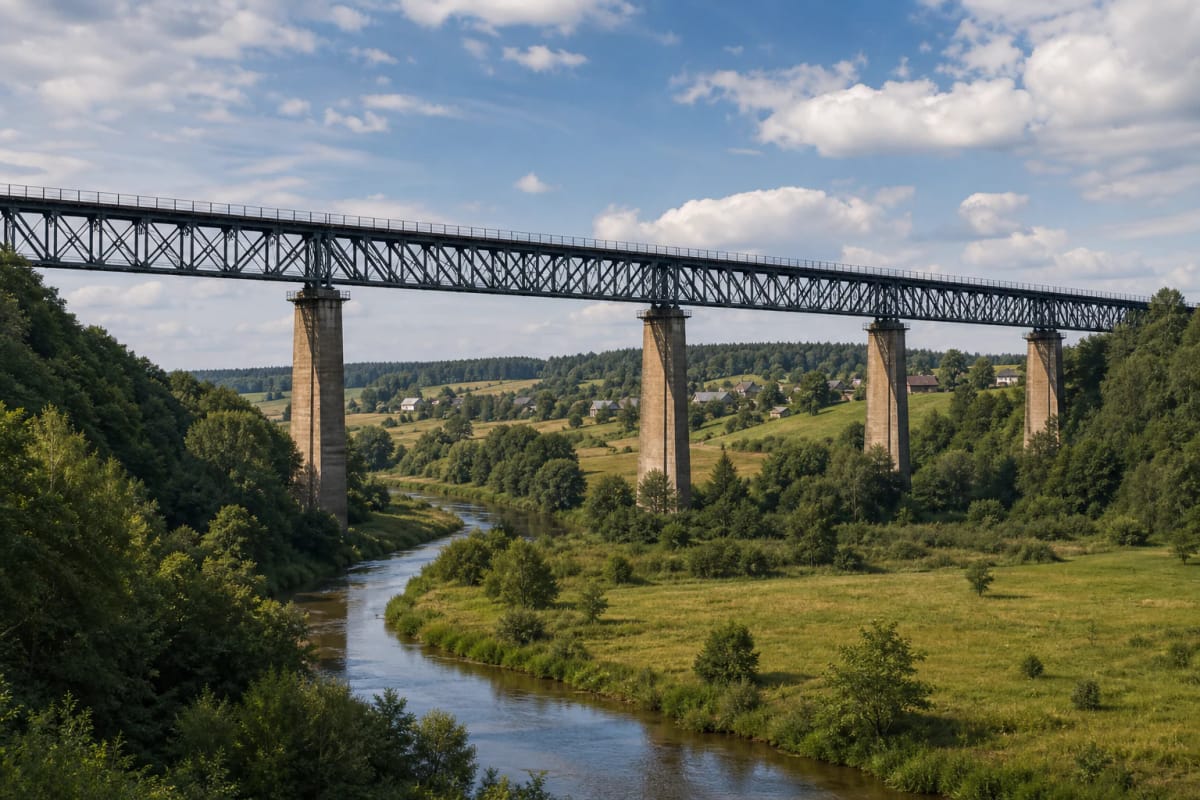
Lyduvėnai Railway Bridge crosses the Dubysa valley in Raseiniai District. From a distance it reads as a long metal structure stretched above the river and valley, so scale is the first impression. The bridge was built at the narrowest place of the valley, and the Dubysa valley here is among the deepest in Lithuania, with banks in places reaching up to 80 m.
The bridge is 599 m long and rises about 42 m above the valley. The Universal Lithuanian Encyclopedia calls it the highest and longest bridge in Lithuania, and visitors can see those numbers with their own eyes.
Structure and defensive shelters
The Cultural Heritage Register connects the bridge's value with railway engineering: it is a nine-span riveted steel-truss structure on reinforced-concrete supports. Two structural types survive: three German-type spans from 1918 and six Russian-type spans, making the bridge a technical-history document as well.
Defensive elements also belong to the bridge's story. In 1937, three reinforced-concrete shelters were installed to defend the bridge according to a design by engineer J. Vitkus and Lieutenant Colonel J. Maciulevičius; two of them survive on the right bank of the Dubysa.
Three bridges from 1916 to 1952
Three bridges have stood here. The first was a wooden First World War bridge, built by the German army in 1916, about 670 m long, and dismantled in 1918. The second was a steel bridge on reinforced-concrete supports, completed in 1918, about 570 m long; the retreating German army blew it up on July 26, 1944.
The present bridge was built after the war and completed in 1952. Today's structure therefore connects early wartime infrastructure, post-war railway needs, and later protection. In 2001-2005 the bridge was strengthened and restored, and in 2008 a government resolution declared it a cultural monument.
Visiting is not an independent walk
Lyduvėnai Bridge is an active object on the Radviliškis-Pagėgiai, historically Tilsit, railway line, so it cannot be treated as a normal pedestrian bridge. Independent walking on the bridge is forbidden, and access is organised only under the safety and visiting rules in force at the time.
During research, visitor access was linked with advance registration and tickets bought in advance. Because tour schedules, safety requirements, and ticket rules change, check official LTG or current bridge-visit organiser information before travelling. A model of the wooden bridge can be seen at the Vytautas the Great War Museum in Kaunas.