- Place
- Kintai, Šilutė District Municipality
- Region
- Pamarys
- Type
- Evangelical Lutheran church and cultural-event space
- Address
- Kuršių g. 26, Kintai
- Coordinates
- 55.41975, 21.26339
Great Kintai Church, Kintai Church of the Crucified Jesus, Kintai Parish Church
The old Kintai church by the Curonian Lagoon
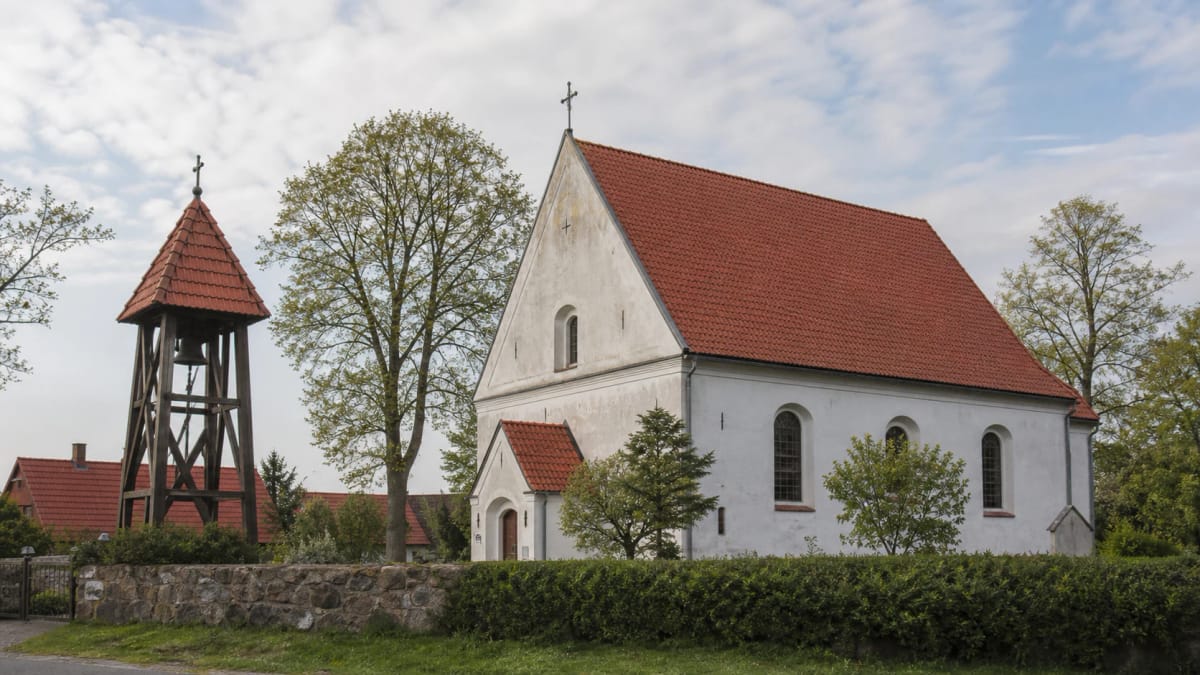
Kintai Evangelical Lutheran Church, also called the Great Kintai Church, is one of the most important and oldest historical places in Pamarys, by the Curonian Lagoon. According to the Register, it was built in 1705, so its story begins much earlier than many other sites in the area visited today.
In the Cultural Heritage Register the church is protected as a state-protected object of regional significance (unique code 1637). It matters not only architecturally - its significance also rests on archaeological, artistic, and memorial layers - so Kintai emerges not as a leisure town but as an old community centre in Pamarys.
From the Ventė church to the 1705 Kintai masonry
The origin of the Kintai church is linked with the house of worship at Ventė Cape: a chapel was set up at the Vindenburg castle built by the Teutonic Knights in 1360, and the later Ventė church was gradually destroyed by the encroaching lagoon waters until it fell apart entirely around 1702. The Register notes that reused materials from the former Ventė church were employed to build the new Kintai church.
There was a dispute over where to build the new sanctuary; a story tells that two runners sent at the same time from the outermost villages - Ventė and Kiošiai - met precisely in Kintai, but this is only a fine legend. The church was built and consecrated in 1705 (by some accounts 1706 or even 1709), and Kintai became a parish centre, though as a branch of Priekulė parish it had had a house of worship since 1550. The new church was of brick, plastered, about 30 m long and 13.5 m wide, with a semicircular sacristy.
A towerless sanctuary and a separate belfry
A tower was included in the design, but to save money it was abandoned - instead a separate wooden belfry with two copper bells was built. The Register confirms that on the west side only the rectangular tower foundations survive, marked by an above-ground concrete strip and buttresses, so the church remained towerless.
It is a rectangular-plan, pseudo-basilican space with a semicircular apse in the east and a dominant central nave surrounded by galleries and an organ-choir tribune. The walls are of ceramic brick on a fieldstone-and-brick foundation, and the space is covered by a wooden cylindrical vault reinforced with metal ties. The six-sided columns that divided the interior were replaced with reinforced concrete ones, clad in board panelling, during a late twentieth-century restoration. The church was repaired in 1750-1754, 1845-1850, and 1905.
The memory of Vydūnas in Kintai
In 1888 the twenty-year-old Wilhelm Storost-Vydūnas (1868-1953), fresh from the Ragainė (Ragnit) teachers' seminary, began work at the parish school by the Kintai church. Appointed junior teacher, he taught Lithuanian and German, geography, history, and physical education; this short 1888-1892 period was very significant for the future philosopher and writer - here he matured as a personality and began writing in his native language. According to the Register, it was in this very church that the wedding of Vydūnas and Klara took place.
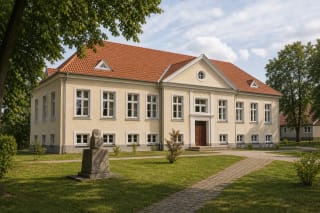
In Kintai Vydūnas was known as a teacher rather than a church musician: the widely renowned Kintai church choir and brass band were led between the wars by M. Dreižys. The adjacent Vydūnas Cultural Centre occupies the very school building where Vydūnas worked, so church and centre together mark Kintai as an important point of spiritual culture in Lithuania Minor.
The Soviet era, restorations, and confession today
In 1948 the Soviet authorities confiscated the church and turned it into a grain warehouse; services had to be held in the parish hall, sometimes together with Catholics. In 1978-1982 the building was restored and adapted for exhibitions and concerts (the project was by architect Vytautas Šliogeris), and even before independence was declared, supporters of the Sąjūdis movement gathered in it and the Lithuanian tricolour was officially raised beside the altar for the first time.
In 1990 the historic building was transferred to the Catholic community - the Kintai Parish of the Crucified Jesus was established in it - and in 2015 the church was partly restored (architect Egidijus Vidrinskas). An Evangelical Lutheran parish also still operates in Kintai, so the sanctuary's historic Lutheran identity and its present use intertwine - worth knowing when planning a time to attend a service or look around.
Events and visiting
Since the late twentieth-century restorations the church has also lived as an event space: its acoustics suit concerts and exhibitions, so the building matters not only as protected heritage but also as a place for community gatherings. No fixed tourist opening hours were found during research, so a visit is best timed around services, concerts, or events.
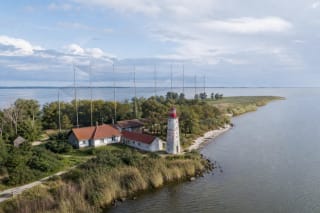
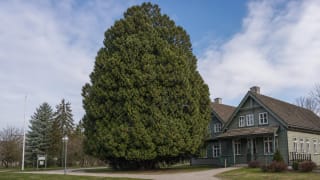
Kintai church is easy to combine with the Vydūnas Cultural Centre, the Kintai Great Thuja, the Curonian Lagoon shore, and Ventė Cape. Together they make one of the strongest small-town routes in Pamarys, holding sacred history, the memory of Vydūnas, and lagoon nature.