- Place
- Kaunas City Municipality
- Region
- Kaunas
- Type
- interwar workers' cultural palace and present Kaunas Cultural Centre
- Address
- Vytauto pr. 79, Kaunas
- Coordinates
- 54.89512, 23.92471
Kaunas Cultural Centre, Kaunas Trade Union Cultural Palace, Trade Union Palace, Darbo rumu pastatas, Labour Palace in Kaunas
An address for workers' culture
The Labour Palace in Kaunas is not only the current Kaunas Cultural Centre building. In the interwar period it was conceived as the cultural, social, and self-education centre for workers across Lithuania. AUTC summarizes its purpose as a building for workers' education and leisure, while the Cultural Heritage Register uses an even broader phrase: the cultural and social work centre for all Lithuanian workers.
This explains the scale. The palace had to hold not only administration, but also a reading room, library, halls, schools, an editorial office, cultural sections, sports clubs, and public activities. When visiting the building, read it not as one hall but as a large piece of social infrastructure.
From A. Mickevičiaus Street to Vytauto prospektas
The register recalls the palace's prehistory. In 1934, on the initiative of the Kaunas city labour inspectorate, the General Workers' Representation was established to unite Lithuanian workers' organizations. That same year it rented premises at the then A. Mickevičiaus g. 15, where the Kaunas cultural club also operated.
By 1939, 23 clubs established by the Labour Palace were already active in Lithuania, so the old headquarters no longer matched the ambition. In 1937 the plot by Kestucio Street and Vytauto prospektas became the property of the Labour Palace. The new building was to be not a branch, but the main organizational centre.
Design, construction, and the 1940 opening
AUTC metadata dates the Labour Palace to 1938-1939, while the register gives a more precise sequence: the project was approved on May 29, 1938, construction began in 1938, the roof was covered in 1939, and the building opened in 1940. It is most accurate to speak of a 1938-1940 design and opening period.
The opening ceremony, according to the register and Kaunas Cultural Centre, was attended by Lithuanian President Antanas Smetona. For the opening, Mikas Petrauskas's opera Birute was staged and presented to the public. That detail matters: from the first day, the workers' palace introduced itself through stage, music, and community culture.
Authors: Lukosaitis and Novickis
AUTC and the register link the building's authorship with engineer Antanas Novickis and engineer-architect Adolfas Lukosaitis. The Kaunas Cultural Centre history page clarifies the division of work: Lukosaitis designed the exterior, while Novickis planned the interior premises.
That division is visible in the building. The exterior is strict, almost institutionally monumental, while the interior is not only representative but logistical: halls, offices, staircases, reading rooms, schools, and clubs all had to function within one building.
How to read the facade
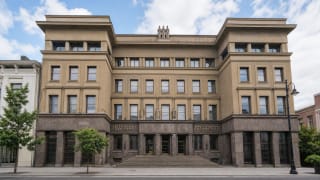
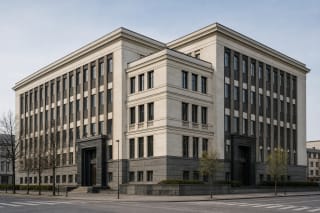
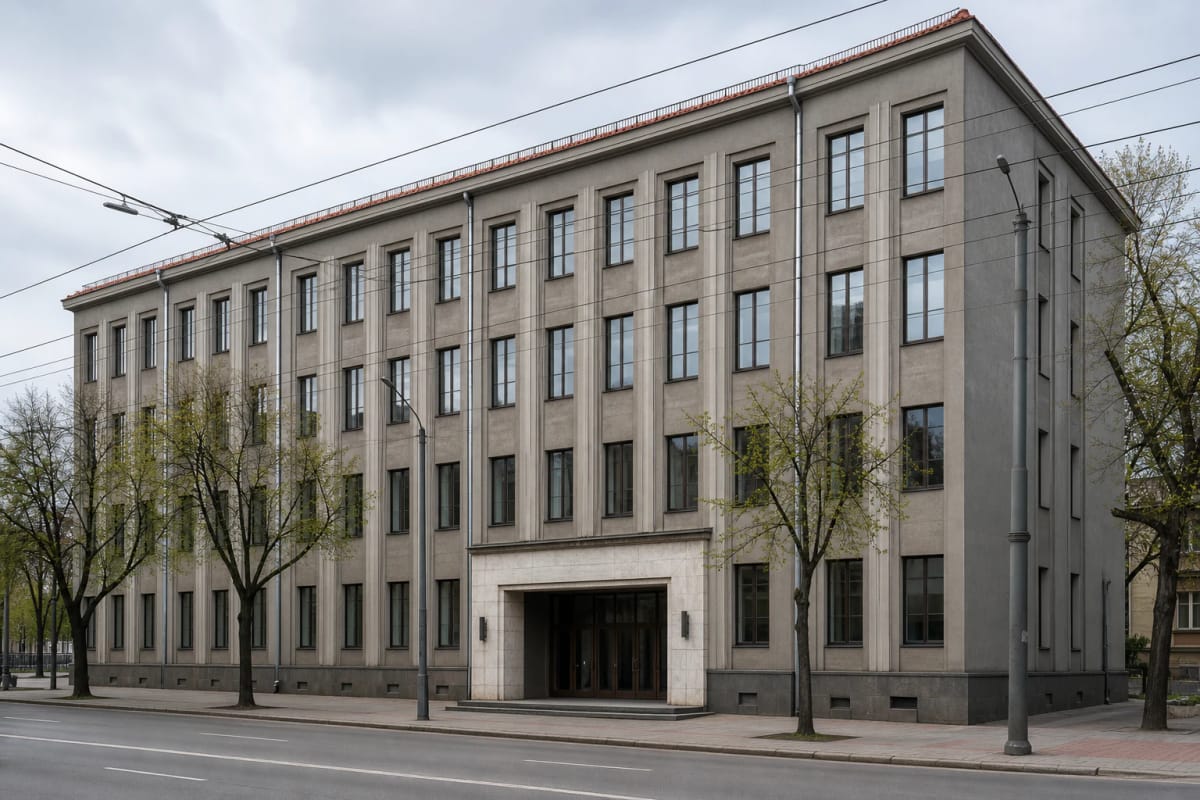
Kaunas Cultural Centre describes the facade as strict and restrained, with the two street facades almost identical. The monolithic impression is created by the rhythm of vertical triangular-profile ribs and narrow windows. The register also protects the overall architectural treatment of the street facades.
From Vytauto prospektas, pay attention to that rhythm: the windows are not independent decoration, but are set between vertical ribs and smoother bands. The building is not ornate, but it is highly disciplined. Its modernism works through repetition, facade density, and the seriousness of volume.
Two portals and later marble
Kaunas Cultural Centre states that the main portal on the Kestucio Street side is wide, with three doors and a grooved surround, while the portal on the Vytauto prospektas side is more modest, with one door. The register also lists these portals among valuable architectural details.
One important detail: the register states that the original greyish granite-render portals were faced with light marble slabs in 1995. The light portal material seen today is therefore not fully the original interwar view. It is a good example of how heritage buildings carry more than one time layer.
Interior spaces, from lobby to Great Hall
The value of the Labour Palace does not end at the facade. The register protects the overall interior treatment of the ceremonial lobby and staircase, semi-basement cloakroom, Great Hall, and anteroom. It mentions mosaic-concrete stairs, decorative openwork metal railings, profiled wooden handrails, doors, window divisions, parquet, and terrazzo-type floors.
The Kaunas Cultural Centre history page names the central lobby with broad stairs and coloured stained glass as one of the most beautiful places. The register specifies that the stained-glass composition Muses fills three window openings across three floors in the ceremonial lobby; it was created in the 1960s by artist Bronius Grusas and restored in 2011.
The programme the palace had to hold
AUTC describes an ambitious functional list. The palace was planned with a workers' cultural club and 400-seat hall, reading room, library, leisure rooms, a 1,000-seat theatre hall with balcony and stage, the Darbas editorial office, a workers' people's university, workers' schools, and institutional offices.
The register's facts section, describing the operating building, mentions the Labour Palace administration, social-care departments, the Darbas editorial office, library, reading room, cultural sections, sports clubs, theatre, Labour Palace progymnasium, Trade School, canteen, and a small hotel. According to Kaunas Cultural Centre, guest apartments were located on the fourth floor.
Occupation and memory layer
The building's history changed very quickly. The register states that only a month after the opening, on June 15, 1940, the Red Army occupied Kaunas. The occupation authorities closed the Labour Palace and handed the building to the Lithuanian SSR trade unions.
During the Nazi occupation the Gestapo was based in the building. The register gives the period 1941-1943, while the memorial plaque on the facade recalls that in 1941-1944 fighters for Lithuanian freedom were imprisoned and tortured in this house. The site is therefore not only modernism, but also a place of memory.
Trade Union Palace and cultural continuity
In 1944, according to the register, the original purpose was restored, and in 1946 the palace was named the Trade Union Cultural Palace. The Kaunas Cultural Centre history page notes that Kaunas residents still remember this name well, although the current official user is Kaunas Cultural Centre.
After the war, art groups, clubs, celebrations, and traditions again gathered here. The register mentions Sonata, Varpelis, Kęstutis Lusas's estrada ensemble, a ballet studio, Jewish amateur art groups, clubs for science-fiction fans, tourists, aircraft modellers, foreign languages, and women, as well as events such as Grok, Jurgeli, Crafts and Storytellers' Days, Music Week, and Pegasas.
The current Kaunas Cultural Centre
Today the building functions as Kaunas Cultural Centre. The official contacts page gives the address as Vytauto pr. 79, and the centre's history page emphasizes that names have changed over 80 years, but community, culture, and human development have remained.
The contacts page lists general centre hours as Monday-Friday 08:00-22:00 and Saturday-Sunday 10:00-20:00. Administrative hours are shorter. For travellers, the key point is to check specific events, exhibitions, educational activities, or tours, because this is not a museum freely viewable at any time.
Heritage status
In the Cultural Heritage Register the object is called the Labour Palace building, unique code 32465. The register lists its status as municipal protected, significance level local, and type single object. The registration date field gives November 20, 2008.
The list of valuable features is extensive: U-shaped plan, street and courtyard wings, hall volume, portals, grey granite render on the facades, window and door openings, stairs, railings, mosaic-concrete floors, wooden parquet, the Great Hall balcony, and interior treatments. In other words, more than the facade image is protected.
UNESCO modernism context
The Labour Palace stands in the modernist heritage environment of Kaunas Naujamiestis, related to the UNESCO World Heritage property Modernist Kaunas: Architecture of Optimism, 1919-1939. The register also links the object's surroundings with the Kaunas city historical part called Naujamiestis.
The most accurate presentation is to treat this building as part of the context of Kaunas modernism and interwar social institutions. It should not be called a separately inscribed UNESCO site, but it clearly shows how modernist Kaunas architecture included not only state offices and banks, but also workers' cultural infrastructure.
How to view it
Start from the corner of Vytauto prospektas and Kestucio Street. From here it is easier to understand the two street facades, the corner formed by the four-storey wings, and how the hall volume joins the courtyard on the Kestucio side. Then walk along the portals and watch how the vertical ribs change the facade rhythm.
If you are following a Kaunas modernism route, the Labour Palace links well with Vytauto prospektas and Laisvės aleja sites. In terms of content, it is one of the strongest stops for understanding not only representative but also social modernization in interwar Kaunas.