- Place
- Kaunas City Municipality
- Region
- Kaunas
- Type
- fortification, museum, and Holocaust memory site
- Address
- Žemaičių pl. 73, Kaunas
- Coordinates
- 54.94500, 23.87200
Ninth Fort, Ninth Fort Museum
From fortress to memory site
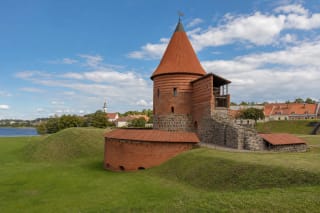
Kaunas Ninth Fort was part of the Kaunas Fortress system, one of its largest structures, standing about 8 km from the city centre by the Žemaičių road. VLE states that construction began in 1887 and ended in 1914, while the official museum links the start of the new concrete fort on the height by Kumpė with 1903. The Ninth Fort was the last and most modern link of the fortress ring.
Kaunas Fortress was created as one of the most important defensive nodes on the western border of the Russian Empire, and the city was encircled by a ring of 8 forts and 9 batteries. Yet at the start of the First World War the fortress failed to meet expectations: according to the official museum, the German army took it in 11 days, from August 8 to 18, 1915, while the Russian garrison of the Ninth Fort withdrew hastily on the evening of August 17. The fort itself suffered little damage during the war.
For that reason, this place cannot be viewed only as military architecture. The fort has several heavy layers of history, and today the museum and memorial speak first about repression, occupations, and Holocaust memory.
Prison and NKVD transfer point
After Lithuania restored independence, in 1924 the Ninth Fort was converted into a branch of Kaunas hard-labour prison. VLE states that it had 14 cells connected by corridors, and until 1940 more than 200 people were imprisoned here for anti-state activity, mostly communists. The state allocated about 80 ha of land to the prison farm, worked partly by the prisoners themselves.
After the 1940 occupation of Lithuania, the fort became an NKVD transfer point. Through it, not communists but Lithuanian intellectuals who resisted Soviet rule - teachers, officers, journalists - were sent to GULAG camps. The official museum mentions that when war began in 1941, retreating Soviets left some prisoners locked inside and shot those who tried to flee toward the city on Žemaičių plentas. After the Second World War, in 1944-1948, people resisting Soviet occupation were again imprisoned and killed in the fort.
Holocaust context of the Ninth Fort
During the Nazi occupation the darkest chapter of the fort's history began. It is believed that in 1941-1944 about 50,000 people were murdered at the Ninth Fort, including about 30,000 Jews. This is one of the key numbers explaining the scale and gravity of the place. VLE states that the fort was named Enterprise No. 100-B, and in July-August 1941 fourteen ditches were dug in a 5 ha area for the bodies of those murdered.
USHMM material on the Kovno Ghetto describes the broader context of persecution of Kaunas Jews, including the Great Action of October 28-29, 1941, when more than 9,200 Jews were driven to the Ninth Fort and shot. Those murdered here were not only Jews from Kaunas but also Jews brought to Lithuania from Austria, Belgium, Czechoslovakia, Poland, Germany, France, and the Netherlands, as well as Soviet prisoners of war. The last large group of French citizens was shot in May 1944.
In autumn 1943, as the Nazis began hiding evidence of their crimes, a prisoner team was forced to dig up the ditches and burn the bodies. The official museum and VLE state that on December 25, 1943 all 64 members of this corpse-burning team escaped from the fort. Because of their testimony, the Nazis failed to hide the scale of the crime completely.
Ninth Fort Museum and memorial
The museum at the Ninth Fort was established in 1958 and formally opened on May 30, 1959. In the Soviet period it created an ideological narrative and promoted the fort as a symbol of struggle against Nazism, deliberately omitting that NKVD terror victims had also been killed here. Only in 1988, during Lithuania's national revival, did the exhibition begin to change so that it could show the crimes of both Nazi and Soviet occupations.
On June 15, 1984 the memorial ensemble was presented to the public. It consists of a new museum building with a stained-glass hall and a memorial square with a monument made of three large concrete sculptural groups. VLE lists the creative team: architects Gediminas Baravykas and Vytautas Adolfas Vielius, sculptor Alfonsas Vincentas Ambraziūnas for the 32 m monument, stained-glass artist Kazys Morkūnas, and metal artist Leonas Vytautas Glinskis.
The memorial field is powerful because of scale: low fort ramparts, open space, and the angular concrete monument of geometric constructive forms create a deliberately heavy memory landscape rather than a decorative one. In 1997 the fortress underground spaces opened to visitors, with ammunition, powder, and food stores. In authentic cells, where last inscriptions remain on walls, an exhibition dedicated to the Jewish Holocaust was installed. VLE states that the museum has accumulated about 54,000 exhibits.
What to see
When visiting the Ninth Fort, leave time not only for the exhibitions but also for the fort spaces, memorial, murder sites, and outdoor territory. Some defensive walls or underground parts can be visited only with a museum guide.
This is not a place for a quick photo stop. It is better to plan at least 1.5-3 hours so there is time to read the exhibitions and walk quietly to the memorial territory.
How to visit respectfully
The Ninth Fort is a site of mass murder and mourning. It is important to keep quiet, avoid disrespectful photography, not climb on memorial elements, and understand that for some visitors the place may be personally painful.
Visiting with children is possible, but the content requires preparation. For younger children, the museum exhibitions and Holocaust themes may be too difficult, so decide in advance what you will explain and how.
Practical information
At the time of source review, the museum listed Monday as closed. In April-September it worked Tuesday-Friday 9:00-17:00 and weekends 10:00-18:00; in October-March Tuesday-Sunday 9:00-17:00, with last entry 30 minutes before closing. A regular visitor ticket cost about 8 EUR and a reduced ticket 4 EUR; permanent exhibitions were free on the last Sunday of the month. Tours of the defensive wall and underground spaces run at set times with advance registration, and from 2026 a new exhibition, Rescuers, about Jews rescued in Kaunas is being opened. Check exact times and prices on the official page before travelling.
The address is Žemaičių pl. 73. If you want to enter the defensive wall or underground spaces, check guide options in advance.