- Place
- Staigūnai, Lazdijai District Municipality
- Region
- Dzūkija
- Type
- a masonry Marian shrine consecrated in 2000, with a 41-metre tower and a separate memorial site for its predecessor
- Address
- 14 Staigūnai, Šventežeris Eldership, LT-67201, Lazdijai District
- Coordinates
- 54.26049, 23.69400
- Visit duration
- 45-75 minutes for the present shrine and old chapel site; longer when attending Mass or an indulgence feast
- Best time
- before or after the 10:00 Sunday Mass for the interior; in daylight for a quiet visit to both sites, or during a feast after checking the programme
Kryžiai Chapel, Kryžiai Shrine, Diocesan Shrine of Our Lady, Queen of the Rosary at Kryžiai
One visit encompasses two distinct parts of Kryžiai Shrine
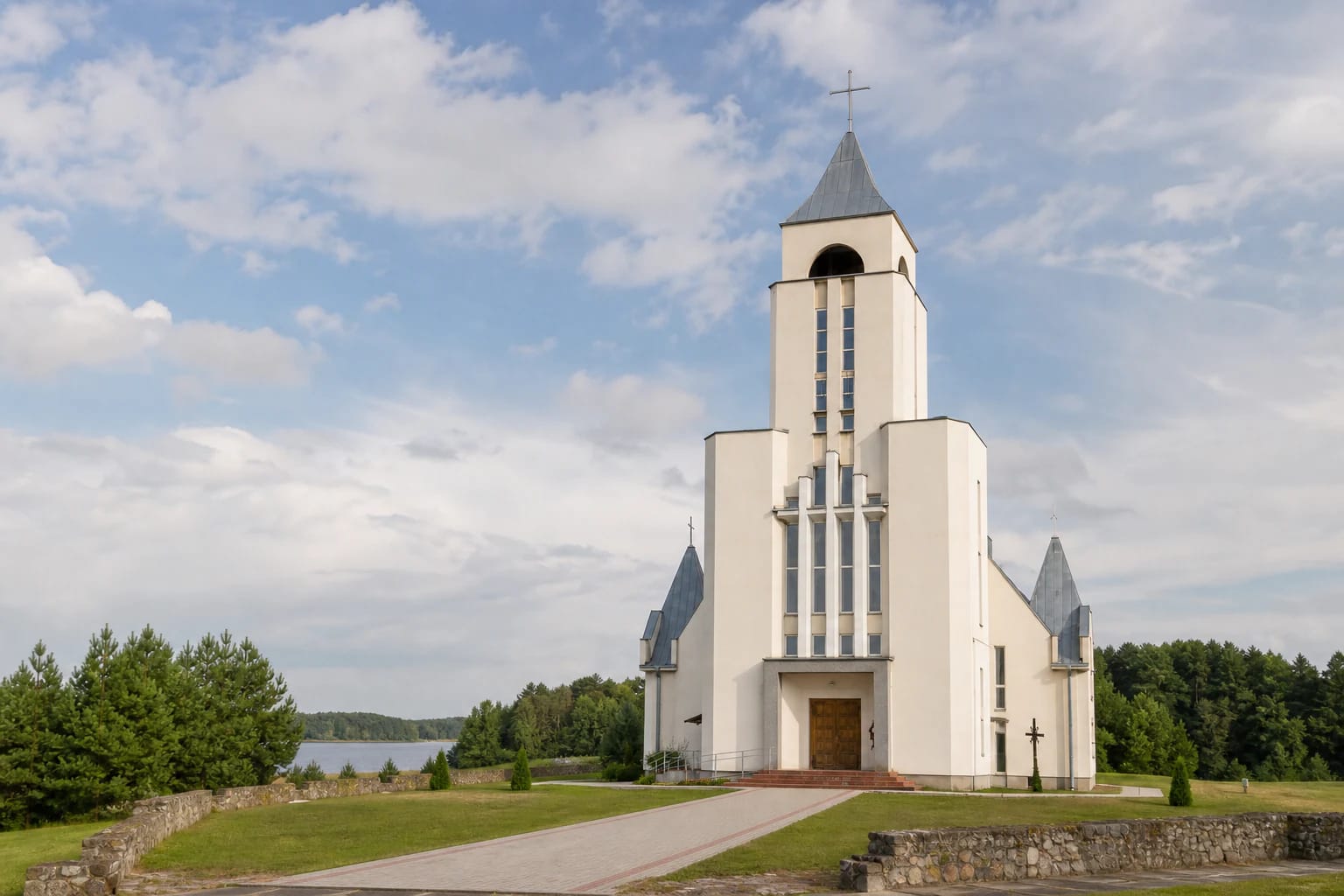
The present chapel stands on an open hill between Staigūnai and Sutrė on the south-western shore of Lake Dusia. Its stepped white facade and tall central tower are visible from a distance. This is an active diocesan shrine of Vilkaviškis Diocese, so the building is best understood not as an isolated piece of modern architecture but as the centre of a living pilgrimage tradition.
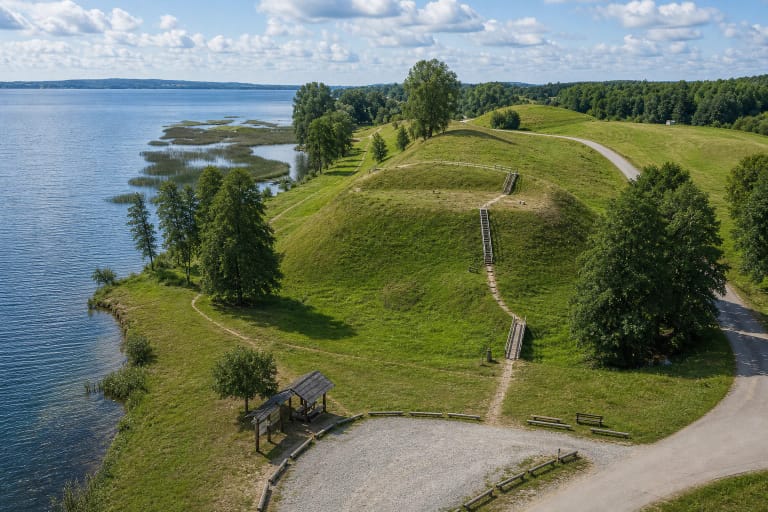
The earlier chapel occupied another site lower down and closer to the lake. Fragments of its foundations, memorial crosses and a well remain there. Saugoma.lt notes a belief that the water possesses special powers, but this is part of religious faith and local tradition rather than a medically established property.
Visit both points together. The current building represents the shrine restored after Lithuanian independence, while the old site makes the destruction of 1963 tangible. Before the Saints Peter and Paul celebration, pilgrims still gather by the former foundations and crosses, showing that this is more than an archaeological trace.
The documented history of the shrine begins in 1807-1816
Vilkaviškis Diocese connects the origins of Kryžiai with a story from the war with Sweden in 1702. Tradition says that Hetman Michał Serwacy Wiśniowiecki's troops erected three crosses and hung a copy of the Mother of God of Barūnai image on one, and that local people hid the image after the battle. A later account of a veteran recovering his sight belongs to devotional tradition rather than a verified sequence of events.
The firmer documentary chronology begins in 1807, when crosses returned to the old site. With episcopal permission, the Meteliai priest Ignas Žibanavičius built a chapel; on 25 May 1816, Augustinas Polikarpas Marciejevskis, an official of Seinai Diocese, celebrated its first Mass. Pope Pius VII granted indulgences to pilgrims visiting the shrine.
Almost a century later, the Meteliai priest Vincas Jurgilas rebuilt the chapel and dedicated it to the Blessed Virgin Mary, Queen of Angels. Large groups of pilgrims arrived at Pentecost and the feast of Saints Peter and Paul. This tradition explains why a small lakeside site was ultimately restored as a shrine serving the entire diocese.
Lithuanian emigrants helped rebuild the chapel demolished under Soviet rule
The old chapel was demolished on Soviet orders on 9 July 1963. Even before Lithuania regained independence, the US-based priest Jonas Buikus and Monsignor Ladas Tulaba founded a reconstruction fund. The site's memory was thus maintained not only in nearby villages but also among Lithuanian communities abroad.
The fund commissioned Italian sculptor Gregor Vincenzo Mussner to carve a wooden statue of Mary after the Kryžiai image. Following the restoration of independence, Sisters of the Holy Family brought it from Rome to Lithuania. It remained in Meteliai church until the new chapel was ready.
The cornerstone of the new chapel was blessed on 5 July 1992. Construction was completed through the efforts of Meteliai priest Vytautas Prajara, and Bishop Juozas Žemaitis MIC consecrated the building under the title of Our Lady, Queen of the Rosary on 11 June 2000. Bishop Rimantas Norvila declared it a diocesan shrine on 26 June 2009.
Juozas Žakauskas made the facade itself read as a cross
Architect Juozas Žakauskas designed a single-nave masonry chapel with side chapels and service spaces behind the sanctuary. Its irregular cross plan and a sanctuary that steps inward towards the apse are easier to understand by walking around the building than by viewing only the front.
The main vertical accent is the 41-metre central tower. Its stepped mass, long narrow window strips and facade planes rising to different heights create a cross-shaped silhouette. Grey conical sheet-metal roofs crown the tower and lower side volumes, making the white shrine conspicuous against the green Lake Dusia landscape.
A paved path and steps lead to the entrance, with a sloping approach at one side. Nevertheless, the protected-areas authority explicitly says that visitors with mobility impairments require a companion. This is not a guarantee of complete accessibility, particularly on the route to the lower old-chapel site.
Plan interior access around Sunday Mass, not Google's opening hours
The official Meteliai parish page lists Mass at Kryžiai diocesan shrine every Sunday at 10:00. On 25 July 2026, Google displayed hours of 09:00-12:00 on Saturday and Sunday and described weekdays as closed, but the parish does not confirm these as general tourist opening hours.
For the most reliable interior access, arrive before or after Sunday Mass, do not interrupt the liturgy and recheck the current time on the official parish page. The parish publishes neither a visitor ticket nor an admission tariff. Call the priest on the official number +370 611 43727 to arrange a group, baptism, wedding or special visit.
Pentecost, the feast of Saints Peter and Paul and the Octave differ from a quiet weekend: more cars, processions and people may be present, and the programme is updated each year. Choose a non-feast day for an unhurried architectural visit. To experience Kryžiai as a pilgrimage shrine, come for a programme confirmed by the diocese or parish.