- Place
- Kėdainiai, Kėdainiai District Municipality
- Region
- Aukštaitija
- Type
- historic urban centre of a multi-confessional town
- Coordinates
- 55.28673, 23.97977
The old town as a single object
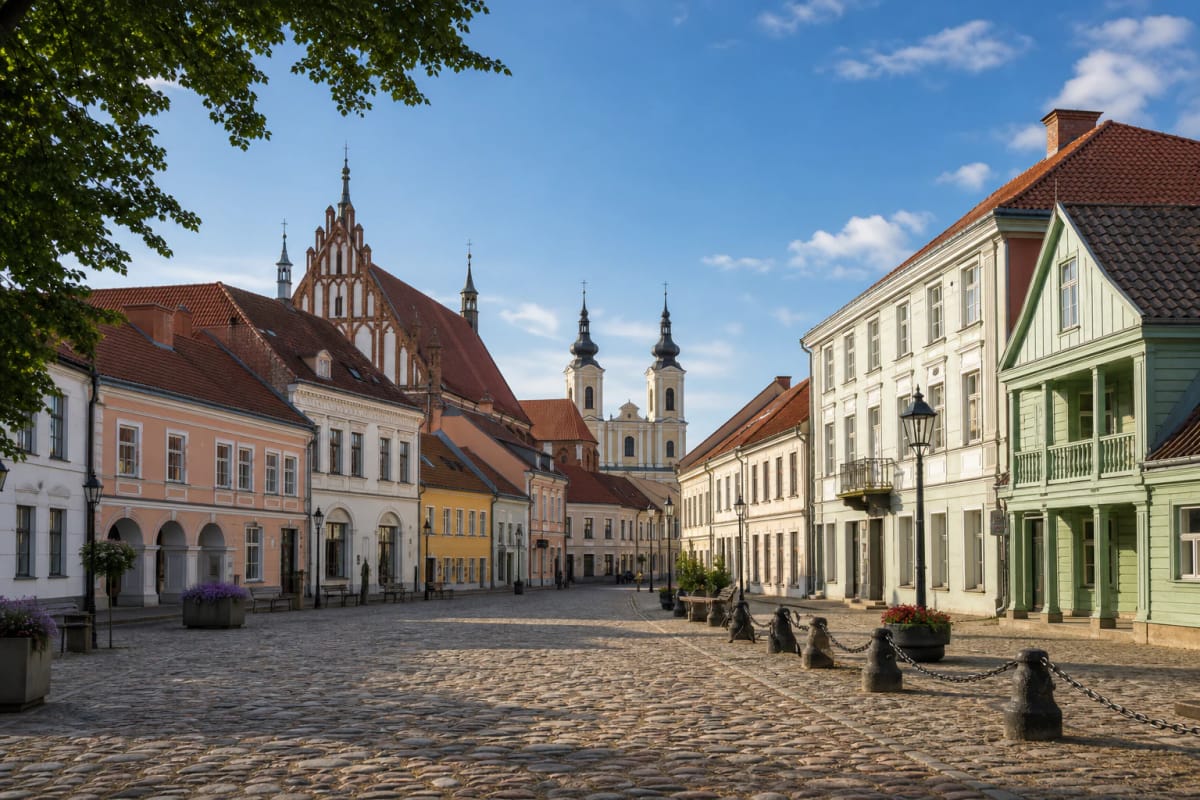
Kėdainiai Old Town is not one square or one attractive facade. The Register of Cultural Property protects it as a historic urban centre of about 87 ha on the right bank of the Nevėžis, whose value comes from the street network, market squares, building fabric, houses of worship, riverfront, and historical layers.
The best way to visit Kėdainiai is on foot. Walk from Didžioji Rinka to Senoji Rinka, turn into Radvilų, Didžioji, Josvainių, and J. Basanavičiaus streets, and watch how the squares, buildings, and sacred landmarks change.
From 1372 to Magdeburg rights
Kėdainiai is first mentioned in 1372, in Wigand of Marburg's chronicle. Until the mid-fifteenth century it belonged to the grand duke; in 1447 it passed to the Radziwiłłs, and from 1544 to 1614 to the Kiška family. In 1590 Jonas Kiška obtained Magdeburg rights and a coat of arms for the town; the rights were renewed several times later.
These dates matter because the old town is not a late decorative centre. It grew as a place of trade, roads, crafts, and self-government, where the market was not an empty ceremonial square but the economic and legal core of town life.
Radziwiłłs, mausoleum, and a multi-confessional town
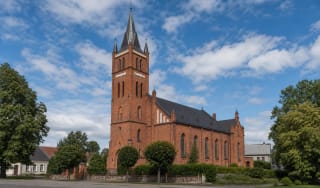
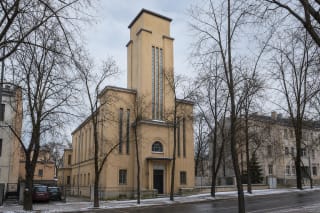
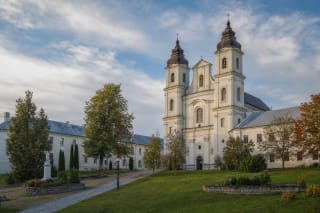
In 1614 Kėdainiai passed to the Biržai-Dubingiai branch of the Radziwiłł family and became the centre of Kėdainiai County. From 1627 people of different nationalities and faiths settled freely here: Dutch, Germans, Scottish Reformed settlers, and Jews. A Reformed school founded in 1625 became a gymnasium in 1631. This layer is visible in the town's houses of worship: Evangelical Reformed, Lutheran, St Joseph's, Transfiguration, and St George's churches, as well as the synagogue complex.
The key monument of this era is the Evangelical Reformed Church, wooden in 1629 and brick-built in 1631-1652. Beneath it is the Radziwiłł mausoleum, the only surviving Radziwiłł mausoleum in Lithuania. It holds six unique seventeenth-century sarcophagi, including those of Krzysztof I Radziwiłł the Thunderbolt and Janusz II Radziwiłł; the latter is attributed to Toruń goldsmith Johann Christian Bierpfaff.
Great and Old Market squares
Didžioji Rinka, the Great Market Square, is one of the old town's key points. It gives the strongest sense of a trading town's scale: a square shaped not only for ceremony but for daily movement, markets, and meetings. Historically the old town had several market spaces and a dense street network.
Senoji Rinka, the Old Market, shows another layer: an earlier town centre and a different street logic. Walking between these squares helps explain why Kėdainiai is valuable as urban fabric, not merely as a set of individual monuments.
The 1655 Treaty of Kėdainiai and later breaks
On October 20, 1655, Janusz Radziwiłł and more than 1,100 nobles of the Grand Duchy of Lithuania signed the Treaty of Kėdainiai, ending the union with Poland and forming a union with Sweden, with King Charles X Gustav of Sweden declared Grand Duke of Lithuania. After the 1656 uprising against the Swedes the treaty ceased to apply, but it shows that the town was a space of political decisions.
Later development was shaped by the railway: the Liepāja-Romny line built in 1871 encouraged industry. Town rights were lost in 1817 and restored in 1919. In the old town these layers appear through changing building patterns, street functions, and urban life; in the former manor park, even an eastern-style minaret from around 1880 survives.
Visiting without a ticket
Kėdainiai Old Town is an open urban space, so it has no single opening time or general ticket. Squares, streets, and exterior architecture can be explored independently.
For specific museums, churches, or exhibitions, such as the Radziwiłł mausoleum or the Multicultural Centre, check their separate opening times and tickets. For the old-town route, daylight and comfortable shoes are best, because the street and market structure is only really legible on foot.