- Place
- Kybartai, Vilkaviškis District Municipality
- Region
- Suvalkija
- Type
- visitor-accessible vaulted cellars beneath the 1870 customs warehouse in the Kybartai railway complex
- Address
- 37 J. Basanavičiaus Street, Kybartai
- Coordinates
- 54.63997, 22.76118
- Visit duration
- according to the programme arranged in advance; the complete historic Kybartai walk is usually advertised at about three hours, while no cellar-only duration is published
- Best time
- only after confirming a guided visit; choose a dry day and wear footwear suited to a damp, uneven brick floor
Kybartai railway station underground vaults, Kybartai customs cellars, Kybartai customs warehouse basement, Virbalis station cellars
The cellars are beneath the customs warehouse, not the whole station building
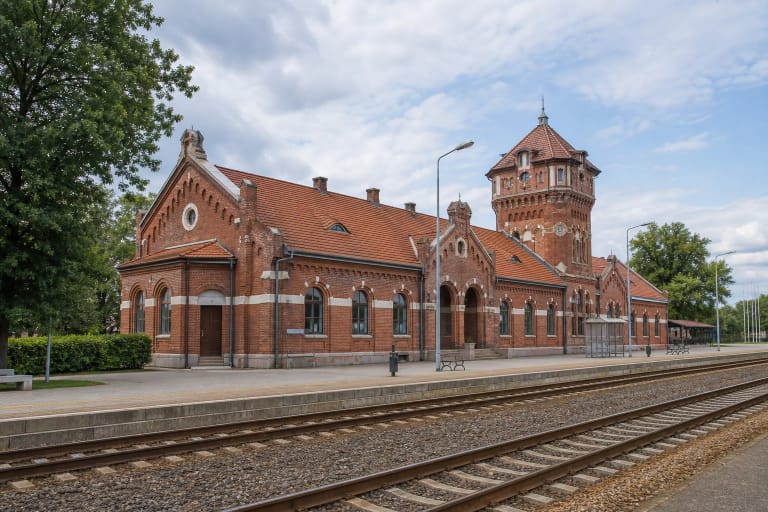
The visitable space is at 37 J. Basanavičiaus Street. Online descriptions often reduce it to an underground site beneath Kybartai railway station, but the Cultural Heritage Register supplies a more exact identity: this is the basement of the customs warehouse within the first Kybartai railway-station building complex. The warehouse has its own register code, 27476, and is one of seven component properties in the state-protected ensemble.
The register dates the warehouse to 1870 and its eastern extension to the early twentieth century. This separates two periods that are often conflated: the high-class border station complex began to emerge in the second half of the nineteenth century, but the particular protected customs warehouse and basement are dated to 1870. The year 1863 in community retellings belongs more broadly to the station's early development and should not displace the registered warehouse date.
The coordinates 54.639975, 22.761175 mark the warehouse site, not a guaranteed unlocked cellar door or a car park. The property stands within an active border-infrastructure setting, so visitors must obey signs, keep out of operational areas, and use only the entrance agreed with their guide.
A border station joined two railway systems
The Kaunas-Virbalis railway, laid in the second half of the nineteenth century, connected cities of the Russian Empire with Prussia. The Cultural Heritage Register says that a border station and customs operation developed at Kybartai, with French engineers designing a complex of the highest class. Until 1965 the station bore the name Virbalis because the original plan had placed the frontier station in that nearby town.
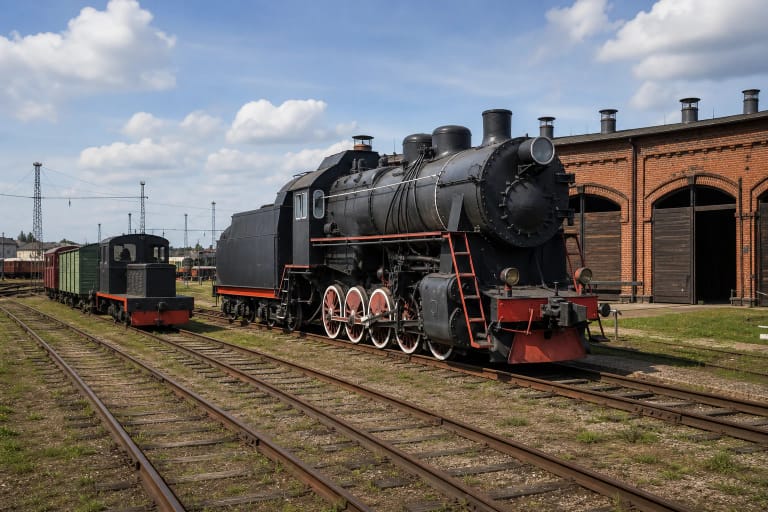
Kybartai became a transfer and transhipment point between the Russian Empire's 1,524 mm gauge and the European 1,435 mm standard. That technical break explains the scale of both the representative station and its customs and warehouse buildings. The register states that one tenth of the Russian Empire's imports and exports passed through Virbalis customs before the First World War. This is a registered historical statement about the complex, not a measured share attributable to this single basement.
The old station building was blown up during the Second World War and rebuilt in 1950, while other buildings in the ensemble were also damaged after the war. The survival of the cellars consequently matters not as an isolated mystery but as a material layer of a once immense border interchange beneath a specific goods warehouse.
Eighteen segments and three bays explain the procession of arches
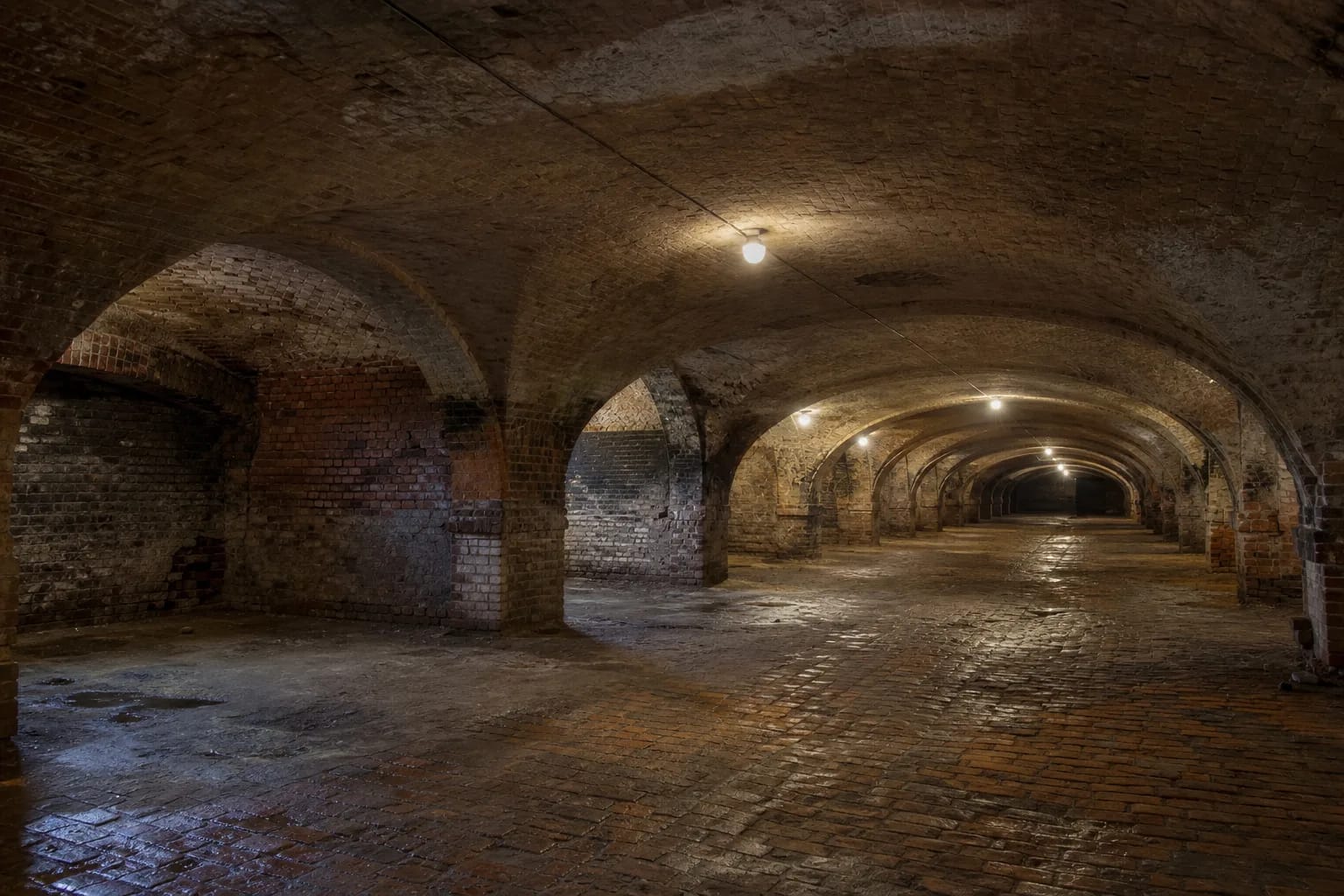
The Cultural Heritage Register describes a basement beneath the full length of the elongated rectangular warehouse. Its plan is divided into 18 segments and, longitudinally, into three bays: a wider central space and two narrower flanks. Arches in the transverse walls connect them, producing the striking sequence of repeated vaults seen along the cellar.
Protected features include the red-brick basement walls and vaulted construction, the gate and light-well openings, and the type of red-brick floor. A 2017 assessment called the walls and vaults satisfactory but the floor poor. That historic assessment is not a present-day safety certificate, yet it explains why damp and uneven brick paving is part of the real place rather than visitor-centre scenery.
Some openings are blocked, and in visitor stories the wall at the end often becomes the threshold of a secret tunnel. The register instead documents the cellar plan, arches, and openings within the warehouse; it does not record an underground route to Russia, the station, or neighbouring villages. The visible architecture is best understood as a rationally planned storage basement.
Rediscovery in 2002 and the community's work toward visitor access
The official Kybartai community site says that workers removing part of a loading ramp during renovation in 2002 opened a void containing red-brick arches. Water stood below, so it had to be pumped out before rubbish and construction debris could be removed. This was not an archaeological discovery of an unknown tunnel but the recovery of a long-disused, locked basement belonging to the registered customs warehouse.
The World Kybartai Society organised the first event in the cellars in 2009 for the ninetieth anniversary of Kybartai's foundation. Visitors then crawled through an opening broken into a wall and descended a ladder. In 2017 the local community widened the entrance, built brick steps, laid paths, and cleaned the space, while the municipality paid for lights in the tunnel.
The later story was not one of uninterrupted improvement. An official 2022 community report mentioned humidity, mould, standing water, problems with the gates and electricity, and replacement of failed lamps from tour income. That report does not diagnose conditions today, but it is ample reason to ask afresh before every visit whether the cellars can safely receive a group.
A goods cellar is documented; long secret tunnels belong to oral tradition
The registered building name, loading ramp, full basement beneath the warehouse, and border-customs setting all support use for goods storage. Local descriptions also suggest that rooms packed with ice may have provided cold storage. That is plausible, but the checked register record does not document a particular ice-storage system, so it should not be presented as certain.
Stories say that a blocked opening once continued to the station, nearby villages, or what is now Russian territory; other versions invoke rulers' security or smuggling. The register records 18 segments and three longitudinal bays beneath the customs warehouse but no far-reaching network beyond it. Without investigation these remain local legends, and nobody should cross a barrier in search of them.
Plans must also be distinguished from completed interpretation. In 2017 the community discussed creating a smuggling museum and a warehouse-manager's corner underground, but these were future ideas. The checked sources do not establish that the cellar now operates as a permanent museum with a collection, ticket desk, and daily opening schedule.
Access is by arrangement, with no promised tariff or step-free route
The cellars are never freely accessible at arbitrary times. On 19 July 2026, the public visitor listing still directed enquiries to +370 612 85242, but it also attached an outdated community-chair title to that contact. Newer official Kybartai reports identify Rūta Skeltienė as community chair, so callers should confirm not only a date and time but who currently guides the tour and exactly where the group meets. An alternative is the contact address published by the official Kybartai site, kybartieciai@gmail.com.
No regular opening hours or reliable official current ticket price could be found. The cellars are usually included in an arranged walk called Pėsčiomis po istorinį Kybartų miestą, whose published guideline is around three hours, but no separate cellar-only duration is given. An old fee or an amount in a commercial coach-tour offer is not a dependable current tariff; ask when booking.
Visitors descend by steps, and no detailed audit covers a step-free route, handrails, emergency lighting, toilets, or evacuation conditions. Humidity, uneven brick paving, low arches, and variable electrical condition matter for children, older visitors, and people with mobility or sight requirements. Wear closed non-slip footwear, carry a small torch only as backup, and discuss age and access needs directly with the guide before travelling.