Circle chase
Žiužis: the Scarf Chase
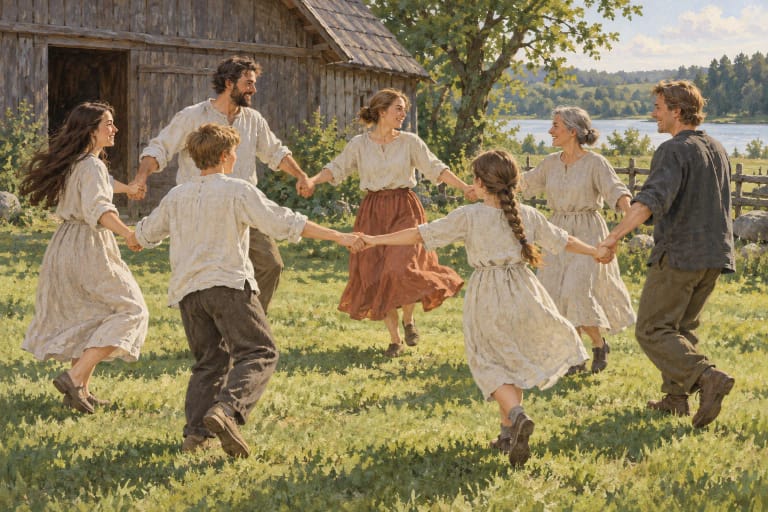
Žiužis names both a rolled cloth and the game played with it. In this activity, a scarf passed secretly behind the circle starts a short chase back to a player’s place.
Read →
Music and movement
Choose an activity and learn how to begin: participants, space, movement sequence and the source of the documented version. Historical rules and our teaching advice are identified separately.
Circle chase
Žiužis names both a rolled cloth and the game played with it. In this activity, a scarf passed secretly behind the circle starts a short chase back to a player’s place.
Read →Recognition game
A blindfolded player finds someone and tries to recognise them. This version of Gūžputpelė uses hands rather than sticks and leaves out the separate dialogue variants.
Read →Guessing game
A small token stands for a ring hidden in someone’s cupped hands. The returning guesser, called the mouse, tries to discover where the distributor left it.
Read →Line chase
A gander protects the geese lined up behind him while a wolf tries to catch the last goose. This Linkuva form ends each chase by exchanging roles.
Read →Circle chase
The circle helps the mouse escape the cat: raised hands open a passage and lowered hands close it. This game uses one pair and one circle, without a maze.
Read →Gate game
A wolf and a bear form a gate while a gander leads geese through it. Each stopped goose chooses one of two groups; this activity ends when the groups are formed.
Read →Chase with safe places
Squirrels move between trees while two catchers may tag them only on the way. Reaching a tree provides safety, making the timing of each crossing the central challenge.
Read →Signal chase
A keeper sends the pigeons out of their nest, then signals them to return. One hawk tries to catch a pigeon during the return, triggering a three-way change of roles.
Read →Folk dance
A slow dance in 4/4: couples walk forwards and back, take side steps and pause while one partner turns. This follows the sequence published by LNKC.
Read →Folk dance
Partners face each other to mime winding thread, stretching it and hammering, then dance a waltz-polka. This is the paired version published by LNKC.
Read →Folk dance
A paired dance with an extended foot, a springing recovery, stamps and a turning section. The LNKC description also offers an alternative second section for children.
Read →Folk dance
Two couples form a moving star, pause to clap and separate for a polka. The LNKC version has two sections of sixteen bars each.
Read →Folk dance
A circle of couples, partner claps and changes of place. This is Solveiga Zvicevičienė’s educational version, with two sections of sixteen bars each.
Read →Folk dance
Couples move towards the centre, retreat and change partners. In the LNKC version, new partners turn with walking steps and clap at the changes.
Read →Folk dance
The version taught in the Vilnius University Ratilio ensemble’s workshop combines travelling in couples, stamping and passing around a partner without turning the body.
Read →Folk dance
Four dancers travel in two couples, trace a triangle with the foot and move one pair behind the other. This is LNKC’s four-person version, with sections of eight and sixteen bars.
Read →