- Place
- Kretinga District Municipality
- Region
- Samogitia
- Type
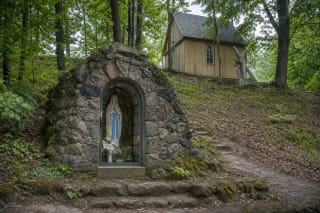
- 7-by-7-metre fieldstone Lourdes grotto built in 1933 with authentic cast-iron statues of Mary and St Bernadette
- Address
- 4A J. Pabrėžos St, Kretinga
- Coordinates
- 55.89273, 21.24350
Kretingos Lurdas, Kretinga Lourdes Shrine, Sanctuary of the Gate of Heaven, Kretinga Franciscan Lourdes
The grotto hides below J. Pabrėžos and Vilniaus streets in the town centre
Kretinga Lourdes is set into the slope of the Pastauninkas valley, beside the stream also known as the Dopultis, between the Church of the Annunciation and the former St Anthony Palace. Its address is 4A J. Pabrėžos Street and its coordinates are 55.8927271, 21.243503. From the centre, walk through the Franciscan ensemble or descend the renewed stairs from Vilniaus Street.
There is no large visitor car park immediately beside the grotto. Leave a vehicle only in a lawful public space on J. Pabrėžos or surrounding central streets, keeping monastery, school, and residential access clear. Traffic and entry arrangements can change during feasts and events, so follow temporary signs.
In 2022 the municipality replaced old path tiles, bridge safety rails, and handrails on the stairs from Vilniaus Street, repaired lighting, and removed metal barriers added at the grotto in the Soviet period. The retaining wall was repaired in 2024. Valley access is easier, but steps, gradients, and damp sections remain, and no official specification certifies a completely step-free route.
In 1933 the Franciscans created an equivalent of Lourdes, not a natural cave
The grotto commemorated the 75th anniversary of the 1858 Marian apparitions to Bernadette Soubirous at Lourdes in France. Augustinas Dirvelė, guardian of Kretinga monastery, visited Lourdes twice in connection with the project. Franciscan friars and local volunteers carried it out under engineer Rapolas Žigas.
Kretinga had no natural cliff suitable for a cave, so a grotto measuring roughly seven by seven metres was built from fieldstones and set into the valley slope. The material came from an old Franciscan brewery demolished for the purpose. Stone from a utilitarian monastery building thus became a sacred setting modelled on the Massabielle rock in France.
Lithuanian-American Franciscan tertiary Liudvika Gedminaitė commissioned two cast-iron statues at Lourdes, brought them to Lithuania, and donated them to Kretinga together with altar fittings. The figures of Mary and kneeling Bernadette holding a candle were so heavy that six men carried each. They are not replicas made during the 1989 restoration: believers had preserved the originals inside the church.
Two openings, two statues, and a marble altar that no longer survives
The grotto has connected upper and lower openings. A white-and-blue Our Lady of Lourdes stands above, while Bernadette kneels across the lower space, looking towards Mary with a candle in hand. This diagonal composition recreates the central narrative of the French shrine, and the figures should be read together as one scene.
A white-marble altar stood in the main opening from 1933 and Mass was celebrated there. It was destroyed in 1941 and not reconstructed when the grotto returned in 1989, so today's open interior differs materially from what interwar pilgrims saw. An altar visible in old photographs is not a surviving exhibit to look for now.
A subterranean spring emerges to the right of the grotto and the Pastauninkas stream flows farther away. Tradition credits the water with healing power because it travels eastward, once described as flowing against the sun; water brought from Lourdes in France was poured into it during ceremonies in 1933 and 1989. This is religious tradition, not a medically proven effect or a current drinking-water quality test.
The 1933 consecration made the grotto a national pilgrimage site
Consecration celebrations lasted two days. On the evening of 1 August 1933, after Vespers, a candlelit procession of thousands moved from the church into the valley, where Augustinas Dirvelė blessed the statues. The next day, for Porziuncola, Masses were celebrated at all seven church altars, and the Franciscans had arranged reduced train fares for pilgrims travelling to Kretinga.
About 25,000 pilgrims joined the procession and solemn Mass on 2 August, alongside 76 diocesan priests, four religious priests, ten seminarians, President Antanas Smetona and his wife Sofija, and Defence Minister Balys Giedraitis. Bishop Justinas Staugaitis of Telšiai formally consecrated the grotto.
A congress of Franciscan tertiaries named the site the Sanctuary of the Gate of Heaven in 1938 and established a fund for poor young men pursuing the priesthood. Porziuncola on 2 August remains especially connected with the grotto, while the present parish also marks St Anthony on 13 June. A particular grotto event is not guaranteed each year; check the parish programme.
The wartime and Soviet story requires precise, respectful language
At the beginning of the Nazi occupation in 1941, the Lourdes valley and the area around the monastery pond became a place of suffering for Kretinga's Jews. Genocide Centre research identifies seven Jewish men shot beside the monastery pond and later buried in the Jewish cemetery, while the regional encyclopaedia links violence to the Lourdes site. The evidence does not justify calling the entire grotto a major mass grave, but this layer of history cannot be omitted.
The white-marble altar was smashed in the same year. In 1952 Soviet authorities ordered the grotto half-filled with earth and converted St Mary's Square into a military exercise ground. Believers saved the statues of Mary and Bernadette by moving them into the Franciscan church.
The site returned to the Catholic community at the end of 1988. In spring 1989, residents organised by Canon Bernardas Talaišis excavated the grotto, cleared the Pastauninkas stream, laid paths, replanted the valley, and returned the statues. Bishop Antanas Vaičius of Telšiai reconsecrated it on 18 June.
A living shrine, cultural monument, hours, and a 4.6 rating
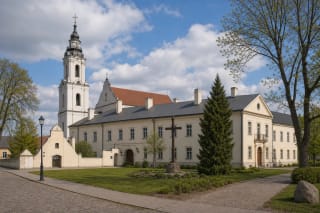
Kretinga Lourdes became a state-protected cultural property in 2005 and a cultural monument in 2008, with unique code 27502. It belongs to the larger ensemble of the Bernardine monastery and Church of the Annunciation, making the church and monastery natural extensions of a visit.
Religious feasts, choir gatherings, Franciscan school celebrations, and town events take place here, but the parish publishes no permanent separate schedule of Masses at the grotto. To attend worship or arrange a group visit, check the Telšiai Diocese page for Kretinga parish and contact its office; church Mass times do not automatically describe events in the valley.
The outdoor grounds are free. In July 2026, Google Maps listed 24-hour access and a rating of 4.6 out of 5 from 170 reviews. The valley has lighting, but the architecture and paths are most comfortably read by day. During an event, respect prayer, do not treat the shrine as a photoshoot prop, and never climb on its stones. Ratings and access conditions can change.