- Place
- Vilnius City Municipality
- Region
- Vilnius
- Type
- national ceremonial square, historic site, and public urban park
- Address
- Gediminas Avenue between Vasario 16-osios and J. Tumo-Vaižganto Streets, Vilnius
- Coordinates
- 54.68939, 25.27083
- Visit duration
- 45-90 minutes for the square and its historical markers; 2-3 hours when combined with the Museum of Occupations and Freedom Fights
- Best time
- a dry morning or evening from late spring to early autumn, after checking the fountain and event schedule
Lukiškių aikštė, Lenin Square, Soviet Square, Plac Łukiski
How to read the present 3.5-hectare square
Lukiškės Square occupies a major central block in Vilnius. Gediminas Avenue borders it to the south, Vasario 16-osios Street to the east, and J. Tumo-Vaižganto Street to the west. The coordinate 54.6893917, 25.2708278 is a representative point within the square rather than a gate or car park. The twin towers on its northern edge belong to the separate Church of Saints Philip and James and Dominican monastery ensemble.
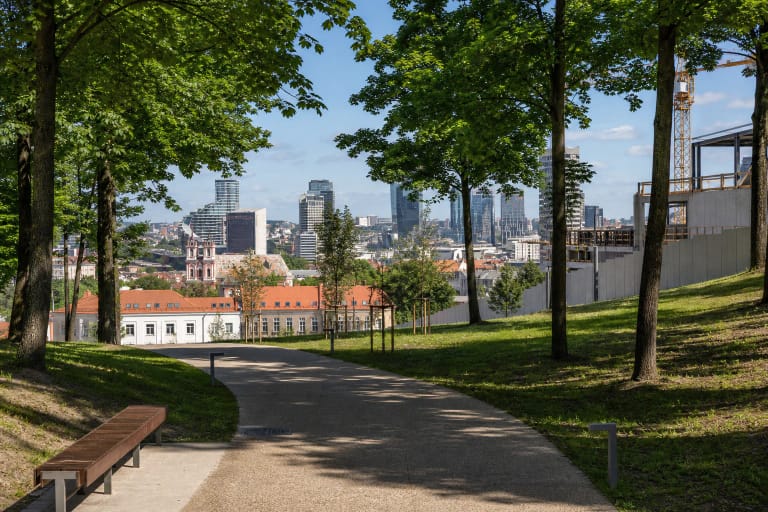
The current plan deliberately combines two different functions. A broad hard-surfaced zone beside Gediminas Avenue accommodates ceremonies, commemorations, fairs, and events, while lawns and tree-framed recreation occupy more of the northern area. Pale paths branch through the grass along everyday pedestrian routes. The designers interpreted this network as a tree of life linking the interior with streets around the square.
Vilnius City Parks lists benches, lighting, a children's playground, drinking fountains, a summer reading room, a cafe, and a public toilet. The interactive fountain is built flush into the paving without an open basin, so its hard surface can return to other uses when the jets are off. The fountain, reading room, cafe, and toilet may be seasonal or keep independent hours, so check their current operation before travelling.
From an outlying market ground to the execution site of the uprising
The open space began taking shape in the mid-eighteenth century. VLE records an area of about two hectares in 1817 and eight hectares in the city plan of 1837. St George's Avenue, now Gediminas Avenue, was laid across its southern part in 1852. In 1860, the city's principal markets were concentrated here. Grain, horse and livestock, hay, and food markets initially occupied 4.29 hectares, but their trading area had shrunk to 0.7 hectares by the early twentieth century.
Between June 1863 and March 1864, the Russian imperial authorities publicly hanged or shot 21 participants in the uprising in Lukiškės Square. The dead included its leaders Zygmunt Sierakowski and Konstanty Kalinowski. Their bodies and those of other victims were secretly buried inside the restricted military fortress on Gediminas Hill. National Museum archaeologists recovered the remains of 20 men in 2017-2019, and they were reinterred in the Old Rasos Cemetery chapel-columbarium in 2019.
Representative buildings increasingly framed the square in the late nineteenth century. An exhibition and circus building operated here from 1897 and later screened films. St Casimir's Fair moved here from Cathedral Square in 1904. During 1920-1939, the square continued to host a market, major fairs, military parades, receptions for state visitors, and protest rallies. Its history therefore combines trade, entertainment, political assembly, and state violence rather than belonging to a single narrative.
Soviet Square and Lenin Square: a landscape of official ideology
Following the Soviet occupation, the site was named Soviet Square in 1940-1941 and 1944-1952, then Lenin Square from 1952 to 1991. State-organised demonstrations and military parades passed through it on Soviet holidays. Administrative institutions surrounded the space. Across Gediminas Avenue, the building that now houses the Museum of Occupations and Freedom Fights was used by the NKVD and KGB in 1940-1941 and 1944-1991. The repression that occurred inside that building is a separate history, though inseparable from the wider setting.
The square was redesigned in 1949-1952 by architect Vladislovas Mikučianis and colleagues. A bronze Lenin by Soviet sculptor Nikolai Tomsky was installed at the centre in 1952 on a red-granite pedestal designed by Mikučianis. Nine red-gravel paths radiated from the monument and linden trees framed the perimeter. The composition subordinated the whole public space to one ideological focal point.
The Lenin monument was dismantled on 23 August 1991, the anniversary of the Molotov-Ribbentrop Pact. It must not be projected into the current scene: neither the sculpture nor its Soviet pedestal remains in today's square. After the restoration of independence, a prolonged public debate began over how a large green space should reconcile national representation, freedom-struggle memory, and ordinary daily use.
From repeated competitions to the 2016-2018 reconstruction
On 11 February 1999, the Seimas designated Lukiškės Square as the country's principal ceremonial square, to include memorial accents for freedom struggles. Workshops and several architectural and memorial competitions followed, including a 2008 competition for a Freedom symbol and the square's redesign. The winning proposals from those processes were not simply built as the square seen today, so the present landscape should not be described as a direct execution of one earlier competition winner.
In 2016, the municipality presented a new design concept by architects Gintaras Čaikauskas and Linas Naujokaitis. A symbolic line between occupation and freedom separates a formal hard-surfaced area from a green democratic zone while holding both within one civic landscape. Paths were adjusted to observed walking directions, the green perimeter was retained, and facilities for rest, children, and events were planned into the same composition.
The principal works lasted approximately eighteen months and the square reopened to visitors on 2 November 2017. The municipality reported laying more than 40,000 paving blocks and 15,000 granite slabs, using 262 tonnes of decorative gravel for paths, and installing 66 lights. The square contract was valued at EUR 3.7 million, with approximately EUR 1 million more invested in the surrounding access. The completed renewal received its formal public opening on 9 June 2018 when the motion-responsive fountain began operating.
Free around-the-clock access does not mean every feature always operates
Vilnius City Parks publishes opening hours of 00:00-24:00 for Lukiškės Square, and there is no admission ticket for the outdoor public space. Those terms do not set the hours of the seasonal cafe, summer reading room, toilet, or an organised event. A concert, commemoration, fair, technical setup, fountain maintenance, or safety operation can temporarily fence off part of the lawn or paving.
Most of the square is level and its principal routes use hard surfaces, making it easier to cross with wheels than many of Vilnius's hillside sites. No comprehensive public audit of every gradient, path, and seasonal installation was found, however. On an event day, confirm routes, toilet availability, and assistance with the organiser. Use only legal parking after checking current central-zone rules; public transport, cycling, or walking is usually more practical here.
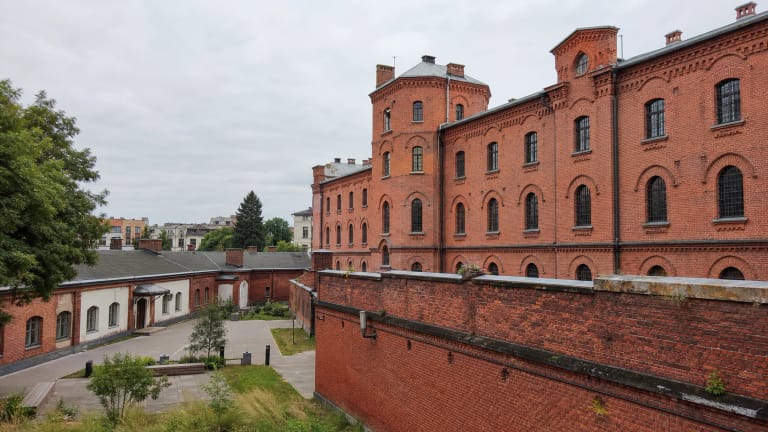
Allow 45-90 minutes to understand the landscape and its historical markers. For a deeper route, combine it with the Museum of Occupations and Freedom Fights across the avenue and the view from Tauras Hill. Lukiškės Prison 2.0 is a few minutes west but is not part of the square, and its tours require separate planning. On 21 July 2026, the most recently indexed summary of the exact Google Maps card showed 4.6 out of 5 from 7,298 reviews. Both the average and count will change.