- Place
- Kaunas City Municipality
- Region
- Kaunas
- Type
- active mature Baroque church and part of the former Discalced Carmelite monastery ensemble
- Address
- Gedimino g. 1, Kaunas
- Coordinates
- 54.88984, 23.92016
- Visit duration
- 20-40 minutes for the exterior, churchyard, and interior when open
- Best time
- daylight for the architecture; for the interior, shortly before or after a public service without disturbing worship
Kaunas Carmelite Church, Holy Cross Church in Kaunas, Kaunas Church of the Exaltation of the Holy Cross
A Baroque church in a busy city-centre setting
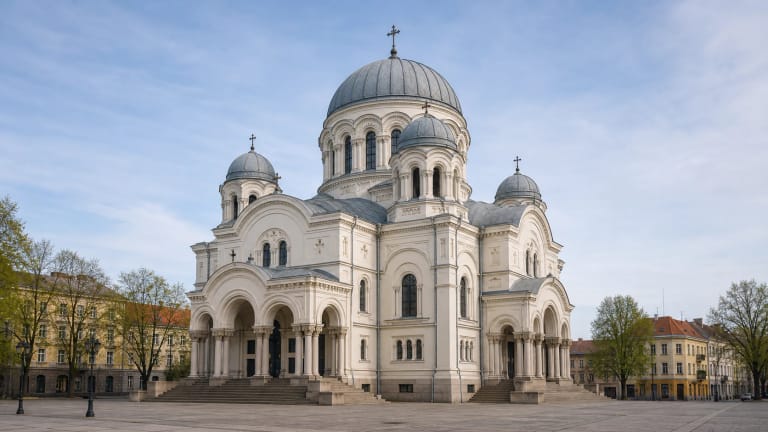
Kaunas Holy Cross Church stands at the end of Gedimino Street between Naujamiestis, the railway approaches, and the Nemunas riverfront. Roads and large commercial buildings now press close to its churchyard, so the clearest views of the twin towers come from Gedimino Street or the direction of Nemunas Island.
The church has a single nave and a Latin-cross plan, with two symmetrical side chapels and sacristies. The parish describes it as a monument of mature Baroque and considers an attribution to Pietro Puttini, an Italian architect connected with Pažaislis, probable. That qualification matters: it is a reasoned attribution, not a surviving signed design.
The facade is not purely seventeenth-century. Repeated repairs and a major late nineteenth-century reconstruction shaped the tall towers and much of the Neoclassical furnishing, so visitors see several periods rather than an untouched Baroque interior.
From Darata Nabienė's endowment to the 1700 consecration
The story begins on 10 July 1510, when Kaunas resident Darata Nabienė donated land beside the Nemunas for a church dedicated to the Holy Cross. The first sanctuary was wooden. The present masonry church rose at the end of the seventeenth century and is usually dated to 1685-1700.
On 27 June 1700, Vilnius Bishop Konstanty Kazimierz Brzostowski consecrated the new Church of the Exaltation of the Holy Cross and the Visitation of the Blessed Virgin Mary. This longer historical dedication explains varying forms in sources, although Kaunas residents usually call it simply the Carmelite Church.
Discalced Carmelites, closure, and return
In 1770 the Discalced Carmelites agreed with the city magistrate and parish priest to take over the church, settling beside it on 7 August 1772. A substantial masonry monastery followed. The Cultural Heritage Register now protects the church, monastery, and churchyard structures as one historical ensemble.
Napoleon's troops occupied the complex in 1812, while political repression left a deeper mark later in the century. The Tsarist authorities closed both church and monastery in 1845, secular uses followed, and much of the Baroque furnishing disappeared. Bishop Aleksander Kazimierz Bereśniewicz helped secure the church's return to Catholics in 1881; it was renewed and became a parish church in 1890.
The Carmelite name remained even when no friars of the order lived here in the interwar period. It is not the dedication of another building but the enduring memory of the same Holy Cross Church's former custodians.
What to notice inside and in the churchyard
The key surviving Carmelite image is the Carmelite Madonna, dated to the late seventeenth or early eighteenth century. It hangs in the altar of the chapel bearing the same name and is a historic devotional object that survived the destruction of much older furnishing.
The cupola preserves an expansive late eighteenth-century scene of Elijah ascending in a chariot of fire. Carmelite tradition regards Elijah as a spiritual forefather, so the subject expresses the order's identity rather than serving as generic decoration. Seventeen further nineteenth-century academic wall paintings explore episodes and mysteries of Christ.
The late nineteenth-century Neoclassical altars include paintings by Elwiro Andriolli. In the churchyard, look separately for the small Neo-Gothic chapel assembled from cast-iron pieces in 1901 and containing a statue of Christ carrying the Cross.
Services and respectful visiting
This is an active Roman Catholic parish church, not a ticketed museum. On 27 July 2026 the official parish listed daily Masses and several Sunday liturgies, including services in Polish, Spanish, and Latin. Schedules can change around feasts, so check the parish website before travelling.
The most reliable chance to enter is shortly before or after a public service. During worship, do not photograph people without permission, move around the nave, or speak loudly. If the doors are locked at another time, the exterior, gates, and cast-iron chapel can still be appreciated from publicly accessible approaches.
The exact Google Maps listing showed an average of 4.6 out of 5 from 450 reviews on 27 July 2026. Ratings and review counts change, so this is a dated visitor indicator rather than a permanent attribute.