- Place
- Kėdainiai, Kėdainiai District Municipality
- Region
- Aukštaitija
- Type
- historic Renaissance town hall used for civil ceremonies and civic events
- Address
- 6 Didžiosios Rinkos Square, Kėdainiai
- Coordinates
- 55.28578, 23.98111
- Visit duration
- 20-40 minutes for the building and courtyard; longer for an event or guided visit
- Best time
- in daylight when the courtyard gate is open, or during a public event checked in advance
Kėdainių rotušė, Kėdainiai City Town Hall, Old Kėdainiai Town Hall
Kėdainiai Town Hall, not all of Kėdainiai Old Town
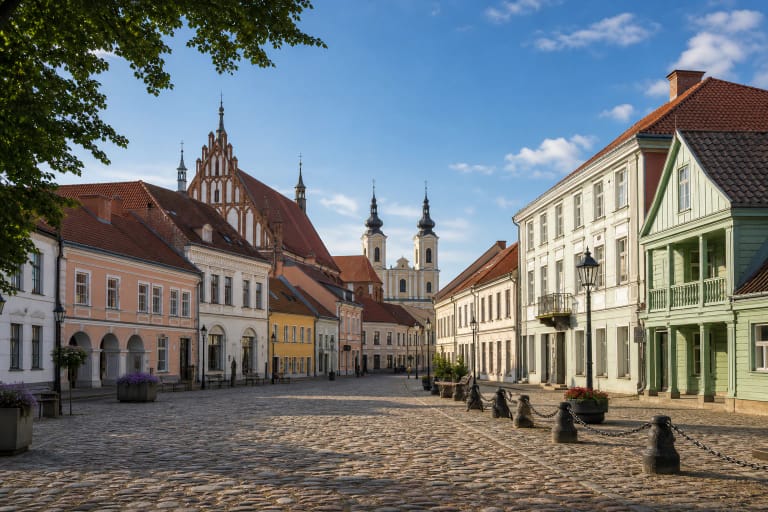
Kėdainiai Town Hall is one specific two-storey building on the eastern edge of Didžioji Rinka, the Great Market Square. This page covers its architecture, magistrate functions, and courtyard, not the roughly 87-hectare old town with its several marketplaces, streets, churches, and synagogues.
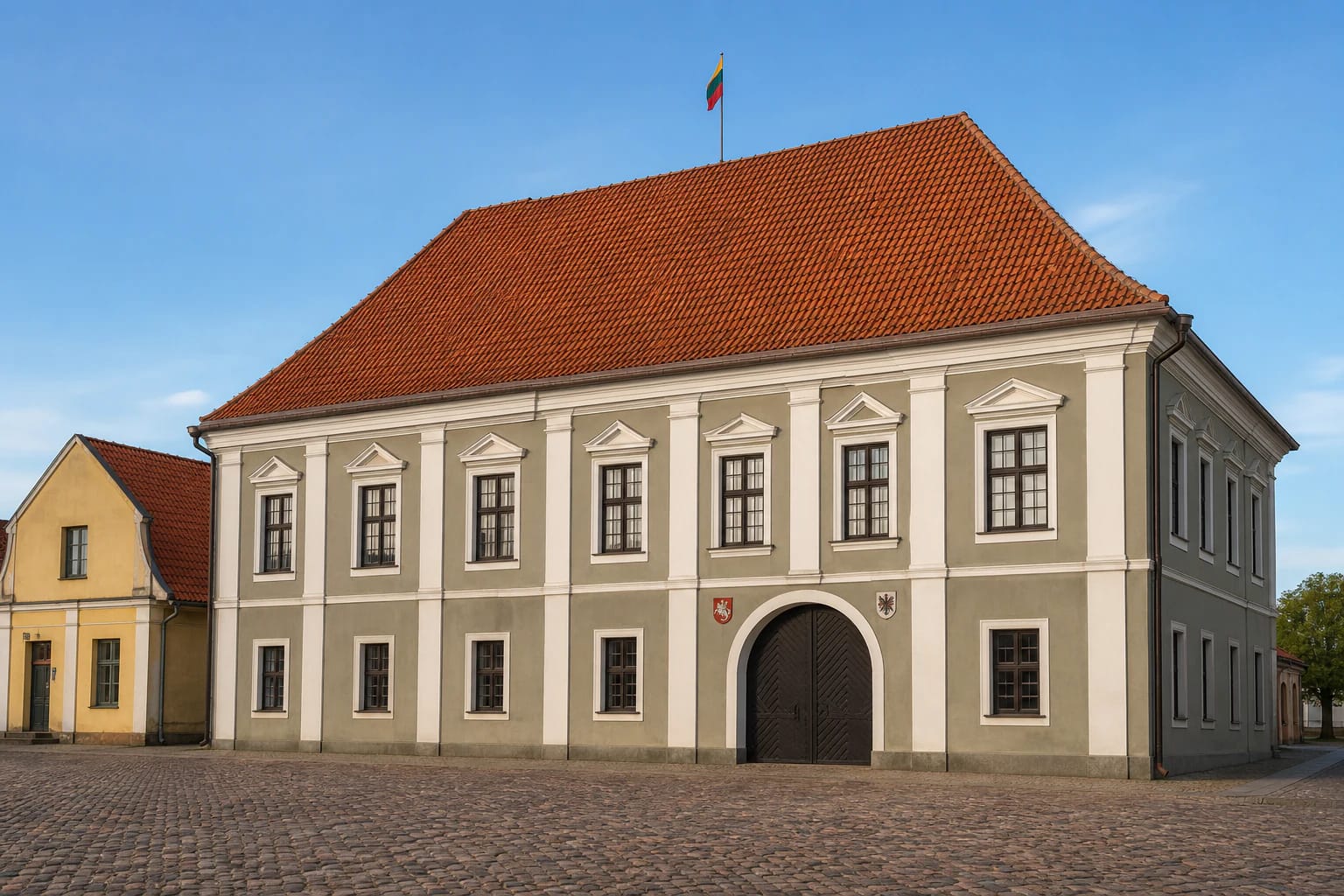
From the square, the defining view is a long grey-green facade with white window surrounds and triangular pediments, a tall arched gateway, and a steep red-tile roof. The present silhouette has no historic clock tower and should not be imagined as a smaller copy of Kaunas Town Hall.
The building is listed in the Register of Cultural Property as object 979. The register and newer municipal records use the address 6 Didžiosios Rinkos Square; some older visitor publications still give the former address 1 Didžioji Street.
From Magdeburg rights to Janusz Radziwiłł's town hall
Kėdainiai received Magdeburg rights on April 15, 1590, creating the need for a seat of municipal self-government. Records of an earlier town hall reach back to 1608, but its location has not been established, so the surviving building should not automatically be called the first town hall in Kėdainiai.
Janusz Radziwiłł had the present town hall built in 1651-1654 from two single-storey masonry houses beside the Great Market. Second floors were added, the two wings were connected by an extension, and a vaulted gateway beneath it led into a semi-enclosed courtyard. This created the two-wing L-shaped plan.
A tower with a mechanical clock and two bells rose above the high tiled roof. Written sources confirm its use and later repair, but not enough visual evidence survives to reconstruct its precise form reliably, so modern proposals to restore the tower remain hypothetical.
How the seventeenth-century magistrate worked
The ground floor joined municipal control with commerce. One room held official standards for length, weight, and dry volume as well as scales; wealthy Scottish merchants rented five shops, and the Scot Thomas Chancellor opened one of Lithuania's earliest pharmacies here in 1653.
The upper floor housed the institutions of Old Kėdainiai and Jonušava. There was a courtroom, chancery, rooms for the town reeve and mayors, an archive, treasury, and meeting room for the merchants' brotherhood and craft guilds. The tower bells marked the beginning and end of magistrate sessions and summoned townspeople to assemblies, drills, and parades.
The present cellars were created during the 1670-1680 reconstruction. They contained a prison and a room for the executioner, but visitors should not expect a permanent underground exhibition because no regular tourist-opening schedule for the cellars was found in official sources.
What survives and what was reconstructed
The fire of 1760 destroyed much of the town hall, and it was not fully rebuilt before the old municipal system ended. The building later changed function, housing a school for nobles from 1835, while alterations in the late eighteenth, nineteenth, and twentieth centuries changed its plan, facades, and roof.
The Register of Cultural Property identifies masonry walls, parts of the cellar's barrel vaults, the vaulted carriage passage, the L-shaped massing, and fieldstone courtyard paving among the significant surviving features. It also states that some openings and exterior finishes were reconstructed from architectural research in 1979-1983, while floors, staircases, and parts of the internal walls were replaced.
The present gabled tile roof was likewise built in 1979-1983, and evidence is insufficient to determine the original roof height. Cellars, foundations, courtyard, and facades received further conservation in 2009-2012. What visitors see is therefore a combination of historic masonry and research-based restoration, not an unchanged building from 1654.
The courtyard sundial and modern details
The gateway opens into a stone-paved courtyard where the historic building meets later public art. Painted coats of arms of Old Kėdainiai and Jonušava appear above the passage, and sculptures made in different periods occupy the courtyard.
The most important separate object is a Rococo sundial cast around 1828 at Count Karol Brzostowski's foundry in Sztabińska Huta, in present-day Poland. Eduard Totleben placed it in the grounds of Kėdainiai Manor; it moved to the regional museum garden in 1967 and has stood in the town hall courtyard since 2000.
The sundial returned to the courtyard after conservation in March 2026. The municipality says the only known analogue of this construction is in Suwałki, but it should be understood as a nineteenth-century object brought from the manor, not as original seventeenth-century town hall equipment.
Access, events, and the Google Maps card
The facade can be viewed from the public Great Market Square at any time without a ticket. Visitors are invited into the courtyard, but no fixed daily gate schedule is published. The interior hosts civil ceremonies, municipal receptions, exhibitions, concerts, and other events, so walk-in access to its rooms is not guaranteed.
No standard sightseeing ticket or permanent interior-exhibition timetable was found. If the rooms, cellars, or a particular event are the purpose of your visit, check the latest information from Kėdainiai District Municipality, the event organiser, or the Kėdainiai visitor information centre before travelling.
The map pin marks the town hall building at its main square facade rather than the centre of the whole old town. On 2026-07-15, the directly checked card was named “Kėdainių rotušė”, showed 4.8/5, and carried place ID ChIJc5QupqJV5kYRy_ukqeMNxcQ; its average rating can change over time.