- Place
- Kelmė District Municipality
- Region
- Kelmė District
- Type
- active late-Baroque Roman Catholic church and place of historical memory
- Address
- 45 M. K. Sarbievijaus Street, LT-86274 Kražiai
- Coordinates
- 55.60017, 22.69497
- Visit duration
- 35-60 minutes; longer during Mass or a commemorative event
- Best time
- in daylight when the interior is open, or during a commemoration of the Kražiai massacre
Kražiai Church, Former Benedictine Church in Kražiai
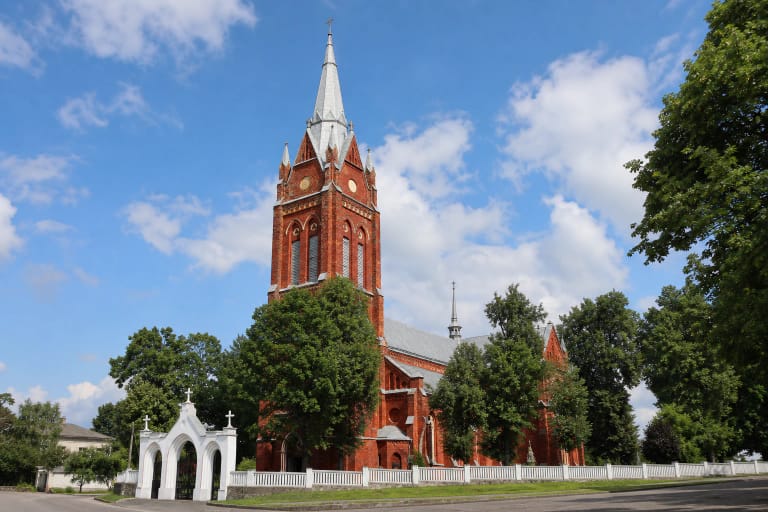
A Benedictine church built in 1757-1763
The Benedictine nuns settled in Kražiai in 1639, and the present masonry church was built in 1757-1763. It belongs to the late Baroque and recalls the period when Kražiai was one of Samogitia's most important religious and educational centres.
KVR describes a rectangular, single-nave church with twin towers lower than its central pediment. A two-storey gallery adjoins one side facade and gives the ensemble an unusual spatial element.
The churchyard, chapel and 1993 relief
A plastered masonry wall encloses the churchyard. Its nineteenth-century chapel has a four-column portico and combines Gothic and Classical forms; members of the Kšonstauskiai noble family are buried there. The chapel was restored in 2001.
In 1993, the centenary of the Kražiai massacre, a relief by sculptor Regimantas Midvikis was installed in the churchyard gate. It connects the architecture with the event in the actual place rather than leaving it as an abstract textbook date.
The Kražiai massacre of 1893
When the imperial administration decided to close the former Benedictine church, parishioners kept vigil inside and sent petitions to the authorities. In November 1893, police and Cossacks suppressed the resistance by force; people were beaten, injured and arrested. The violence entered history as the Kražiai massacre.
Reports spread through the Russian Empire, Western Europe and the United States, strengthening anti-imperial feeling and Lithuanian national consciousness. The church was left neglected, returned to the parish in 1908, repaired by local people and consecrated in 1910.
A respectful visit to an active church
This is an active parish church, not a ticketed museum. On July 22, 2026, the parish page said the church was open to visitors from 09:00 to 20:00 in summer and by prior arrangement in winter. Mass was listed at 13:00 on Sundays, 09:00 on weekdays except Monday, and by arrangement on Saturdays.
Opening and service times can change, so confirm them on the official parish page before a dedicated trip. During Mass, do not walk through the nave or take photographs without permission.
If the interior is closed, examine the gate, relief, chapel and facade proportions from the churchyard. The church fits naturally with the Sarbievijus Cultural Centre and a walk through historic Kražiai.