- Place
- Kretinga District Municipality
- Region
- Samogitia
- Type
- active Gothic Revival Evangelical Lutheran church forming part of a state-protected building complex
- Address
- 8 Rotušės Square, Kretinga; parish contact address: 3 Kęstučio St
- Coordinates
- 55.88842, 21.24320
Kretinga Lutheran Church, Kretinga Evangelical Church, Prussian Church in Kretinga
A Gothic Revival church at the corner of Rotušės Square
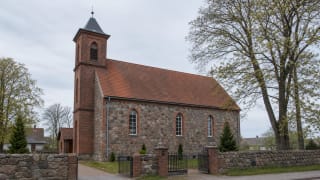
Kretinga Evangelical Lutheran Church stands on the south-eastern edge of Rotušės Square, at the beginning of Kęstučio Street. The building is modest in scale, but its high spire, exposed stone walls, and red-brick dressings create one of the clearest landmarks in the historic town-centre skyline.
The present church was built in 1897-1899 through the efforts of Pastor Johann Straumann and consecrated on 29 June 1899; its architect is unknown. Count Tyszkiewicz, the Catholic owner of Kretinga Manor, donated most of the timber. Four Jewish merchants contributed towards coloured windows, neighbouring congregations offered money, and German Emperor and King of Prussia Wilhelm II gave 1,500 marks for the altar.
That network of donors is more than an attractive anecdote. It shows a church built by its local congregation with help from wider Baltic connections that crossed denominational and political borders.
Several places of worship, two fires, and a persistent congregation
Lutherans lived around Kretinga in the sixteenth and seventeenth centuries, but the claim that they already had a church in the town in the sixteenth century remains a hypothesis. The documented urban story begins differently: Kretinga's 1609 charter prohibited public non-Catholic worship, so Lutherans travelled across the Prussian border to Kretingalė.
Tsar Alexander I authorised a parish and church in 1802. Lacking building materials, the congregation adapted a two-storey masonry house and consecrated it in 1808. Worship later moved to private homes and the disused town hall. A wooden church consecrated on present-day Vytauto Street in 1831 burned down in 1854.
In 1851-1852 the parish acquired a masonry house at the corner of Rotušės Square and converted it into a single-tower church. Fire destroyed that building in 1889. A temporary masonry prayer house erected the same year on Gargždai Street, now Kęstučio Street, survives as the restored parish house beside the present church.
The parish remained active during the Soviet occupation, when many Lutheran churches in Lithuania were closed or destroyed. After Kretingalė Church was closed and Palanga parish was prevented from operating, members of those communities also travelled to Kretinga; the parish's official history records about 900 members in 1965.
Exposed stone, red-brick contrasts, and a restrained interior
The church is a three-nave Gothic Revival building on a regular rectangular plan. Buttresses divide its exterior rhythmically, a square tower rises at the west end, and a five-sided apse closes the east. Pointed windows, round openings, and red-brick details stand out against the varied colours and textures of the natural stonework.
A choir gallery spans the interior above the main entrance. Beyond it are a high pulpit, a small altar in the apse, and coloured glass; the altar painting depicts Jesus praying in Gethsemane. The restrained Lutheran space directs attention to the proclamation of the Word, altar, congregational singing, and organ.
The church and neighbouring parish house form a state-protected complex numbered 29929 in the Cultural Heritage Register; the church itself is 29930. The present metal fence recalls an ornate enclosure brought from Saint Petersburg before the First World War, demolished in 1964, and reconstructed in the 1990s.
The journey of Johann Preuss's 1785 organ
The most important interior object is more than a century older than the church itself. Johann Preuss, organ builder to the royal court in Königsberg, made it for Verdainė Church, now within Šilutė, in 1785. The instrument moved to Kretingalė in 1827 and entered the new Kretinga church in 1899.
The original organ had one manual, eight stops, and star-shaped bells. Later alterations added a second manual and independent pedal pipes, yet almost the entire Preuss first-manual division, mechanism, windchests, and pipework survive. Its Rococo case and an inscription on a pipe helped identify the maker and original destination.
Kretinga's municipal encyclopaedia describes it as the only known authentic instrument by Preuss to retain its original composition in Lithuania and, to current knowledge, in Europe. The organ is separately protected under register number 21012, but an ordinary visit does not guarantee that you will hear it: use depends on the liturgy, event, and condition of the instrument.
How to get inside and why two addresses appear
Official planning records identify the church building as 8 Rotušės Square, while the parish contact details and Google Maps listing use 3 Kęstučio Street. These are not two different churches: number 3 is the adjacent parish house within the same complex.
No daily sightseeing hours or visitor ticket are published. The exterior can be viewed from the public square and street at any reasonable time; the most reliable opportunities to enter are a service, concert, or appointment with the parish. The official 2026 calendar lists individual dates with start times varying between 11 am and 1 pm, so do not rely on a general Sunday assumption.
Check the latest calendar on the official parish page or call Pastor Darius Petkūnas at +370 611 38226 before travelling. There is no confirmed public information on a step-free entrance, accessible toilet, or permanently present attendant, so discuss mobility and group needs in advance. During worship, seek permission before photography and respect the active congregation's liturgy.