- Place
- Kaunas City Municipality
- Region
- Kaunas
- Type
- historic Catholic church
- Address
- Aukštaičių g. 4, LT-44147 Kaunas
- Coordinates
- 54.90519, 23.92100
- Visit duration
- 30-60 minutes, depending on whether the church is open and services are taking place
- Best time
- outside services, after checking with the parish in advance
Small Church of the Resurrection
The small Žaliakalnis church, not the basilica
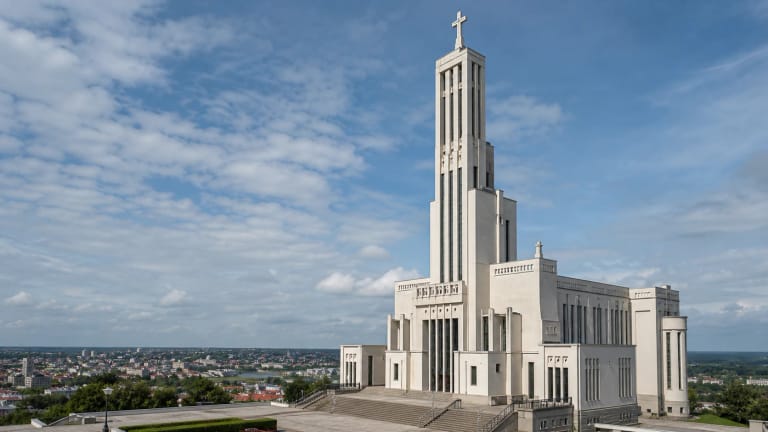
Kaunas Small Church of the Resurrection is a separate small building in Žaliakalnis at Aukštaičių g. 4. It belongs to the history of the same Resurrection parish, but it is not the large basilica at Žemaičių g. 31A: the buildings, addresses, scale and visiting experience are different.
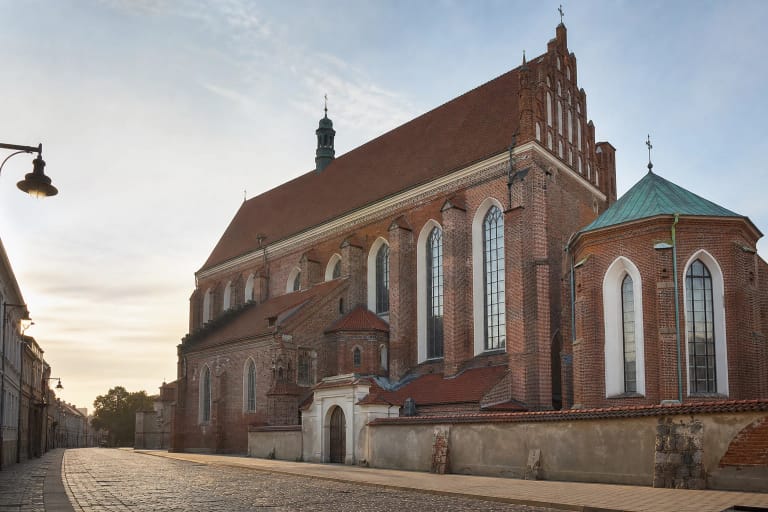
Outside, it is recognisable by red brick, a steep grey roof, a square timber bell turret with a cross, a round window and two small entrances. A dark metal fence and modest green churchyard place the building within the residential fabric of Žaliakalnis.
From the first temporary church to the 1928 building
The Resurrection community began its first temporary wooden church at the start of 1923, and it was consecrated on 23 September that year. A second temporary structure, designed and overseen by engineer Z. Novenys, was consecrated on 23 December 1928.
Engineer K. Reisonas led restoration and reconstruction in 1933, when the building received brick cladding and five altars. The present red-brick appearance is therefore the result of both the early temporary church and a later transformation, not a single uncomplicated construction date.
Stained glass and a five-altar interior
The interior is distinguished by eleven stained-glass windows made by professor Stasys Ušinskas and dated 1945-1947. Three presbytery windows depict God the Father, the Immaculate Virgin Mary and Saint Casimir. These details can be appreciated inside only when the parish permits a calm visit.
The windows work with the scale of the small nave, wooden pews and altars. This is different from a monumental basilica: the point is not a vast panorama, but a surviving community space and the changing light through coloured glass.
The parish through the twentieth century
After the large Resurrection Basilica was confiscated, the small church supported the Resurrection community through the Soviet period. When the liturgical centre moved in 2004, its role changed, but the building remained part of a living parish.
Parish history also records major repairs in 2006 and work in the churchyard in 2010. Cultural Heritage Department documents identify the building as cultural property KVR 33558; its present form developed through several early twentieth-century construction and reconstruction stages.
Practical visiting information
This is an active church, so services and parish life take priority over a sightseeing schedule. There are no permanent museum hours or an admission fee here; check the parish information before travelling, behave quietly inside and do not photograph where it is not allowed.
Address information uses two variants: parish and heritage information use Aukštaičių g. 4, while an archdiocesan list also shows no. 6. The map point uses no. 4 for the building, but contact the parish if you need the entrance or parish office. Allow about 30-60 minutes for the exterior and churchyard.