- Place
- Kernavė, Širvintos District Municipality
- Region
- Aukštaitija
- Type
- early-20th-century Neo-Gothic parish church and part of a protected sacred ensemble
- Address
- 8 Kerniaus Street, Kernavė, Širvintos District
- Coordinates
- 54.88479, 24.85196
- Visit duration
- 30-60 minutes; longer if attending Mass and visiting the old church site and both chapels
- Best time
- on Sunday before the 13:00 Mass if you hope to see inside; a bright morning or afternoon for the facade and churchyard
Church of Our Lady of the Scapular, Kernavė, Kernavė Church, Kernavė Catholic Church
One tower, a rose window, and red-brick Neo-Gothic
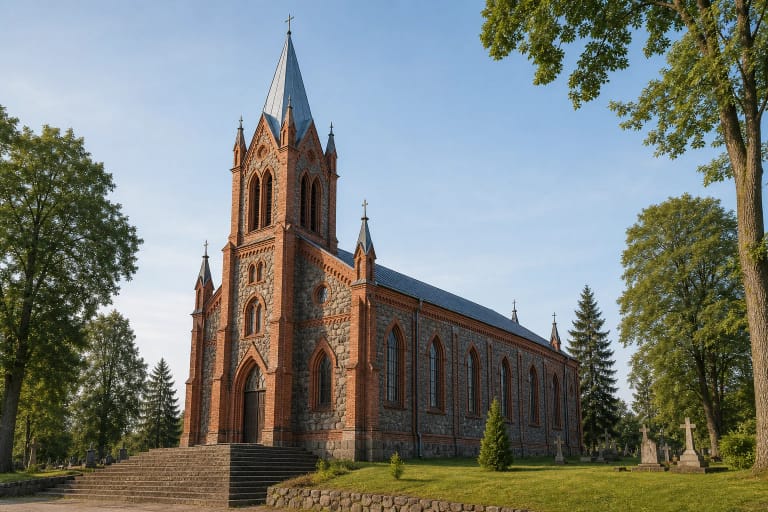
Kernavė Church is recognisable less by scale than by its clear silhouette with a single tower. A tall central tower rises from the principal facade and ends in a metal-clad spire. Below it are a circular rose window, a deep pointed entrance, and small pinnacles. Ceramic-brick buttresses strengthen the vertical rhythm, while the grey roof stands out cleanly against the warm red masonry.
The Department of Cultural Heritage evaluation describes a rectangular, three-aisled hall church with a tower at the front, a five-sided apse, and chapels and sacristies on both sides of the sanctuary. Pointed and circular windows retain stained glass from the 1920s. A walk around the churchyard reveals not only the formal facade but also the long body of the aisles, the rhythm of the buttresses, and the polygonal geometry of the apse.
For the complete view, step back in front of the Neo-Gothic brick gate. Move closer for architectural details only when the gate is open and no service is under way. Trees conceal different portions of the facade through the seasons, so angled morning or afternoon light is best for bringing out the relief of the brickwork.
The present church was built in 1910-1920
No single exact date is documented for Kernavė's first church. The heritage evaluation and AUTC cautiously connect it with a foundation by Grand Duke Vytautas around 1420-1430. A later church burned in 1655, another begun near the end of the 17th century burned in 1729, and an oak-log church erected in 1739 remained until the early 20th century.
The present masonry Neo-Gothic church was built in 1910-1920 and consecrated on 17 August 1924. Its wooden predecessor continued standing nearby for a time and was dismantled in 1933. A 2025 KPD evaluation dates its sale to Krivonys parish to 1933, while AUTC's detailed account gives 1934. Materials from the old church were reused to build St Anthony of Padua Church to a new design. In 1990, the 1739 foundations were exposed in Kernavė, along with the roughly 4 by 4 metre remains of what is thought to have been a 16th-century chapel.
The church is often attributed to Vaclovas Michnevičius, but reliable sources do not confirm this consistently. A survey of the architect's work calls Kernavė only a possible commission, while the 2025 heritage evaluation names no designer. Michnevičius should therefore be treated as an attribution rather than an established fact.
Older altars inside a younger sanctuary
The date of the building does not reveal the age of the art inside it. Two side altars from the second half of the 17th century were transferred from the old church: the Assumption of the Virgin Mary altar on the left and the St Roch altar on the right. They are tangible evidence of continuity between the demolished timber sanctuary and the present masonry church, not later imitations of a historic interior.
Kazimieras Šėža made the mensa, tabernacle, and retable of the present high altar of Our Lady of the Scapular in 1988, but it incorporates much older figures of St Peter, St Paul, and probably St Nicholas. The heritage register also protects the painting of Our Lady of the Scapular with crowns, metal revetments, and votive offerings. VLE dates it to 1816 and records a brass Baroque bell cast in Vilnius in 1667.
The interior can be seen only when the parish opens it. The altars, paintings, and liturgical objects are not a permanent museum display, so visitors should not expect unrestricted access to the sanctuary or permission to photograph worship. Even before Mass, the needs of people who have come to pray take priority.
The churchyard is an art and memory site in its own right
Fifteen mosaics of the Stations of the Cross fill pointed niches in the ceramic-brick churchyard wall. The heritage evaluation dates the cycle to 1982-1987 and credits Kazimiera Jadvyga Grišiūtė, who worked with fieldstones and cut granite. The cycle is best viewed in sequence as you walk around the wall, not merely glimpsed through the gate as a decorative backdrop.
Antanas Kmieliauskas's granite sculpture of Moses, made in 2000, stands in front of the church. The churchyard is also the burial place of priest, writer, and museum advocate Nikodemas Švogžlys-Milžinas, who served in Kernavė in 1930-1934 and again in 1968-1979. His work connects the parish with the development of the local museum and the town's 20th-century cultural memory.
This remains a working religious and burial space. Keep to paths, do not touch mosaics or grave markers, never pose on graves, and ask before photographing people. The gates may close for services or other parish needs, so access to the churchyard should not be assumed at every hour.
The church, old foundations, chapels, and UNESCO site are not identical
On 6 May 2025, the Department of Cultural Heritage granted protection to the Kernavė Church of Our Lady of the Scapular building ensemble. It comprises the present church, a wooden chapel, the Römer family mausoleum chapel, and the rectory. The present church has heritage code 49101, while the ensemble as a whole is numbered 49100.
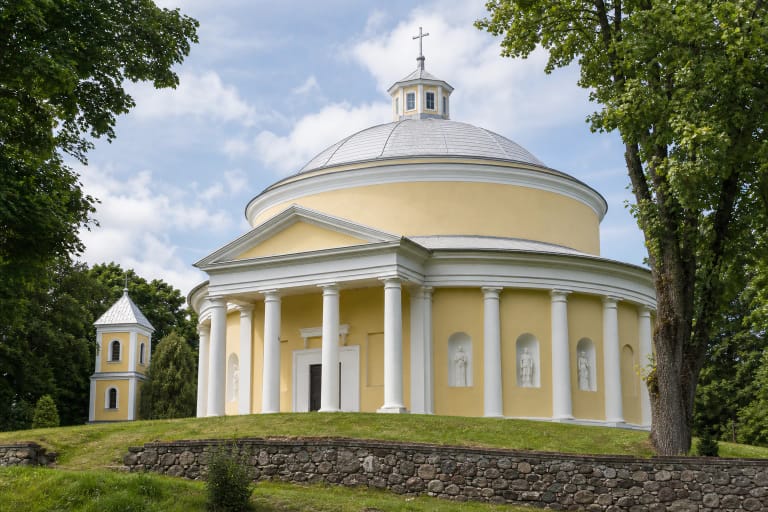
A separate old church site behind the present churchyard displays the foundations of the 1739 timber building. VLE describes the nearby wooden chapel, dated to the late 18th century or 1822, as a museum of church relics. The masonry, octagonal Römer mausoleum chapel was built in 1856. The parish publishes no regular interior opening schedule for these structures, so they should not be promised as permanently accessible exhibitions.
Kernavė's World Heritage status primarily protects its archaeological site and cultural landscape, including layers of old settlements, hillforts, and former church sites. It does not make the present 20th-century church a separately inscribed UNESCO monument. The church has national protection as part of the sacred ensemble confirmed in 2025.
Mass, admission, and accessibility in 2026
On 29 July 2026, the Diocese of Kaišiadorys listed Sunday Mass at 13:00. The parish page published neither regular visitor hours nor an admission charge. If seeing the interior is important, arrive before the listed Mass or contact the parish in advance, and recheck the official schedule because it can change.
The heritage evaluation records a metal ramp installed at one side entrance in the 21st century. That does not confirm a complete step-free route, adequate door widths, or on-site assistance, so contact the parish about specific mobility needs. Park only where permitted and never block Kerniaus Street, the gates, or a processional route.
Allow about 30-40 minutes for the exterior, gate, and Stations of the Cross. If the interior, old church foundations, and both chapels are accessible, plan at least an hour. The UNESCO hillforts, Pajauta Valley, and archaeology museum require several additional hours.