- Place
- Lankupiai, Klaipėda District Municipality
- Region
- Lithuania Minor
- Type
- navigation lock and technical heritage site
- Address
- Lankupiai village, Priekulė ward, Klaipėda District
- Coordinates
- 55.48151, 21.36006
Lankupiai Lock of the King Wilhelm Canal building complex
Lankupiai Lock between the canal and the Minija
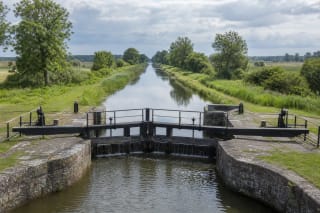
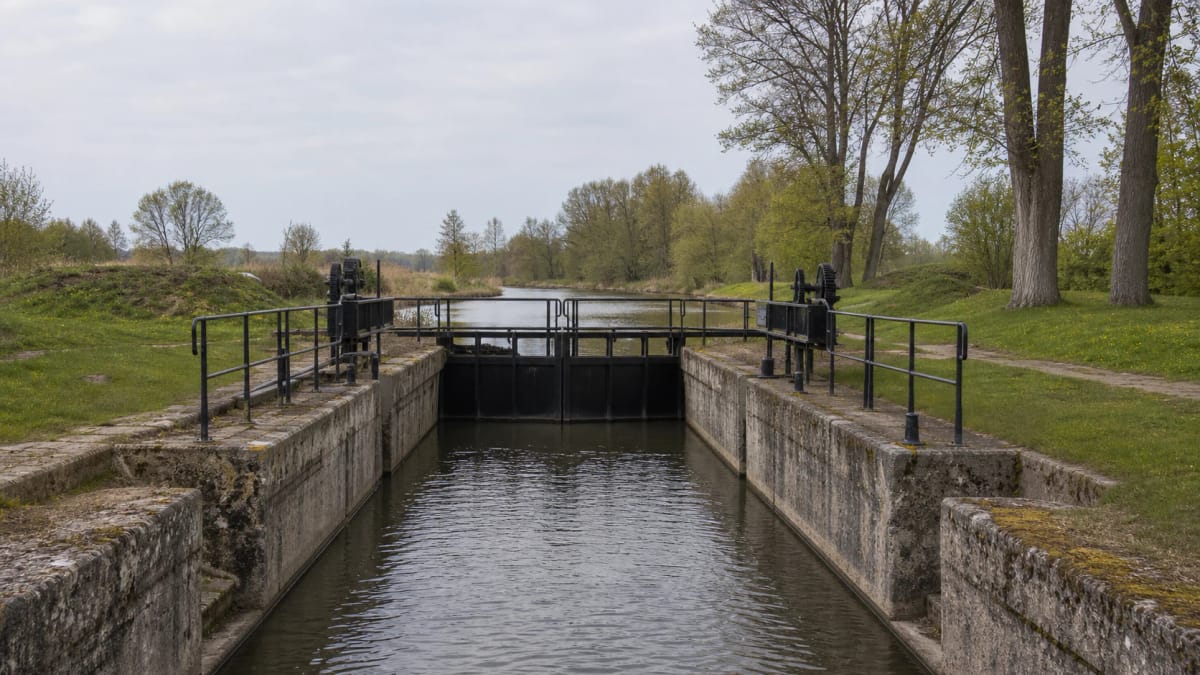
Lankupiai Lock is one of the most interesting engineering points on the King Wilhelm Canal. It is not just a pretty waterside view: the lock shows how navigation, water-level differences, and flood control were handled.
Official Klaipėda District data emphasize that this is the only lock in Lithuania declared a technical monument. So the place is best understood not as an ordinary waterside stop but as a rare Pamarys technical-heritage object that is still occasionally used for its purpose.
The 1864 lock and how it worked
According to the Register of Cultural Property, the lock was built in 1864 and rebuilt in 1960-1961. It is a single-chamber navigation lock; encyclopedic data give its length as about 157 m, with roughly 11 m wide operable gates at each end. When the water was low, both gates were left open and the level did not need to be changed.
The lock's main purpose was to even out large water-level differences, especially when the Minija flooded. Moving a vessel through the lock took about 45 minutes - a detail that helps imagine the slow, precise work of water infrastructure, very different from today's quick travel by car.
The King Wilhelm Canal building complex and Register status
In the Register of Cultural Property, Lankupiai Lock (code 25966) is recorded as part of the King Wilhelm Canal building complex (code 25965) - a state-protected object of national significance. That is a high heritage status, so the place is rightly seen as a technical monument, not just a scenic spot.
According to the Register, the whole complex was built in 1863-1873 and improved repeatedly afterwards: reprofiled in 1890, its banks reinforced with board walls in 1893-1895, ten metal bridges installed in 1902-1904, and the canal widened in 1938. The construction was initiated by the Klaipėda merchant Gubba, with Degner and Mohr as works leaders.
The canal's significance and water-route logic
The King Wilhelm (Klaipėda) Canal is a 24 km waterway, 22-30 m wide and 2.3-3.6 m deep, that once linked the Minija with the Curonian Lagoon. It was dug in 1863-1873 (Franco-Prussian War prisoners took part in the work), and its main purpose was to provide a safe route for ships and timber rafts from the Nemunas to Klaipėda during storms, bypassing the wave-battered Curonian Lagoon.
So that ships would not erode the banks, the speed on the canal was limited to no more than 5 km/h, so a journey took 8-9 hours and vessels used it only during heavy lagoon waves. After the First World War the canal was no longer used for navigation, and part of it was adapted to feed a Klaipėda water intake and separated from the lagoon by an earthen embankment.
Why it matters to Lithuania Minor
Lankupiai Lock is a place where this whole water-route logic becomes physical - in the gates, the walls, the canal bed, and the relationship with the Minija. What you see here is not scenery but an engineering solution that once allowed safe movement between the Nemunas Delta, the Curonian Lagoon, and Klaipėda port.
When visiting the lock, remember that in the Pamarys region water was not only beauty. It was transport, risk, labour, and an engineering challenge. This layer is clearer at Lankupiai than at many beautiful but less technical waterside places.
Practical visiting
The lock is an outdoor object, so no standard opening hours or ticket information were found during source review. Be careful near the water, do not climb on unsafe structures, and respect any restrictions on site, as the object is still sometimes used for its purpose.
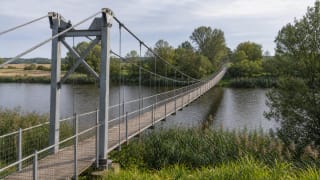
The best pairing is Lankupiai Lock with Lankupiai Suspension Bridge and a King Wilhelm Canal route. A short stop is enough, but history-focused visitors may want more time for details.