- Place
- Jurbarkas District Municipality
- Region
- Panemunė
- Type
- active modern Evangelical Lutheran church and a site of the restored parish's history
- Address
- 43 K. Donelaičio Street, Jurbarkas
- Coordinates
- 55.08028, 22.77118
- Visit duration
- 20-40 minutes for the exterior and, when the church is open, the interior; longer for a service or concert
- Best time
- daylight for the facade artwork and the naturally illuminated stained glass; check service or event times before travelling
Jurbarkas Kristijonas Donelaitis Evangelical Lutheran Church, Kristijonas Donelaitis Church in Jurbarkas, Jurbarkas Lutheran Church
The Present White Church Is a New Building, Not a Nineteenth-Century One
Jurbarkas Evangelical Lutheran Church stands on K. Donelaičio Street, north of the town centre. The point at 55.080278, 22.771179 marks the footprint of the present church itself, not a car park or a promise that the doors will be open. Visitor listings identify the building as number 43, while the official parish contact page and an earlier municipal list give number 41 for the parish complex. Both numbers may therefore appear in directions.
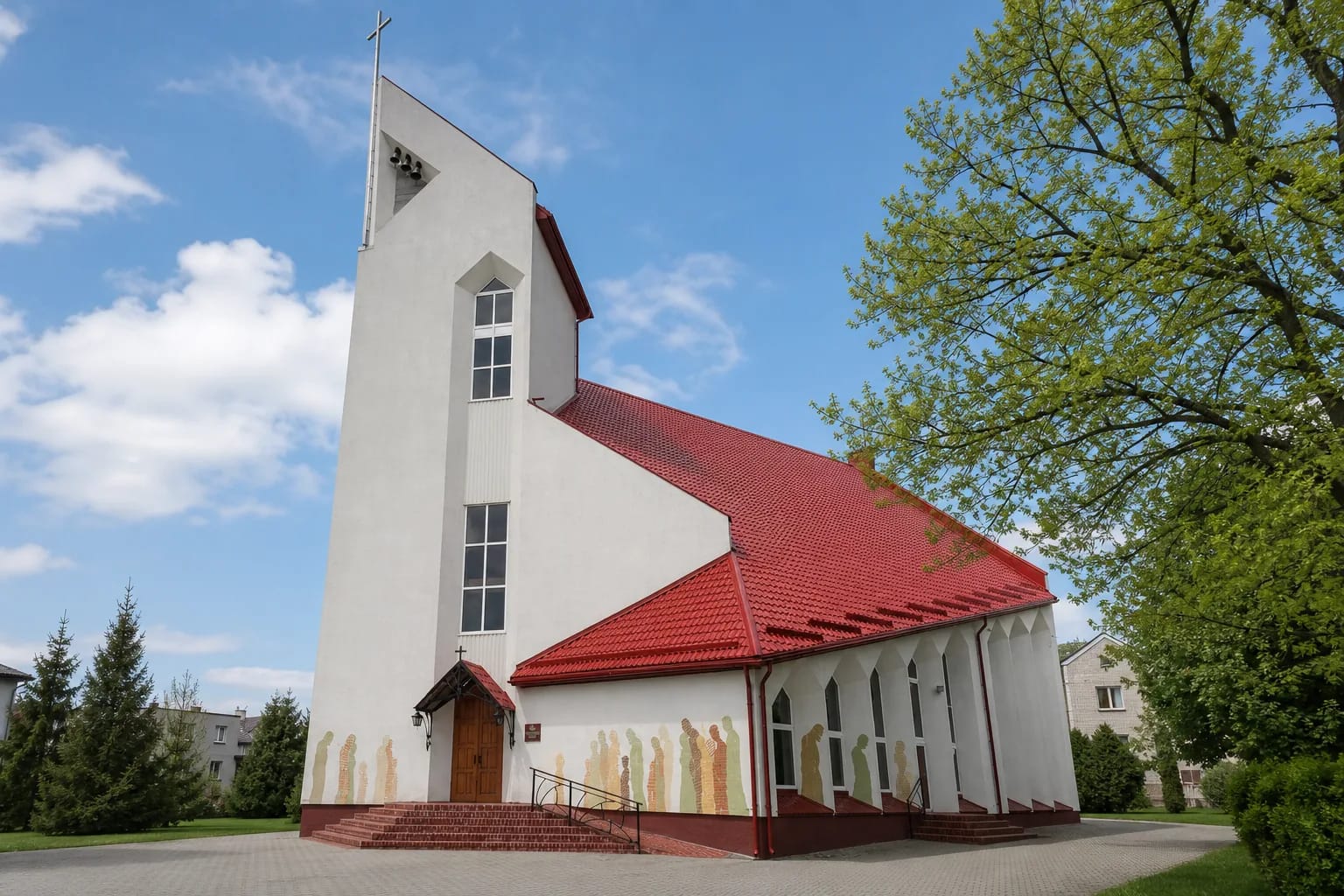
This is a modern masonry sanctuary, not the restored former Lutheran church of Jurbarkas. Its exterior is defined by broad white rendered planes, a tall asymmetrical tower integrated into the front, a steep red gabled roof, and narrow vertical windows. Along the lower walls runs a composition of coloured silhouettes walking towards the church, each carrying the same New Testament passage in one of 14 languages.
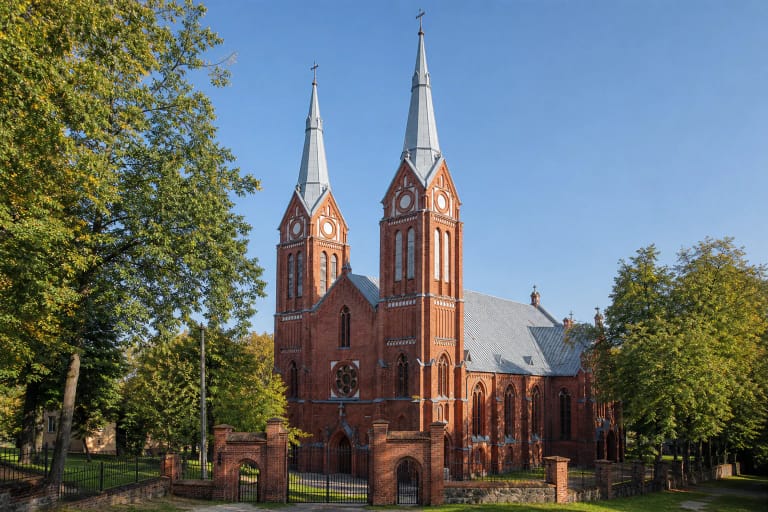
Those contemporary features also prevent confusion with Jurbarkas Church of the Holy Trinity, the red-brick Catholic church with twin towers elsewhere in town. The Lutheran building's importance lies chiefly in the late-twentieth-century revival of its community and the art created for it, rather than in surviving nineteenth-century fabric.
The 1851 Prayer House and the Parish's Large Wooden Church
Until the mid-nineteenth century, Jurbarkas was a branch served by Tauragė pastors and was later connected with the Žvyriai parish. Jurbarkas became an independent parish in 1851; VLE also records a parish school operating in 1851-1867. A wooden prayer house with a separate timber belfry was built that same year. The bell-ringer or organist lived at one end, while services were held at the other.
The official parish history dates the next building, a proper wooden church seating 500, to 1890. A masonry parsonage followed in 1900, with farm buildings and a timber cantor's house in 1905. A 1962 memoir by Eduard Kolbe, reproduced in the 2024 anniversary article, instead dates the church to 1886. The sources therefore differ by four years; the parish's main official chronology uses 1890.
The community also belongs to the history of Lithuanian print culture. The official parish account says that Martynas Keturakaitis, a pastor who served Jurbarkas, was removed from office by the imperial authorities in 1892 for distributing Lithuanian books. In 1900 Jurbarkas became the permanent centre of a Tauragė adjunct parish, and Nikolajus Ozolinis was the first Lutheran pastor to reside in the town.
The Old Church Survived Two Wars but Was Closed in 1952
The official 30th-anniversary account states that on April 22, 1945, around 70 families from the Jurbarkas and Žvyriai parishes were deported to Tajikistan. Pastor Jurgis Gavėnis was arrested and deported to Siberia in 1948. With its pastor and many members gone, the community rapidly weakened.
The wooden church was closed in 1952 and its contents were stripped. The building first became a warehouse and was later altered into a house; the old Swedish organ and resonant bell were destroyed. The white church visited today is consequently not a restoration, and its interior should not be mistaken for surviving nineteenth-century furnishings.
Lutherans in Jurbarkas began to regroup in 1989. Their first service that November took place in M. Lendraitytė's private flat, and the parsonage was finally returned late in 1991. On February 16, 1992, the first service there drew so many people that some stood in corridors and outside. Other parish buildings were returned, but the former church, already converted into housing, was not.
Building the New Church Took From 1994 Until 2014
Once the parish decided to erect a new sanctuary, it chose a design by architect Kazys Kazlauskas. Bishop Jonas Kalvanas consecrated the cornerstone on August 26, 1994. The masonry shell rose and the roof was partly covered over the following years, but lack of funds brought work to a long halt.
Construction resumed in 2008. At the initiative of pastor Mindaugas Kairys, German Protestant charities, individual donors, and Jurbarkas parishioners provided support; the roof was completed and windows installed that year. The official anniversary account places particular emphasis on gifts and voluntary work by local families, making the two-decade build part of the community's story rather than merely a construction timeline.
The church was completed, consecrated, and named after Kristijonas Donelaitis in August 2014, the 300th anniversary year of the poet and Lutheran pastor's birth. The name had already been considered when the cornerstone was laid and was made still more apt by the K. Donelaičio Street address. It links the church with the beginning of Lithuanian imaginative literature; it does not imply that Donelaitis served or visited Jurbarkas.
Rasa Grybaitė's Stained-Glass Cross and a Few Links to the Former Church
The interior centres on a three-dimensional cross above the altar by Jurbarkas stained-glass artist Rasa Grybaitė. More than 7 metres tall and weighing over 600 kilograms, it was installed with the help of her engineer brother, Kęstutis Grybas. Because the curved wall behind the altar originally had no window, an opening had to be cut into the already completed structure and adapted to the sculptural composition.
Within the blue glass cross, Christ appears not simply to suffer but to rise upward. Daylight reveals the work most fully: after dark the glass naturally loses its radiance, and small internal spotlights cannot reproduce the effect of light from outside. Grybaitė is a granddaughter of the Jurbarkas-based sculptor Vincas Grybas, tying the church to the town's wider art history.
One of the few objects preserved from the former church environment is a catafalque saved by parishioner Jonas Maksvytis, an old horse-drawn funeral carriage now kept inside. Together with the stained glass and contemporary facade artwork, it presents selected layers of community memory rather than an attempted reconstruction of the lost interior.
An Active Parish and Music Venue, Not an Everyday Museum
When checked on July 20, 2026, the official parish page listed services at 10 am on the first, second, and third Sundays of each month. That schedule may change and is not a set of tourist opening hours. No permanent daily interior hours, tour programme, or admission price is published, so consult the official page before travelling and contact the parish if seeing the interior matters to your visit.
The church hosts ecumenical worship, choral and organ concerts, and events in an international sacred-music festival. During a service or concert, visitors are guests in an active place of worship: arrive a little early, remain quiet, do not photograph people without permission, and keep away from the altar during the liturgy.
Allow 20-40 minutes for the exterior and a brief interior visit when the doors are open. Although paving and handrails are visible by the entrance, no current official audit of step-free access, parking, or visitor adaptations was found. Confirm particular needs with the parish and follow signs on site. Jurbarkas Manor Park, the Vincas Grybas Museum, and Synagogue Square make natural continuations to the walk.