- Place
- Kaunas City Municipality
- Region
- Kaunas
- Type
- interwar Ministry of Justice and Seimas Palace, now an active concert hall
- Address
- E. Ožeškienės g. 12 / L. Sapiegos g. 5, Kaunas
- Coordinates
- 54.89894, 23.90557
Ministry of Justice and Seimas Palace of the Republic of Lithuania, Lithuanian Justice and Seimas Palace, Ministry of Justice Palace in Kaunas, Seimas Palace in Kaunas, Kaunas Philharmonic
A concert hall with a state-palace biography
Kaunas State Philharmonic is today first of all a concert venue. But the building's biography begins not with music, but with state institutions. AUTC and the Cultural Heritage Register present it as the Ministry of Justice and Seimas Palace of the Republic of Lithuania, and the official Philharmonic history reminds visitors that the current institution is housed in precisely this former palace.
This double name matters. The monumental portico, column rhythm, and semicircular corner seen from the outside were designed for the representation of justice and parliament. Only later did the same system of halls and vestibules become part of Kaunas concert life.
An administrative corner of central Kaunas
The building stands at E. Ožeškienės g. 12 and L. Sapiegos g. 5, close to the K. Donelaičio Street environment. AUTC stresses that already in the governorate period, this part of the city concentrated government and departmental offices, and that tendency continued in the First Republic period.
AUTC also notes that the ornate State Bank Palace at the corner of K. Donelaičio and Maironio streets and the Ministry of Justice Palace encouraged other representative state institutions to settle in this area. The Philharmonic is therefore best viewed not as a separate hall, but as one of the most important accents of the temporary capital's institutional centre.
Construction in 1925-1929
AUTC, the Cultural Heritage Register, and the official Philharmonic history agree on the main dates: the Justice and Seimas Palace began construction in 1925 and was completed in 1929. AUTC adds that a quicker completion was expected, but work depended on state allocations, and the cost rose from a planned little over one million litas to 2.2 million litas.
The architect was Edmundas Alfonsas Frykas. AUTC calls the building the largest and most prestigious object he designed, while the register lists it as one of the first official-style buildings intended for Lithuanian state institutions.
Ministry of Justice and Supreme Tribunal
In 1929 the Ministry of Justice, Supreme Tribunal, and various judicial services moved into the palace. Above the colonnade was a Latin inscription in gilded letters, JUSTITIA EST FUNDAMENTUM REGNORUM, which AUTC, the register, and the Philharmonic history translate as the idea that justice is the foundation of states.
That phrase explains the solemnity of the facade. The building had to appear not only convenient for offices, but legally authoritative. The colonnade, portico, and massive composition were the language of state legitimacy.
The Neumann-Sass trial
AUTC's historical-significance section states that in 1934-1935 this building hosted the trial of pro-Nazi organization figures from the Klaipeda Region, often called the Neumann-Sass trial. It was one of the most important political trials in interwar Lithuania.
AUTC emphasizes that the sentences read here had a major impact on Lithuanian-German relations and on the later development of Lithuania's economy. The building is therefore not only a beautiful administrative facade. It is also a place where questions of international tension were decided.
The Seimas in the palace
In 1936 the building was repaired and adapted for the needs of the Seimas of the Republic of Lithuania. The register states that the Seimas began its work here with a solemn sitting on September 1, 1936 and met until the 1940 occupation.
The palace held offices for the Seimas chair, deputy chairs, secretary, and chancellery director, along with chancellery and committee rooms. A diplomatic corps box was arranged in the balcony for observing solemn sittings and treaty ratifications.
The 1938 Constitution
The register's facts section singles out February 11, 1938: in this building the Seimas adopted Lithuania's third permanent Constitution. It came into force on May 12, 1938, because after publication there was no demand to submit it to a referendum under the amendment procedure then in effect.
This fact is important, but it must be stated precisely. It belonged to the political environment of the Fourth Seimas, active in 1936-1940, and the Constitution itself narrowed the Seimas's powers and expanded presidential powers. The building is therefore connected not only with parliament as an institution, but also with the history of an increasingly authoritarian state.
Frykas's official style
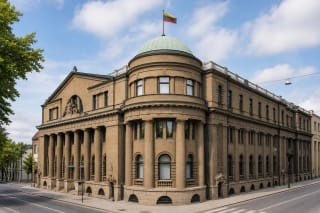
Architecturally, the palace is not pure functionalism. AUTC assigns it to neoclassicism with strong Art Deco elements and searches for a distinctive national style. The register notes the semicircular-plan main block, round tower above the central part, polygonal and rectangular blocks, all adapted to a tight irregular plot.
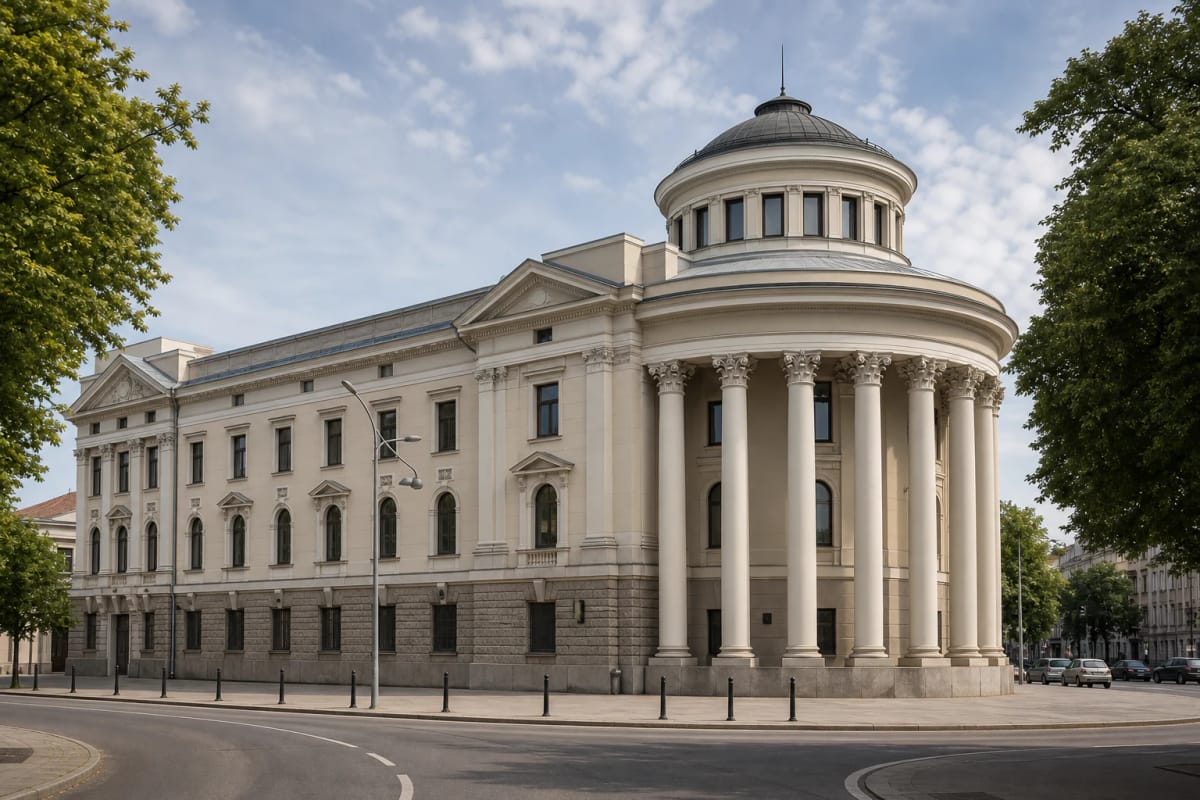
From the street, the most visible feature is the semicircular portico with eight modified Corinthian columns. The register also protects the colonnade at the courtyard entrance, pseudo-risalits with triangular pediments, stepped parapets, the rhythm of arched and rectangular openings, and the overall facade solution.
National-style interior
AUTC singles out original interior details: vestibule column capitals decorated with folk-carving motifs, column bases encircled by ornaments imitating a woven national sash, a stained-glass ceiling, the Columns of Gediminas at the top of the main stairs, and a central flower ornament in the floor.
The Cultural Heritage Register confirms and protects this interior layer, including the overall solutions of the main block vestibule, Great Hall, and Small Hall. It mentions the semicircular arrangement of vestibule columns, mosaic-concrete stairs, geometric metal and glass compositions, ceiling stained glass, the Great Hall balcony, and the spatial structure of the halls.
From occupation to philharmonic
After the Soviet occupation in 1940, the building was nationalized. AUTC states that many institutions crowded into its spacious rooms: the Lithuanian SSR Ministry of Waterways' Nemunas Shipping Administration, a design institute, a puppet theatre, and from 1961, the Philharmonic.
The official history of Kaunas State Philharmonic clarifies that in 1961 part of Frykas's building, together with the Great Hall, was transferred to the Kaunas branch of the Lithuanian SSR State Philharmonic. Until then the branch had no permanent hall, so concerts took place in the regions and in various Kaunas halls.
Independent concert institution and reconstruction
In 2006, by decision of the Ministry of Culture of the Republic of Lithuania, the Kaunas branch of the Lithuanian National Philharmonic became an independent concert institution: Kaunas State Philharmonic. This is the building's current public name and the main visitor experience.
AUTC and the official Philharmonic history give 2005-2008 as the reconstruction period, with projects by Rimante Gudiene and Liuda Marija Pereviciene. After reconstruction the Great Hall became more capacious: a choir balcony was installed, second-floor audience balconies were expanded, and the former natural-light ceiling structure was adapted for regulated lighting.
How to visit today
The most reliable way to enter is through a concert, event, or special public programme. The official visitor page states that tickets are sold at the Philharmonic box office, online, and through other channels, and that the box office is open Tuesday-Sunday 14:00-18:00.
The Philharmonic also provides accessibility information: there is a ramp at the entrance, and on the first floor a lift gives access to the stalls of the Great Hall and to the Small Hall, but it does not go to the audience balcony. Visitors with mobility impairments are advised to choose stalls seats.
Heritage status
In the Cultural Heritage Register the object is called the Ministry of Justice and Seimas Palace of the Republic of Lithuania. Its unique code is 4047, status is state protected, significance level is national, and type is individual object. The register date is November 3, 1992.
The register's valuable features include volume, plan structure, facade solution, porticoes, colonnades, pediments, parapets, roof and tower forms, interior details, the Great and Small Halls, vestibule, and landscape relationship with Kaunas Naujamiestis. It is a nationally significant heritage object, not only an active cultural building.
UNESCO modernism context
The building stands in the Kaunas Naujamiestis modernist-heritage environment associated with the UNESCO World Heritage property Modernist Kaunas: Architecture of Optimism, 1919-1939. The register also states that the object falls within the territory of the Kaunas city historical part called Naujamiestis.
The precise visitor wording is this: the Philharmonic building is part of the Kaunas modernism and state-representative architecture context, but it should not be called a separately, individually inscribed UNESCO object. Its value is clearest when compared with the Bank of Lithuania, Land Bank, Officers' Club, and other state-institution buildings.
How to view the exterior
The best place to stop is where the semicircular portico and the long facade are both visible. From there Frykas's solution reads most clearly: a tight and irregular plot was turned into a representative corner, with the colonnade curved according to the street situation.
Notice the rusticated lower floor, the alternation of arched and rectangular window rhythm, triangular pediments, stepped parapets, and small domed tower. If you are attending a concert, arrive earlier: the vestibule, stairs, and hall structure are as important to the experience as the facade.