- Place
- Klaipėda City Municipality
- Region
- Klaipėda
- Type
- late twentieth-century postmodern Catholic church with twin towers
- Address
- Smiltelės g. 27, Klaipėda
- Coordinates
- 55.66765, 21.18546
- Visit duration
- 20-40 minutes; about 1 hour when attending Mass
- Best time
- in daylight for the architecture or shortly before an advertised service for the open interior
Klaipėda St Joseph the Worker Church, St Joseph the Worker Parish Church
Twin towers and an unexpected landmark in southern Klaipėda
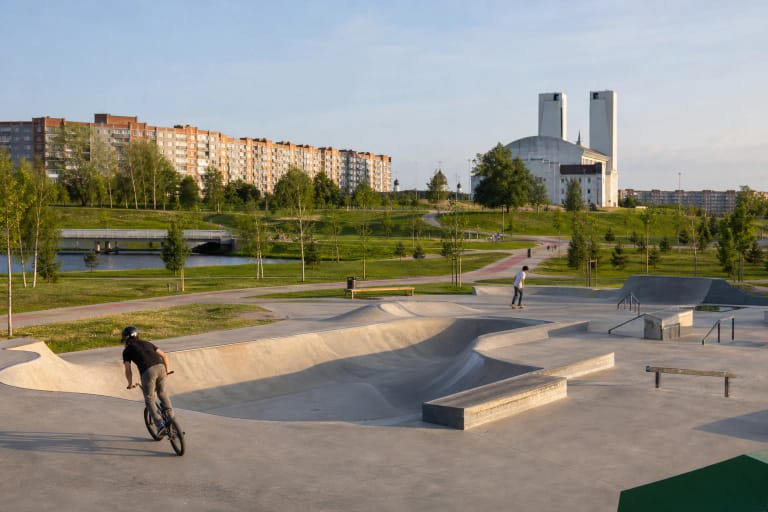
The Church of St Joseph the Worker stands not in the old town but among the apartment districts of southern Klaipėda, between Smiltelės Street and Sąjūdis Park. This setting explains its scale: the white towers serve as a distant marker in an area long dominated by residential blocks of consistent height.
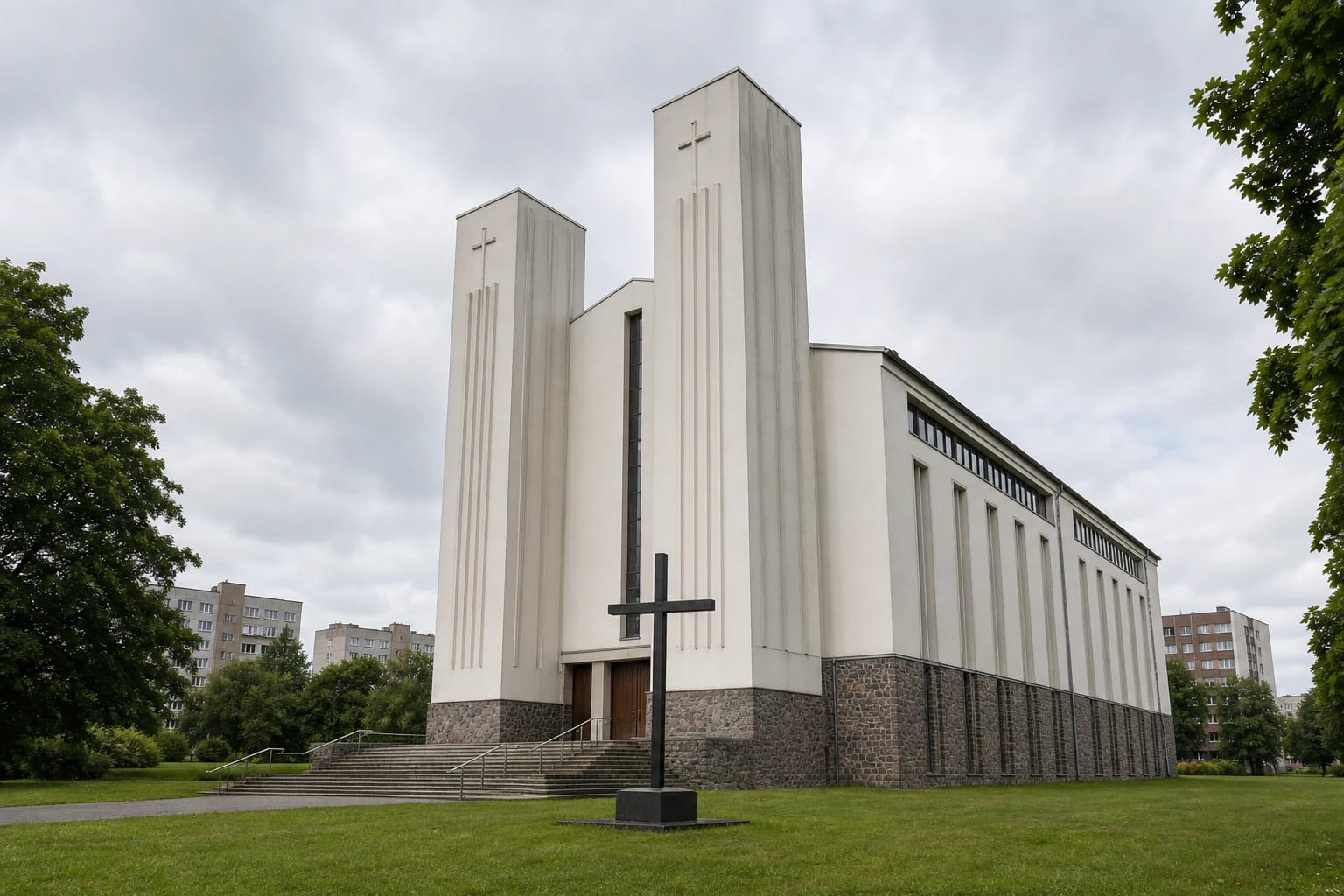
The building is usually classified as postmodern. Two tapering towers of unequal height, a tall window slit, and a cross set between massive white planes form its principal facade. Fieldstone cladding replaces pale render at the base, while a separate black cross stands on the lawn in front of the broad steps.
Along the extended nave, narrow windows and a high band of glazing admit daylight without breaking up the large wall planes. The clearest overall view is from the green space and Sąjūdis Park side, where both towers, the nave, and the freestanding cross fit into one composition.
A project begun as Lithuania restored independence
A three-hectare site on Smiltelės Street was allocated for the new church on 22 March 1990. The cornerstone was blessed on 1 May, the feast of St Joseph the Worker, and Mass began outdoors; an architectural competition was announced on 10 May.
Architects Saulius Plungė, Valdas Janulis, and Gintaras Čičiurka won the competition, with Vincas Žemaitis responsible for structural engineering. The parish dates the start of masonry work to 1991, while the diocese records the building permit in 1992. Waterlogged, uneven ground required levelling and drainage, ending hopes of moving quickly into the future basement.
The initiator, Monsignor Bronislovas Burneikis, was simultaneously overseeing the recovery of Mary Queen of Peace Church from Soviet use. Parishioner donations and organisational support financed St Joseph's, while volunteers worked on site, which is why local memory treats the church as the project of a growing district rather than a single patron.
The temporary wooden church and a slow move into the main building
While the masonry church rose, a temporary wooden chapel was completed in October 1990 and blessed by Bishop Antanas Vaičius of Telšiai on 11 November. The little wooden church served as the parish's real home for almost two decades, making it more than a disposable construction-phase shelter.
The first Masses in the large church were held for major feasts in 2000, and services moved there permanently in 2003-2004. On 2 November 2008, arson destroyed the wooden church; the principal masonry building was already in use and survived the fire.
The masonry church was certified fit for use on 20 August 2010. Work later continued on its towers, facades, sanctuary, and supporting spaces, so one completion date is misleading: liturgical use, technical acceptance, and final furnishing happened in distinct stages.
A luminous interior and the 2024 marble altar
Inside, the exterior mass gives way to a tall white nave filled with daylight. Galleries run along both sides, long rows of oak pews lead towards the sanctuary, and vertical windows continue the upward movement established by the towers outside.
An Allen organ was installed in 2022. In 2024 the sanctuary gained a marble altar, tabernacle, two ambos, bishop's chair, and servers' benches made by sculptor Mindaugas Jankauskas; the interior also contains paintings by Juozas Vosylius and Viktor Timonin.
Bishop Algirdas Jurevičius of Telšiai dedicated the church and its new altar on 1 May 2024. Relics of St Peregrine Laziosi and Blessed Teofilius Matulionis were placed in the altar mensa. The year 2024 therefore marks formal liturgical dedication, not the start of construction or the building's first use.
Visiting when you are not attending a service
This is an active parish church, not a ticketed attraction. In July 2026, the parish listed Mass at 08:00 and 18:00 on weekdays; 08:00, 10:00, and 18:00 on Saturdays; and 08:00, 10:00, 12:00, and 18:00 on Sundays and feast days. Winter weekday Mass may move to the parish chapel. Schedules change for major festivals, so verify them officially before travelling.
For a quiet look inside, arrive a little before an advertised Mass, avoid disturbing preparations, and do not photograph people without permission. There is no admission ticket, although a donation is always voluntary.
Broad steps lead to the principal facade, so a visitor with limited mobility should ask the parish office in advance which entrance to use. Parking and approaches are busier for major services; for architecture, come at another time and continue the walk through Sąjūdis Park.