- Place
- Kaunas City Municipality
- Region
- Kaunas
- Type
- active Muslim prayer place and interwar sacred-architecture monument
- Address
- Totorių g. 6, Kaunas
- Coordinates
- 54.89438, 23.92839
Kaunas Mosque, Vytautas the Great Mosque, Tatar Mosque in Kaunas, Kaunas Muslim Mosque
A small mosque in a large city layer
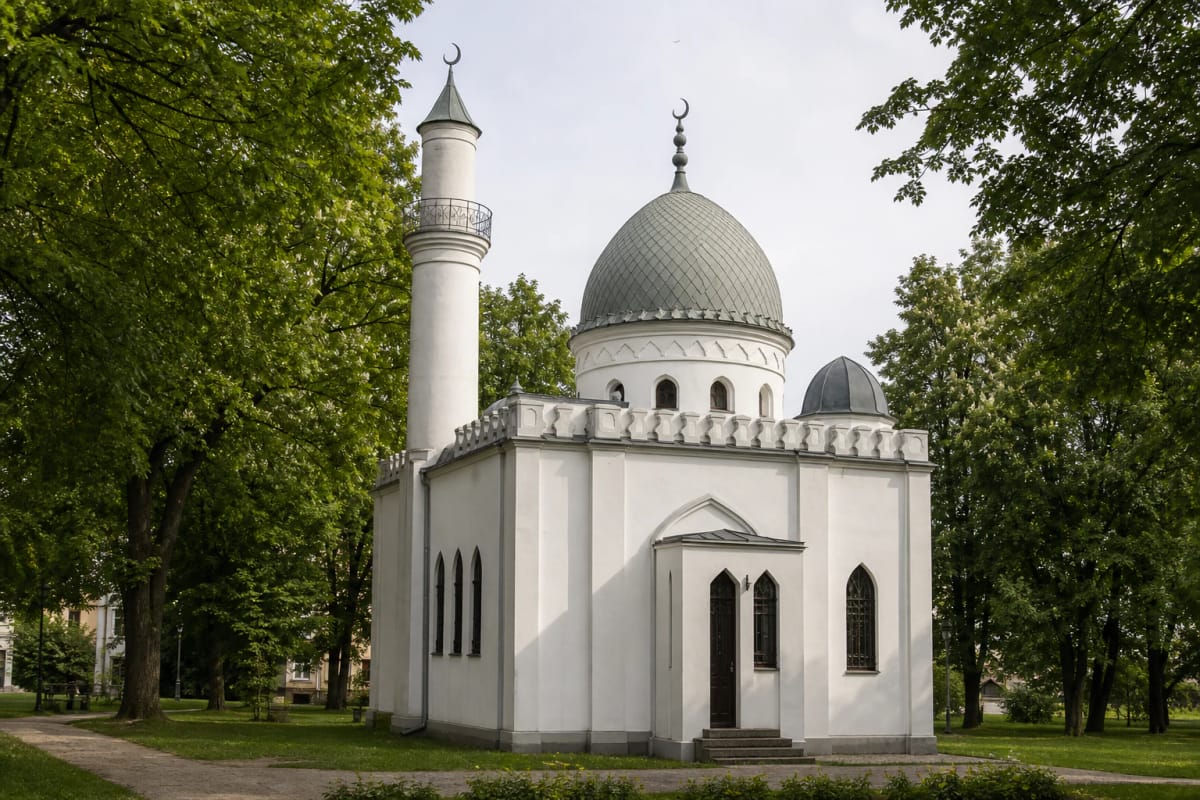
Kaunas Tatar Mosque stands at Totoriu g. 6 in Ramybes Park, on the territory of the former old Kaunas cemetery. It is a small white building, but its history joins several Kaunas layers: Lithuanian Tatars, multi-confessional city cemeteries, the Vytautas the Great jubilee, Soviet closure of the shrine, and the Muslim community's return after independence.
OSM marks the mosque as a Muslim Sunni place of prayer and a tourism attraction. Still, it is important not to visit it as a decorative park pavilion: it is an active sacred place where prayers still take place.
KVR status
In the Cultural Heritage Register the object is called Kaunas Mosque. Its unique code is 1151, status is state protected, significance level is national, and type is an individual immovable object. The register also records older codes S242 and AtV134.
The register evaluates the mosque's valuable features architecturally, historically, as landscape, memorial, and sacred values. That explains why visitors cannot separate the building from the park and former cemetery territory around it.
The cemetery where the mosque appeared
The register states that Kaunas Mosque is in the territory of the old Kaunas cemetery, also known as the Karmelitai cemetery. The cemetery was planned in 1847 together with the Naujamiestis development plan, and its areas were assigned to the city's faith communities: Catholics, Orthodox, Evangelical Lutherans, and Muslims.
The north-eastern plot assigned to Muslims became the cemetery and prayer-house environment of the local Tatar community. The register also mentions other memorial layers: Turkish soldiers who died in captivity during the Russo-Ottoman War of 1877-1878 were buried near the Tatar cemetery, and in 1915 German Empire soldiers were buried in the Muslim plot.
The wooden mosque before the masonry one
The community history page writes that Kaunas Tatars had a wooden mosque by the Nemunas in the sixteenth to nineteenth centuries, in the area called Tatar Square, but it burned in 1812 during Napoleon's army campaign. After that, a common place of prayer was lost for some time.
The register and community sources state that in 1906 local Kaunas resident of Tatar origin Aleksandras Iljasevicius built a 10 by 8 m wooden mosque in the Muslim cemetery territory in memory of his parents. This first cemetery-plot mosque was demolished after the new masonry shrine was built.
A monument of the Vytautas the Great years
The idea of the present masonry mosque is connected with 1930, when Kaunas marked the 500th anniversary of the death of Vytautas the Great. AUTC calls the mosque a kind of monument to the Tatars who settled in Lithuania in Vytautas's time and stresses that among Vytautas-year constructions it stood out as a sacred object.
The same year brought a symbolic city decision: then Ukio Street was renamed Totoriu, or Tatar, Street. Today's address is therefore not an accidental map name; it directly connects the building, community, and city memory.
Architects and construction
The register dates the mosque to 1930-1932 and names architects Vaclovas Michnevicius and Adolfas Netyksa. AUTC gives the same authors, describes the style as historicism, and lists brick masonry as the material.
The community history says construction took several years and the mosque officially opened on July 15, 1933, the commemoration day of the Battle of Grunwald. That date further strengthens the connection with Vytautas the Great and the Lithuanian Tatar historical-memory theme.
The only masonry mosque in the Baltic states
The Kaunas Muslim community page and the register's historical section emphasize that this is the only masonry mosque in the Baltic states. This wording should be understood precisely: it refers to building type and regional distinctiveness, not size.
Kaunas Mosque is compact. It does not have a huge courtyard or multiple minarets like some large Islamic architectural traditions. Its value lies in the small volume adapted to a local community and in modernized Eastern forms placed within interwar Kaunas.
What to see in the architecture
The register describes a composite volume: a square-plan main body, above it a dome raised on a cylindrical drum, and a three-stage minaret attached to the north-western part. Four corner small domes and one more above the northern facade add to the roof silhouette.
AUTC writes that historicist forms and Eastern motifs intertwine in the building. Visitors should look for the elliptical dome, small minaret, plastered entrance portal with a trefoil arch, stylized toothed parapet, crescents on the central dome and minaret, and narrow arched windows.
Interior: mihrab and women's gallery
The register's valuable features identify the square-plan prayer hall and an open women's gallery above the northern vestibule. It also mentions the mihrab niche in the southern, qibla, wall, the architectural element marking the direction of Islamic prayer.
The register also records a surviving but altered and conserved layer of ornamental wall painting. This is not a museum exhibition available at any time, so interior details should be discussed carefully and visited only according to community rules.
Soviet closure and adaptations
AUTC and community sources state that the mosque operated until 1946 and religious activity continued until 1947. After that it was expropriated, and the Muslim community's religious life in this place was interrupted.
The register details later adaptations: after 1947 the building was adapted for a circus, later held a library and reading room. In 1972-1973, according to architect Zenonas Dargis's project, the mosque was reconstructed for public use; a Museum of Eastern Art was planned, and a door to the southern gallery was inserted in the place of the mihrab.
The cemetery becomes Ramybes Park
In 1959 the old Kaunas cemetery was abolished, and a square, later named Ramybes Park, began to be created in its place. The register notes that remains were moved over several years, but the exact number of burials transferred and left in the territory is unknown.
This context is essential when visiting the mosque. The park is not simply a green pause around the building: it is a former multi-confessional cemetery territory, so walking here calls for a quieter, more attentive gaze.
Return to the community
After Lithuanian independence was restored, the mosque was returned to the Kaunas Muslim community. The community page states that in 1990 the first services of the religious community took place, and the building again began functioning as a prayer house.
Repair work followed. The community source mentions 2007-2008 repairs to the minaret, roof, facade, heating system, and prayer-hall carpeting. In 2018-2019 broader exterior, interior, and surroundings work was carried out in cooperation with the Department of Cultural Heritage.
How to visit today
The Kaunas Muslim community page states that the mosque is unlocked every day during daily prayer times, and information can be requested from the community administration by email. It also says group tours are organized together with a tourism specialist and guide.
In practice this means the exterior can be viewed in Ramybes Park, but the interior is not a regular museum exhibition with fixed tourist hours. If you want to enter, respect prayer time, dress, behaviour rules, and arrange the visit in advance, especially for a group.
UNESCO Kaunas modernism context
Kaunas Mosque stands in the Naujamiestis and Ramybes Park environment connected with the broader Kaunas modernist heritage story. The UNESCO World Heritage property Modernist Kaunas: Architecture of Optimism, 1919-1939 covers the interwar modernization phenomenon of Kaunas.
Still, the most accurate wording is to call the mosque a state-protected KVR object of national significance and part of the Kaunas modernism context, not a separately, individually inscribed UNESCO building.