- Place
- Klaipėda City Municipality
- Region
- Klaipėda
- Type
- Soviet-era Catholic church with the Peace Bell
- Address
- Rumpiškės g. 6, Klaipėda
- Coordinates
- 55.69750, 21.14190
Church of the Blessed Virgin Mary Queen of Peace, Queen of Peace Church
A church built despite Soviet rule
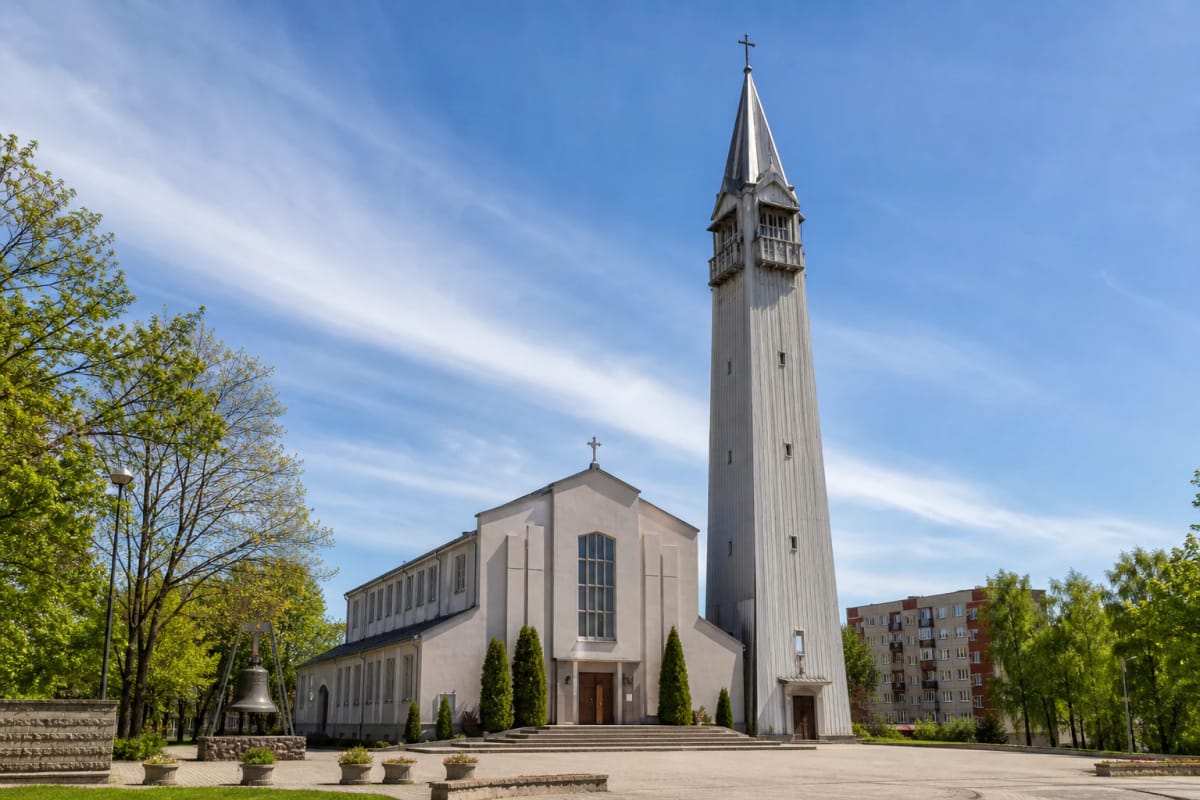
Klaipėda Mary Queen of Peace Church is important first because it is one of the few Catholic churches built in Soviet Lithuania. Donations for a new Klaipėda church began as early as 1938, but construction permission came only in 1955 during Nikita Khrushchev's thaw. Building took place in 1957-1960 to a design by engineer-architect Juozas Baltrėnas.
In size and meaning it was a unique sacred building of the period. The cornerstone was blessed on June 30, 1957. The church was designed as a 63 m long, 25 m wide building for about 3,000 people, with a tower planned up to 70 m high. The large altar fresco of Mary Queen of Peace was painted by artist Antanas Kmieliauskas. Because of this importance, the church's history also became a symbol of believers' resistance to the Soviet system; in the Cultural Heritage Register its object code is 43662.
Confiscation, demolished tower, and philharmonic hall
Soon after completion, the church was confiscated from the Catholic Church. In 1961, the construction organizers were arrested: priest Liudvikas Povilonis, later archbishop, vicar Bronislovas Burneikis, and others.
The building was reconstructed for philharmonic use. The tower was demolished, according to local accounts at night; the facade was changed, thematic stained-glass windows were torn out, and rooms needed for the new function were installed. The remains of the old tower were sunk in a pond near Šilutės plentas.
Return to believers and the Peace Bell
The church building was returned to believers in 1988 after a long campaign for its recovery; in 1979, 148,149 signatures had been collected. The last philharmonic concert took place on November 24, 1988, and the first Mass was celebrated the next day, November 25, with Bishop Antanas Vaičius of Telšiai taking part. The church was then repaired: the almost 50 m tower demolished by the Soviets was rebuilt, and a 3-ton bell called the Peace Bell was cast.
Today the church is again an active shrine and one of Klaipėda's taller landmarks. Priest Liudvikas Povilonis, who organized its construction, later became a bishop in 1969, apostolic administrator of the Kaunas Archdiocese, and chairman of the Lithuanian Bishops' Conference. That makes the church not only a place of prayer but also a place of memory and a sign of peace.
Architecture: historicism, national style, and basilica plan
The church was designed in 1956, after the Soviet campaign against architectural excess had already been announced, so its forms are restrained. The facades are covered in brownish granite render, and the windows end in triangular forms, a reminiscence of the interwar national style. The massing is based on a basilica plan, though the central nave of the three-nave space does not stand out strongly in height.
The main exterior accent is the tower, gently narrowing upward and recalling traditional Lithuanian wooden bell towers in its silhouette. Inside, elements close to historicism dominate: powerful arcades, coffers, and stucco decoration.
How to visit
The church is an active shrine, so it is best to follow the service schedule and behave respectfully. Half an hour is enough to view the exterior and tower silhouette; allow more time for the interior or a service.
Before going, check current service and event times in official parish or Telšiai Diocese sources. The church combines well with a broader Klaipėda architecture route.
What to notice on site
Notice the proportions of the tower and its relationship to the wooden-bell-tower tradition, the triangular window endings, and the restrained granite-rendered facade. These details help show how sacred architecture in the Soviet period hid under permitted forms.
Inside, look at the arcades, coffered ceiling, and stucco work. Knowing that the tower was once demolished and later rebuilt gives the whole building a stronger dimension of memory.