- Place
- Kazokiškės, Elektrėnai Municipality
- Region
- Elektrėnai Municipality
- Type
- an active early Classicist church with a protected churchyard ensemble and a pilgrimage tradition
- Address
- 22 Bažnyčios Street, Kazokiškės, Elektrėnai Municipality
- Coordinates
- 54.81676, 24.84026
- Visit duration
- 30-60 minutes for the church, bell tower, gate, and churchyard; longer during Mass or a major feast
- Best time
- daylight for the architecture; Pentecost for the living pilgrimage tradition, after checking that year's programme
Kazokiškės Church, Kazokiškių Švč. Mergelės Marijos Nugalėtojos bažnyčia
The map pin marks the church ensemble, not a car park
Kazokiškės Church of Our Lady Victorious stands at 22 Bažnyčios Street in Kazokiškės, roughly five kilometres northwest of Vievis. Coordinates 54.816761, 24.840260 identify the church on the map published by the Diocese of Kaišiadorys. They are not a verified driveway, accessible drop-off point, or public car park.
The Register of Cultural Properties protects the entire church ensemble under code 31042. Its individually registered components are the church building, code 1726; bell tower, 31043; and the churchyard wall and gate component, 31044. The site's value therefore lies not only in the principal facade but in the relationship among the church, detached tower, gateway, wall, and old churchyard.
This is an active parish church in Elektrėnai Deanery, not a museum with identical daily hours. On 19 July 2026, the diocese listed Sunday Mass at 10:30, but the timetable, feast programme, and possibility of entering at other times can change. Recheck the same official page or contact the parish before making a special journey.
The ensemble's three principal structures belong to different periods
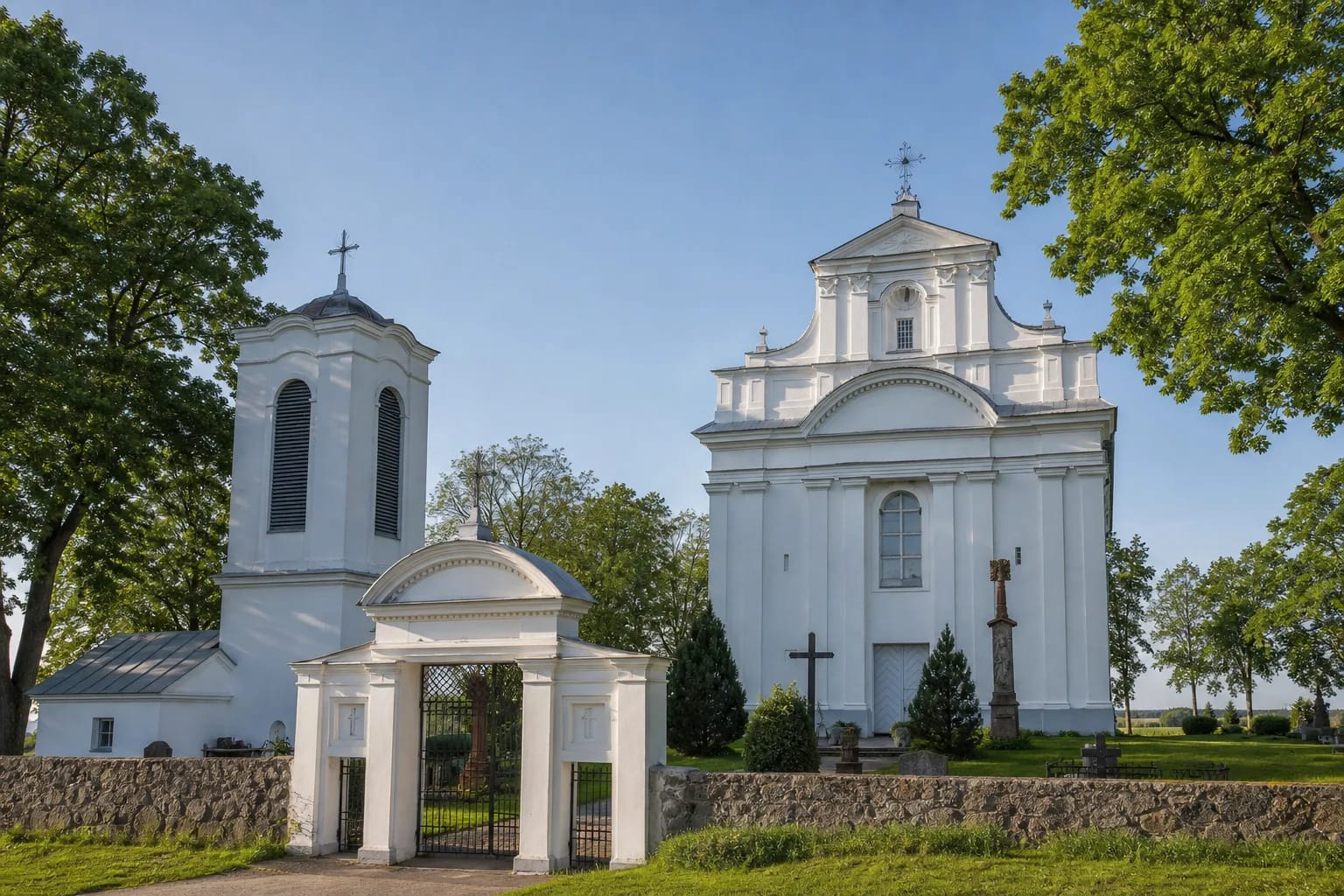
The main church is a rendered masonry, towerless, single-nave building. AUTC describes restrained early Classicist forms with Baroque and Renaissance-like elements characteristic of sacred architecture in the final quarter of the eighteenth century. Its tall facade, curved shoulders, and controlled decoration are read most clearly from the gate.
The present bell tower is not a tower from the church's 1790 construction. A separate square timber belfry still appeared in the 1891 visitation and a photograph of 1904-1905. Engineer Bernardas Žintelis designed the masonry replacement in 1937, and the plan was approved on 2 March 1938. Its two-stage square tower has an arched portal, upper arched openings with louvres, an undulating cornice, and a helmet roof crowned by a cross.
The masonry churchyard gateway dates from the second half of the nineteenth century, and a fieldstone wall encloses the grounds. From publicly accessible parts of the churchyard, one view can compare an eighteenth-century church, nineteenth-century gateway, and twentieth-century interwar bell tower. Old graves and crosses deserve the same respect as the interior.
The traditional date of 1609 must be separated from documentary evidence
Later Vilnius diocesan calendars and some encyclopedia summaries repeat a claim that Stanislovas Beinartas built a church at Kazokiškės in 1609. Surviving ownership evidence, however, places the estate with another family at that date and records Beinartas acquiring it only on 28 February 1639. The year 1609 is therefore best treated as a later traditional date, not a securely demonstrated construction event.
The exact day on which the first sanctuary was built remains unknown. A small church is documented by 1641, making 1639-1641 the better-supported window. Beinartas founded the Dominican monastery at nearby Paparčiai in 1649, and Kazokiškės became its filial church. After the Russian imperial administration closed Paparčiai Monastery in 1864, this church was attached to Žasliai parish.
During repairs in 2006, a fragment of a large masonry arch was uncovered above the sacristy entrance. It has been interpreted as a remnant of an earlier building, leaving even the material of the first church open to discussion. The fragment does not prove a 1609 date, but it illustrates why the early history belongs to continuing research rather than a single neat sentence.
Augustinas Kosakauskas's present church was completed in 1790
AUTC dates construction of the present masonry church to 1780-1790, and VLE records its completion in 1790. Its architect, Augustinas Kosakauskas, was an early exponent of Classicism in Lithuania and designed extensively for Dominican, Bernardine, and Franciscan communities. At Kazokiškės, early Classicist order still coexists with Baroque plasticity.
The towerless single nave explains why the belfry stands independently in the churchyard. Older brief descriptions sometimes assign the gate and bell tower to the same eighteenth-century architect, but AUTC's archival study firmly associates the present masonry bell tower with Bernardas Žintelis and the 1937-1938 project. The chronological gap is one of the ensemble's most instructive features.
VLE highlights a seventeenth-century image of the Virgin and Child inside the church, along with an eighteenth-century Saint Casimir painting and portrait of founder Stanislovas Beinartas, a nineteenth-century Crucifix, and a small cross dated 1799. These are not exhibits in a separate gallery: they remain within the liturgical space of an active church.
The image of Our Lady Victorious connects Kazokiškės with Dominican pilgrimage
The high altar holds the image of Our Lady Victorious, a Virgin and Child dated by VLE to the seventeenth century. Dominican tradition associates it with the friar Liudvikas Skickis, who brought the image from Italy. Later accounts variously give 1669, 1680, or a general late-seventeenth-century date, so choosing one falsely exact year would be misleading.
The written tradition says that the image attracted little wider attention during its first decades, then became associated with graces experienced by worshippers after restoration and placement in the altar in 1700. Calling it an image renowned for graces describes religious testimony. It is not a claim that every story has been scientifically verified or that the image held a formal miraculous designation in every period.
Kazokiškės is particularly associated with the Pentecost indulgence feast. The Diocese of Kaišiadorys includes it among diocesan sanctuaries known for their feast traditions, but each year's liturgy, procession, and traffic arrangements are announced separately. Choose the published feast if you seek living pilgrimage, or another day for quieter architectural study.
A visit depends on active-church etiquette and actual access
No separate tourist admission or daily visitor-centre timetable was found in authoritative sources on 19 July 2026. The churchyard architecture can ordinarily be viewed from outside, but an unlocked door, guided visit, or close access to the altar is not guaranteed. Allow 30-60 minutes for the exterior and, when the church is open, a respectful interior visit.
During worship, do not circulate through the nave taking photographs; silence the phone and flash, and never photograph people or rites without consent. Allow extra time during a major feast because traffic and parking arrangements may change. Park only where permitted, without blocking the gate, residents' access, or a procession route.
No recent comprehensive accessibility audit was found. The churchyard may include grass, uneven paths, thresholds, and historic graves, while the map pin does not certify an adapted entrance. If you need step-free access, seating, or help with a locked door, ask the parish before travelling and assess conditions when you arrive.