- Place
- Kėdainiai, Kėdainiai District Municipality
- Region
- Aukštaitija
- Type
- historic market square, two former synagogues, and an exhibition on the Jewish heritage of Kėdainiai
- Address
- 12B Paeismilgio Street and Old Market Square, Kėdainiai
- Coordinates
- 55.28736, 23.98046
- Visit duration
- 30-45 minutes for the square and exteriors; 1-1.5 hours with the Multicultural Centre exhibition
- Best time
- Wednesday to Sunday if you want to enter the exhibition; daylight for the architecture and cobbled square
Kėdainiai Synagogue Complex, Old Market Square, Jewish Market, Multicultural Centre
The square and the two synagogues are three distinct visitor sites
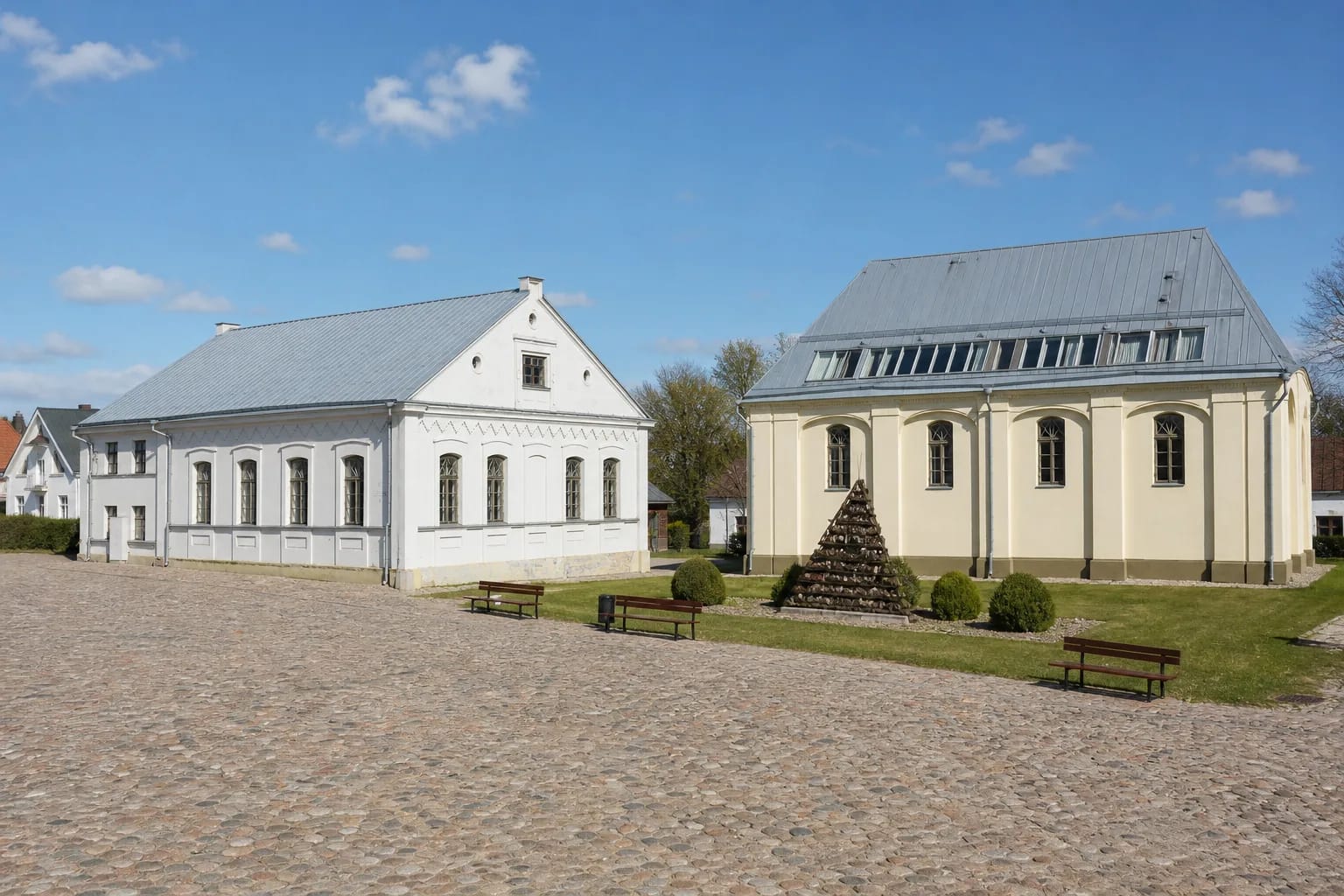
Old Market Square is an open public space, while the two former synagogues on its northern edge have separate functions today. The larger Great Summer Synagogue houses Kėdainiai Art School, so its interior is not a permanently open tourist exhibition. The Small Winter Synagogue contains the Kėdainiai Regional Museum's Multicultural Centre, with its own opening hours and admission ticket.
Start on the cobbles and compare the volumes and windows. The Great Synagogue has a tall roof, a spacious former men's prayer hall, and Late Baroque exterior features. The smaller Winter Synagogue combines one- and two-storey sections, tall segmental-headed windows, gables, and a distinctive sawtooth-like frieze.
The coordinate marks the synagogue complex using the map on the museum's official page, not a car park. The current visitor address for the Multicultural Centre is given as 12B Paeismilgio Street, while historic and heritage records also use 12A Old Market Square or simply Old Market Square.
A fifteenth-century market became the centre of the Jewish quarter
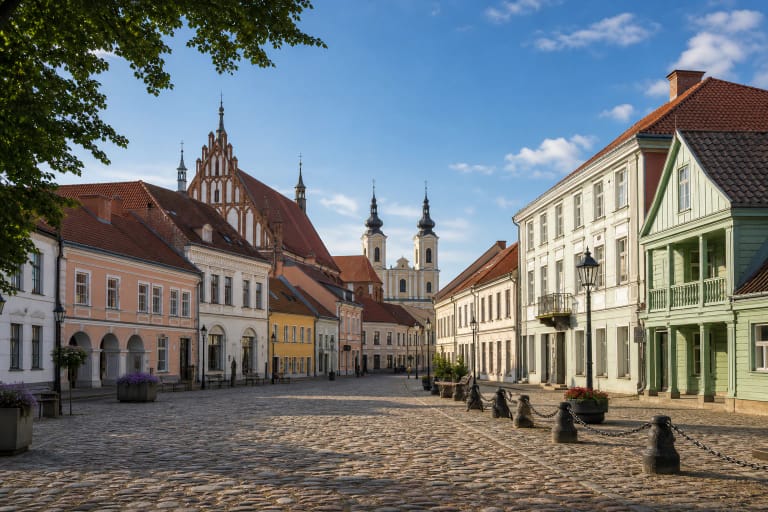
Kėdainiai's first market square was laid out in the fifteenth century and later acquired the name Old Market. In 1627 the town's owner, Krzysztof II Radziwiłł, allowed Jews to settle beside it. By the second half of the seventeenth century it was known as the Jewish Market, surrounded by homes, shops, workshops, and the community's religious institutions.
The first synagogue was wooden. After a fire devastated the square in 1781, the community began a new brick Great Synagogue in 1784. Construction was completed about three years later, while work on the interior continued until 1807. VLE identifies it as one of only two surviving Baroque-style synagogues in Lithuania.
The Great Synagogue was called the summer synagogue not because worship occurred only in one season, but because its large hall was unheated. A smaller heated synagogue made winter gatherings practical and also supported study and communal business. That functional distinction explains why two buildings with related purposes share the same square.
The Small Winter Synagogue is dated to 1837, but the records are not unanimous
The Small Winter Synagogue is generally dated to 1837, a year researchers found carved into a roof timber. AUTC nevertheless notes that archival evidence is scarce and that 1857 also appears in the literature. Kėdainiai Regional Museum gives a broader construction span of 1837-1857, so the responsible approach is to treat 1837 as the main evidence-based date while acknowledging the disagreement.
The building contained a men's prayer hall, women's galleries, and spaces for study. Four surviving columns mark the former bimah, nine octagonal ceiling coffers carry rosette details, and small openings remain in the wall of the former women's gallery. A niche records the location of the Aron Kodesh; it is an architectural trace rather than functioning religious furniture today.
The synagogue's plan and openings were altered under Soviet rule, and its interiors suffered. Architectural investigation in 1999 preceded restoration and conversion to a new use. AUTC dates the work to 2002-2005, while the museum traces the Multicultural Centre's opening to 2002. The project did not revive a regularly operating synagogue, but preserved a setting in which its history can be told.
The exhibition tells the story of Keidan, the Mir Yeshiva, and the Holocaust
The Multicultural Centre holds the modern permanent exhibition 'Ich bin Keidaner', renewed and presented to visitors in 2023. It explores Jewish life in Kėdainiai through businesses, schools, organisations, religion, and personal stories. Keidan is the historic Yiddish name for Kėdainiai, so the title expresses belonging to the local community rather than referring to a separate town.
The museum records that Jews made up a large share of the town's population by the late nineteenth century. On 28 August 1941, 2,076 Jews from Kėdainiai, Šėta, and Žeimiai were murdered near the village of Daukšiai. That number describes the destruction of a specific local community, not the Holocaust across Lithuania as a whole. A memorial in the square shifts attention from surviving architecture to the people who lived around it.
A trilingual plaque unveiled on the building in 2023 also commemorates the Mir Yeshiva, for which Kėdainiai briefly became a refuge in 1940. Exhibitions, concerts, conferences, and educational sessions take place in the same space, so a quiet self-guided visit may feel very different from an event evening. Check the current programme on the museum website.
The square is free, while museum hours and prices can change
Old Market Square, its cobbles, and both synagogue exteriors can be seen at any time without a ticket. On 18 July 2026, the Multicultural Centre's official page listed opening hours of 11:00-18:00 Wednesday to Friday, 10:00-17:00 Saturday, and 10:00-15:00 Sunday, with final admission 30 minutes before closing. It was closed to exhibition visitors on Monday and Tuesday, operated one hour shorter before public holidays, and closed on public holidays.
On the same review date, standard admission was EUR 3, with discounts or free entry for groups listed by the museum. Hours, prices, free-admission arrangements, and event access change faster than the building's history, so confirm them on the official museum page before travelling.
The old cobbled surface is uneven and can become slippery in rain or ice. No comprehensive accessibility audit for the full outdoor route and exhibition was found, so a visitor with limited mobility should contact the centre about the easiest entrance. On foot, the square combines naturally with Kėdainiai Regional Museum, Great Market Square, and the town hall; leave a car only in a legally marked old-town space.